Allow changing build plates without re-slicing

Allow changing build plates without re-slicing

Suggested tag: firmware-feature

Currently, Bambu Studio requires selecting a build plate before slicing. If the printer detects a different plate, the user generally has to return to Bambu Studio, change the plate selection, re-slice, and send the job again.

This seems unnecessary in many cases, particularly on printers that already support automatic build plate recognition.

I’d suggest an optional feature that allows the printer to adapt an existing sliced job to the installed build plate without requiring re-slicing.

Example

I often slice a model on my H2D using the default Textured PEI Plate, then realize that a Smooth PEI or Cool Plate SuperTack would be preferable, perhaps because the model has numerous small features with limited bed contact.

The geometry, supports, infill, and toolpaths generally don’t need to change. Often, the main difference is the required bed temperature and potentially some first-layer calibration settings.

Proposed behavior

  1. The printer detects the installed build plate, as it already does.

  2. If the detected plate differs from the one specified in the print file, it offers an option to adapt the print to the installed plate.

  3. The printer automatically applies the appropriate plate-dependent settings, such as bed temperature and relevant calibration adjustments.

  4. The existing toolpaths are reused without re-slicing.

This would be particularly useful when reprinting jobs directly from the printer’s storage or print history.

Compatibility considerations

I’m aware that certain build plate changes can affect first-layer adhesion, extrusion parameters, or even toolpath generation.

The feature could therefore be optional, with appropriate compatibility checks and warnings. If the printer cannot safely accommodate the change, it should retain the existing behavior and request a new slice.

Implementation could involve including alternative plate temperatures and relevant filament profile information in the sliced file, allowing the firmware to select the appropriate settings at print time.

Why?

The printer already knows which plate is installed and controls bed heating and calibration. It seems reasonable to let it handle compatible plate changes without regenerating an otherwise identical print.

The goal isn’t to eliminate plate-specific slicing, but to avoid requiring it when only printer-side parameters need to change.

Related request: Bambu Studio #6919 – Bind Build Plate to Printer

I don’t think that’s likely to happen. Whenever the build plate is changed, essential parameters in the g-code need to be adjusted, which means the model has to be sliced again.

What you’re essentially asking for is for the printer to handle the entire slicing process itself. Right now, the printer only needs to interpret and execute g-code.


To do what you’re suggesting, it would have to take over the full job of the slicer.


That raises two major challenges. First, does the printer have enough processing power for that? Probably not. Second, you would need to run slicing software on the machine itself, in addition to the printer firmware.

It’s a nice idea, but I highly doubt it will be implemented on existing hardware. The required computing resources and software changes would be significant.


Try slicing the same model twice, once for each build plate, and then compare the resulting g-code files. You might be surprised by how many parameters actually change between them. That’s exactly why it’s not as simple as just swapping the build plate on the printer. The slicer adjusts a lot more settings behind the scenes than many people realize.


As I said, it’s a nice suggestion, but I’m quite certain it won’t happen on current hardware. If you’re personally confident that you still want to proceed after changing the build plate, you can already do that today. Just acknowledge the warning message and continue with the print.

I know for a fact that on a textured build plate, the printer measures the Z-offset and then pushes the nozzle down extra, as it’s measured to the texture instead of the base and it wants to make sure filament gets right down in there. On a non-textured plate, it would not need to modify the Z-offset like this.

So as has been said, some gcode adjustment is needed. How much? If it was just 0.1mm z-offset for the texture, maybe that does not need a full re-slice. But is it just that? I don’t know. Many other changes like temperature might also be needed.

Thanks for the feedback! I went ahead and sliced the exact same model twice, once for Textured PEI and once for Cool Plate SuperTack, and compared the resulting G-code (AI overview).

The results actually seem to support my original suggestion:

  • 357,148 vs. 357,149 lines of G-code.

  • Identical estimated print time (5h 33m) and filament consumption (104.19 g).

  • Approximately 99.9% of motion commands are identical, disregarding execution order.

  • Bed temperature changes from 55°C to 40°C.

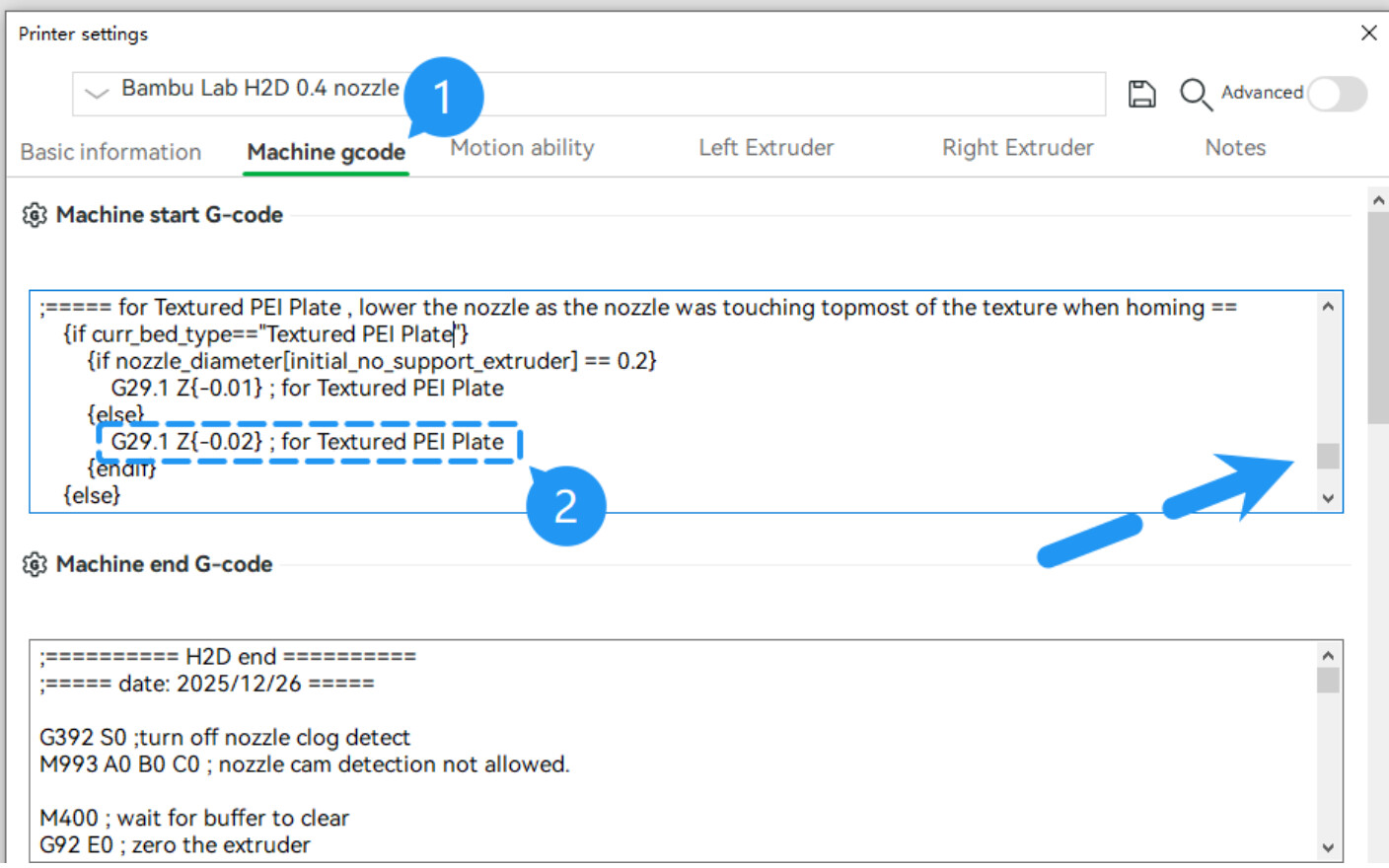
  • Textured PEI adds a G29.1 Z-0.02 offset that SuperTack doesn’t use.

  • A plate-dependent surface detection command also changes.

There are some differences in toolpath ordering, but the actual geometry is essentially unchanged. Those differences might simply be due to variation between slicing runs.

I agree that certain parameters need adjusting when changing plates, but that’s not the same as needing to regenerate the toolpaths.

The Z-offset is a good example. The printer already performs bed calibration, and a plate-specific offset could generally be applied during print initialization. The same goes for bed temperature, which the printer already controls. Interestingly, both exported files even contain the temperature settings for the different plate types in their metadata.

I’m certainly not proposing running an entire slicer on the printer. The idea is simply to let the firmware adjust compatible plate-dependent parameters while reusing the existing toolpaths.

Of course, some plate changes might genuinely require different first-layer geometry or adhesion strategies, which is why I suggested making this optional, with compatibility checks and warnings.

For ordinary plate changes like this example, though, I still don’t see a fundamental technical reason to require a complete re-slice.

Let me put this a bit more briefly and bluntly: modifying specific lines in G-code without having a slicer verify the result is a very bad idea.

We’re not talking about something relatively harmless, like changing a fan speed from 50% to 80%. We’re talking about one of the most fundamental parts of the entire print process: the build plate and the foundation everything else relies on.

That’s why Bambu will never support a “fire-and-forget” approach to these kinds of modifications without proper validation, even if warnings are shown. The risk of generating incorrect or unsafe printer behavior is simply too high.


And with all due respect, your posts are increasingly reading as if you asked an AI whether this would be theoretically possible, without understanding what a slicer actually does beyond generating G-code:

A slicer’s job is not just to produce G-code. One of its most important responsibilities is to validate and coordinate the entire print process so that the printer can execute it safely and predictably without damaging itself.

A printer itself is actually quite dumb. Even though modern printers include various safety features, their primary job is still to execute the G-code they’re given, without questioning or interpreting it.


…and I haven’t even started on the update and maintenance implications yet.

At that point, you no longer have just two components that need to stay in sync, namely the slicer and the printer firmware. You now introduce a third one: a stripped-down slicer running inside the printer itself.


We can keep discussing the technical details back and forth if you’d like, but I’m 100% convinced that Bambu will not integrate something like this into the current generation of their products.

  • Maybe that’s something that could make sense in the future, if MakerWorld or parts of the Bambu ecosystem were running directly on the printer.

.. thanks.

“With all due respect” usually precedes something incredibly condescending, and your reply is no exception. Take a step back please and don’t just lecture.

Yes we’re talking about the build plate, but what is the current status? As it is today you can ignore the warning and get exactly the errors you are implying would be caused.

I verified that it’s a simple offset issue and the printer automatically flags whether the plate is as expected or not. With what I’m suggesting the easily ignorable error would be prevented by an extremely minor adjustment that the printer already is fully capable of making. This adjustment has nothing to do with the slicer and relates only to the printer itself.

Obviously if you actively disable the verification step, like many users do, the assumption remains the same as it is today.

And of course, exact implementation would of course mean it’s only happening when it is known that other parameters would be unaffected.

As I suspected, it’s basically the build plate offset and the bed temperature, but it needs to be tested. What i would do is modify the gcode for z offset and bed temperature, then swap the plate, and send that modified gcode directly to the printer. if it works, write it up and post it somewhere bambu will see it.

Being a large company they probably need the heads of multiple departments (printer, slicer, and accessories?) to meet and agree on it and then write up a procedure for when it can be used :slight_smile:

edit Its kind of pointless posting patches against bambu studio, but orca might take it if they don’t have it already, and the BS is kind of forced to implement it to stop people complaining orca is ahead.

What I meant by those words is that I want to discuss this with you as an equal, in a respectful way, and that I take your contribution seriously. Anything beyond that is your own interpretation.

My intention isn’t to lecture you, but to point out potential implementation challenges. That’s a normal part of discussing suggestions, especially when hardware limitations and how G-code actually works can have a significant impact.

And while posting it here is absolutely valid, it might also be worth bringing the suggestion to the developers directly on GitHub, where it can receive feedback from the people responsible for evaluating and implementing such features.

I don’t think that’s entirely correct. While it may work in some cases, plates such as the Engineering Plate or Cold Plate require completely different settings, which highlights the kind of hardware limitations that need to be considered.

Also, calling it “verified” is a bit of a stretch if the information comes primarily from ChatGPT or a similar AI tool. Those can be useful for generating ideas, but they’re not a substitute for documentation, developer input, or hands-on experience when deeper technical knowledge is required.


My point isn’t to dismiss the idea, but to highlight practical considerations that could affect its implementation - and just as a friendly suggestion: starting your very first forum post with such a confrontational tone may not be the most effective approach.

I think one big issue is that the printer is actually surprisingly stupid. It doesn’t know anything about buildplates, offsets, sensible temperatures etc., it just executes the instructions in the gcode one by one. So for the printer to understand what to change when it is confronted with a different plate, it first would need all that information.
I think that is strongly against the current strategy to keep most functionality in the slicer, because that allows maximum flexibility compared to baking functionality into the firmware.

But maybe an alternative solution could be that the slicer creates the gcode for all plates and then the printer could just skip all the code that is not for the detected plate. That is, if plate temperatures don’t appear multiple times in the gcode.
The printer wouldn’t need any more information than it currently has.

Sounds great until Bambu gets the cloud storage bill for all the extra gcode in model downloads!

I don’t know how determinstic gcode slicing is. If you slice a file twice with the same settings, its the gcode byte for byte identical or are the orders of some of the operations different? If the first it would quite low effort to just store a nice small diff. If the second I suspect it might be an idea for them to understand why slicing isn’t determinsitic.

We haven’t even mentioned the fact that different filaments will behave differently on different plates… some of which are not compatible with one or the other. The slicer has built in checks that warn you if you try to start slicing a model using a filament that isn’t compatible with the “set” build plate.

What happens in the printer when a model is sliced for a compatible plate that isn’t installed… but finds that an incompatible plate is installed? Although the G-code may contain the “name” of a filament… it generally doesn’t include the properties of the filament… ie what build plates the filament is or is not compatible with.


Example of different layer height for different nozzle or build plate.

The same thing that happens when build plate detection doesn’t match what the slicer is set to? The user can decide what to do

I actually think this idea - change plate without slicing - is a silly idea that will probably fail prints and damage build plates - but we have try because “engineering”. And maybe someone will work something out that Bambu can use.

I just compared the g-code for the Textured Plate with the one for the Cool Plate, and a few key differences immediately stood out. Sure, they make up only about 1% of the total code, but that’s the crucial 1% everything else is built upon.

If the temperature isn’t right, the filament won’t stick.

Here’s an snippet:


;======== start gcode==========
;===== 2026/05/18 =====

  M140 S55 ; heat heatbed first
;===== wait temperature reaching the reference value =======
  M190 S55

;===== for Textured PEI Plate , lower the nozzle as the nozzle was touching topmost of the texture when homing ==

      G29.1 Z0.01 ; for Textured PEI Plate
;===== bed leveling ==================================
  M1002 gcode_claim_action : 54
  M190 S55; ensure bed temp
;===== wait temperature reaching the reference value =======
  M190 S55
;===== bed leveling ==================================
  M1002 gcode_claim_action : 54
  M190 S55; ensure bed temp

This issue has been discussed many times before, and the root cause is always the same. The g-code contains fixed values for many variables, such as a bed temperature, and currently provides no placeholders for build plates, filaments, or nozzles. Likewise, the printer does not store this information internally. The g-ocde itself isn’t really suitable for placeholders in its current implementation.

While Bambu could theoretically add such placeholders in the future, doing so would require maintaining internal databases for build plates, filament profiles, and nozzle configurations. The specific requests may vary, but the underlying limitation remains the same.


Sure, while this might still be manageable for print plate, as soon as someone request the same function for nozzle, g-code chaos breaks out.

But even then, the printer would have to recognize what temperature the designer originally intended and at what point the filament begins to adhere to the print bed - which brings us back to the topic of the filament database.


Personally, I’m fine with that for now. I’d rather keep the printer relatively “dumb” than become dependent on cloud-based slicing or an printer on-board slicer.

:joy: Seriously, any change to the slicing engine or changing one parameter in some presets has bigger impact on GCode size. And then I would be very surprised if bandwidth for GCode is a relevant factor in Bambu’s budget.

That could easily be handled by the slicer. It must only embed GCode for the plates that are supported by the filament. So if you put in an incompatible plate it would still complain about the wrong plate as it does today.

I think embedding the gcode for all compatible plates would really be an option. The printer already has the capability to skip sections of the gcode for skipping failed objects. (Which is nothing more than skipping sections of gcode that the slicer has marked as belonging to an object). Any line that would need a variable for different plates could instead have all the different lines of gcode instead, embraced by a marker that says which plate each line is relevant for.

But I highly doubt that BambuLab will implement such a feature. It is just too niche to be attractive for them.

I don’t know anything about what their costs are (beyond the fact that MW crowdfunding isn’t paying for the website) but as someone who used to be a software engineer, a change like this sets off my danger sense; it’s something I’d want to study and talk about before approving.

  1. This is a change that will encourage re-slicing of older profiles, not just an addition to newer ones.

  2. Costs at scale can be weird. You add 1 extra bag slot for players in your game and suddenly the DBA is banging on the door yelling.

  3. Makerworld is not commercially self-sustaining; it’s probably the marketing budget paying for it.

Hi,

You’re right in large parts, and I apologize for my hasty reply.

It still seems to me that you are answering a suggestion I never made. I’m not proposing arbitrary G-code modifications or bypassing slicer validation. I’m suggesting that the slicer could explicitly identify which plate-dependent parameters can safely be adjusted at runtime, leaving the firmware to apply those predefined adjustments when a compatible plate is detected.

That wouldn’t require a stripped-down slicer running on the printer, nor would it change the existing toolpaths. Any configuration requiring different toolpaths would still require re-slicing.

You’re arguing against something considerably more ambitious than what I’m suggesting. I find that most of the pushback here is pointing out cases that should naturally never be included in a feature like this. Most of the time when swapping the plate would help it doesn’t actually require those changes.

Just a friendly note: I’m not arguing against your suggesting, just sharing my view - as well as the technical background behind it. The whole thing is simply much more complex than it might seem at first. :grin: :+1:


To put it simply: How is the printer supposed to know if it’s not “most of the time” and it’s that one exception that could damage your printer or fail? :thinking:


Otherwise, it’s already possible to disable print plate detection at your own risk and adjust the heated bed temperature at the start of printing / during printing. It’s just not called “Change the print plate.” - That means you don’t have to re-slice it either.