Ok.
I don’t own an h2c.
25characters
Ok.
I don’t own an h2c.
25characters
I don’t own a H2C anymore, but I still have a custom garolite plate for the printer, so when I get the H3C I’ll fetch my saw to cut the offending bottom ridge of the H2C plate. According to the pictures It cant’ be more than 1 cm of depth ( probably less ) what needs to be trimmed.
Bambu’s engineering or textured plates are OK for some high temp. filaments, but garolite/fiber glass is way better for PC.
I’m just surprised everyone is making such a thing of this. It’s really not that big of a deal. It’s a different type of machine and so the process for handling the filament is going to be different.
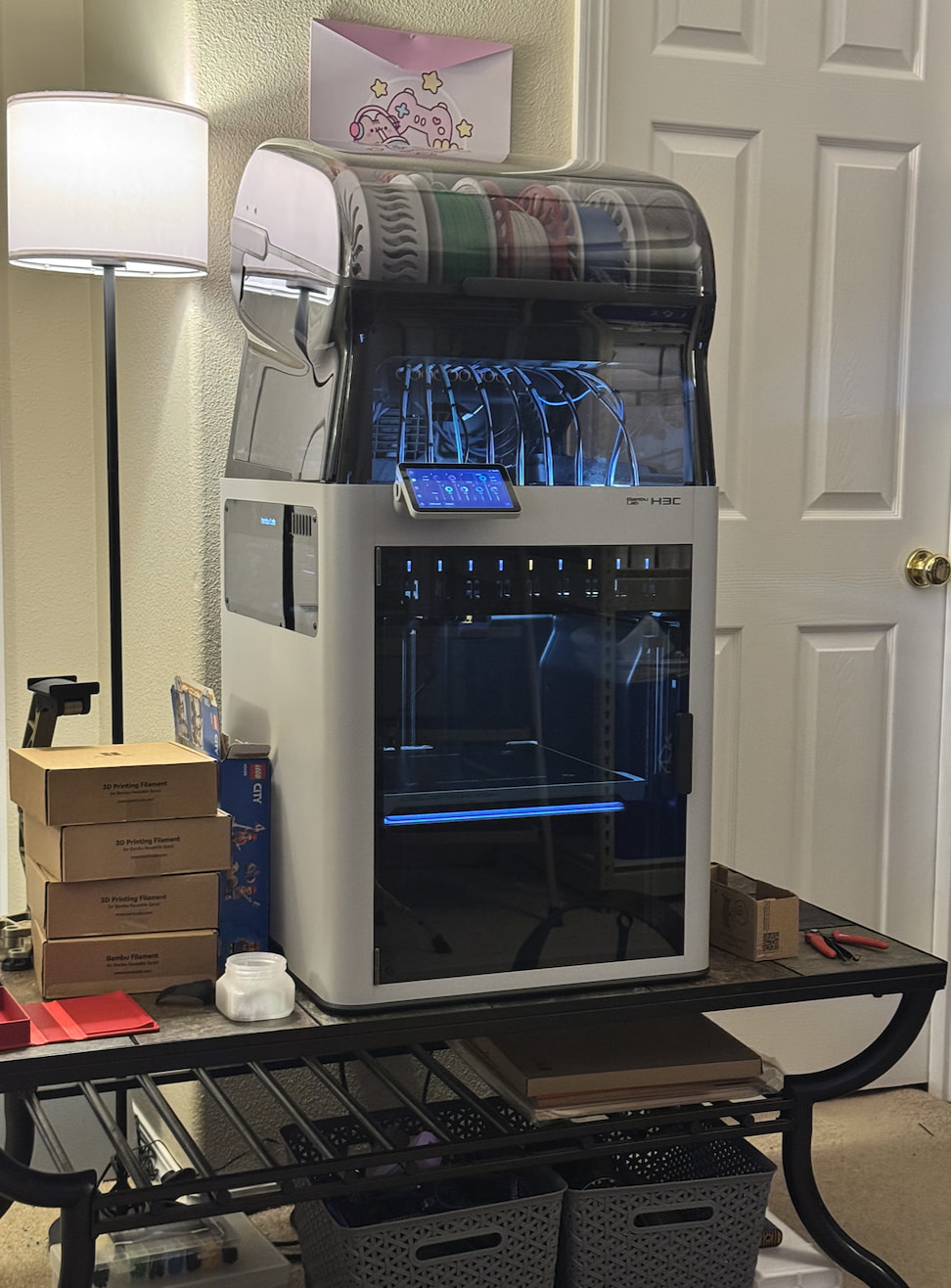
I’ve got the H3C! It’s right here behind me! So not speculating when I say it’s not that big of a deal. I’ve been swapping spools and going through the process. It’s just… different.
I think it’s an overall well rounded machine. I think whatever cons there are, aren’t of anything significant and if you want a tool changer, you should get it. Seriously, the decision about buying it should have more to do with if you need/want a tool changer, and if you need/want one that big. I’m sure there’s sub-categories with more considerations, but broadly speaking.
A few are, but majority of these aren’t inherently necessary / unsolvable for a toolchanger. It just 1st gen / cost optimization.
It makes financial sense that apparently it barely shares parts with the H2C so the tooling cost must be immense. But from a user perspective that also sounds like a 2nd gen toolchanger will have the headroom to address many of these QoL step backs.
Next year maybe the H4C will do or a updated advanced AMS 3.
I was refering to me 
252525