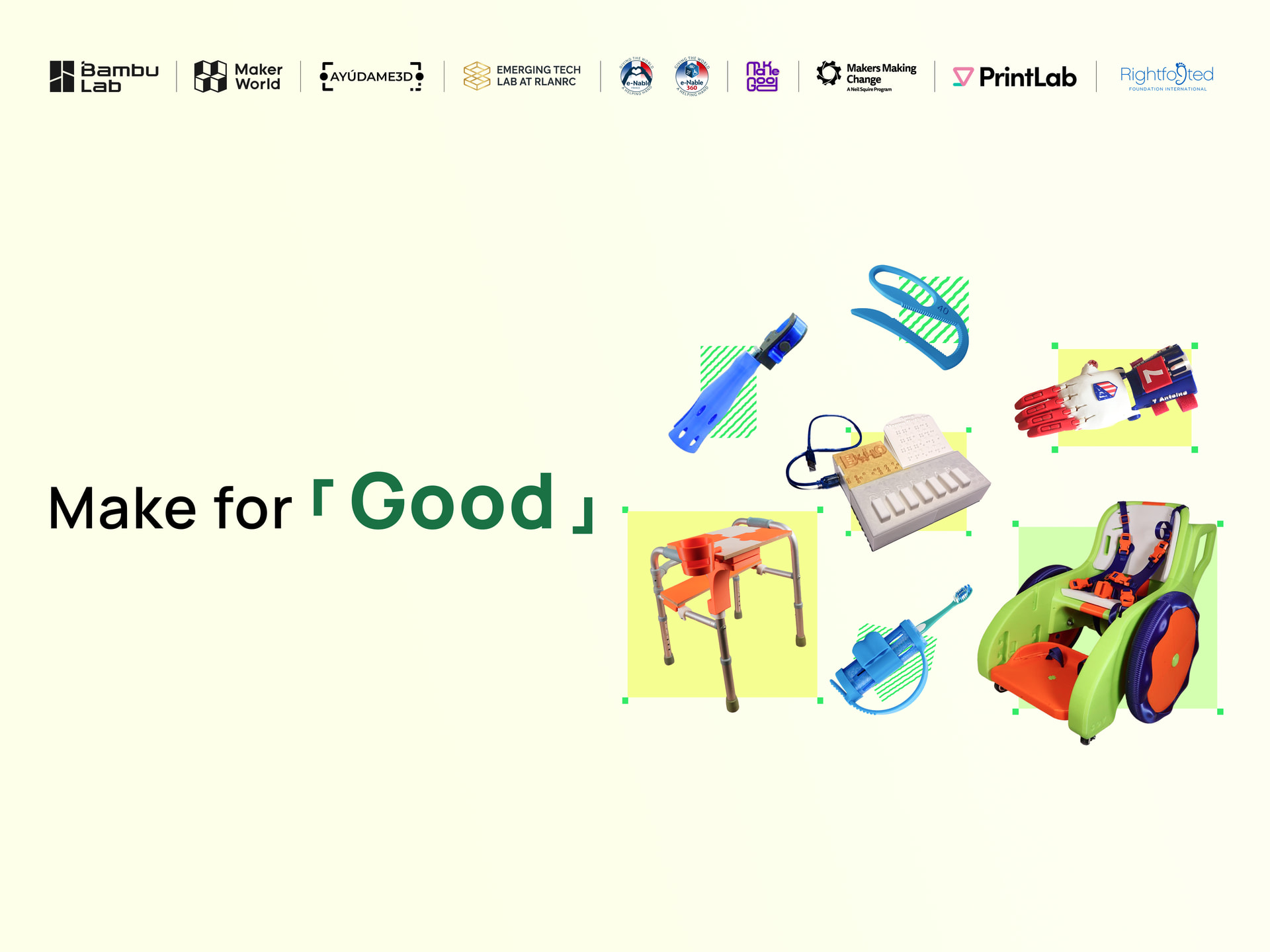
MakerWorld is hosting a design contest like no other: make accessible solutions for people with disabilities, the Make for Good contest. We have partnered with 7 accessibility-focused organizations around the world, and each of them owns a part of the process. From everyday tools to mobility aids, they bring 24 real-world needs that remind us 3D printing can mean something more, putting its power to work for those who need it most. Design the missing piece, so someone doesn’t need to ask others.
Our co-creation partner for the contest
- Ayúdame3D, based in Spain, has designed and given away free Trésdesis arm prostheses since 2017. It will promote the challenge in Spain and send winning devices to communities around the world, including in Africa.
- The Emerging Tech Lab at Rancho Los Amigos, in the United States, helps make sure designs reflect the lived experiences, interests, goals, and everyday environments of the people they are meant to support.
- e-NABLE France will take the challenge to French-speaking makers. Its network of more than 450 volunteers has already fitted over 200 3D-printed hands.
- MakeGood, in the United States, advises on briefs rooted in real user research. Since 2021 it has made free, custom assistive devices, among them the Toddler Mobility Trainer, a fully 3D-printed wheelchair for children.
- Makers Making Change, a Neil Squire Society program in Canada, will promote the contest there. Winning designs will be considered for its open-source assistive technology library, so its network of volunteer makers can build them for people with disabilities. It has delivered more than 30,000 devices with help from about 40,000 volunteers.
- Print Lab, in the United Kingdom, brings a human-centered design toolkit it has used in its assistive-technology challenge since 2020.
- Rightfooted Foundation International, in the United States, is contributing briefs from the limb-difference community including work done with cofounder Jessica Cox, and will help get finished models to the people who need them.
Behind every brief is a real person and a specific, present-day need.
For example, picking up an item from the floor can be difficult when a conventional reacher requires squeezing a handle to operate it. People who use wheelchairs may also have difficulty storing, accessing, and retrieving everyday items such as phones, wallets, purses, and keys. These everyday situations can inspire makers to create simple solutions that make a meaningful difference.
Jessica Cox, who founded Rightfooted Foundation International, was born without arms and uses her feet for daily life. She can pull on her first sock with a bare foot. The second sock is the problem: once one foot is covered, she loses the friction she needs to work fabric over her heel. This inspired the SecondSock brief, in which you are invited to design a foot-operated sock puller for hands-free dressing.
How it works
You’ll have until Nov. 15 UTC to submit your designs. Our partner organizations then spend a month printing shortlisted models and testing them with the people named in the briefs. Then, some partners will deliver those prints to real users, and their feedback will help shape the final results.
Winning files will be added to open libraries and distributed through volunteer networks that already deliver devices in more than 70 countries.
The success of this initiative will come down to ordinary moments: someone who once set a board game aside because the pieces were too small finally sits down to play; someone ties her ponytail without help; someone slips on that second sock with ease.
If there are even a dozen moments like these by the end of the contest, the challenge will have done exactly what it set out to do.
Click here to learn more about and participate in the contest.