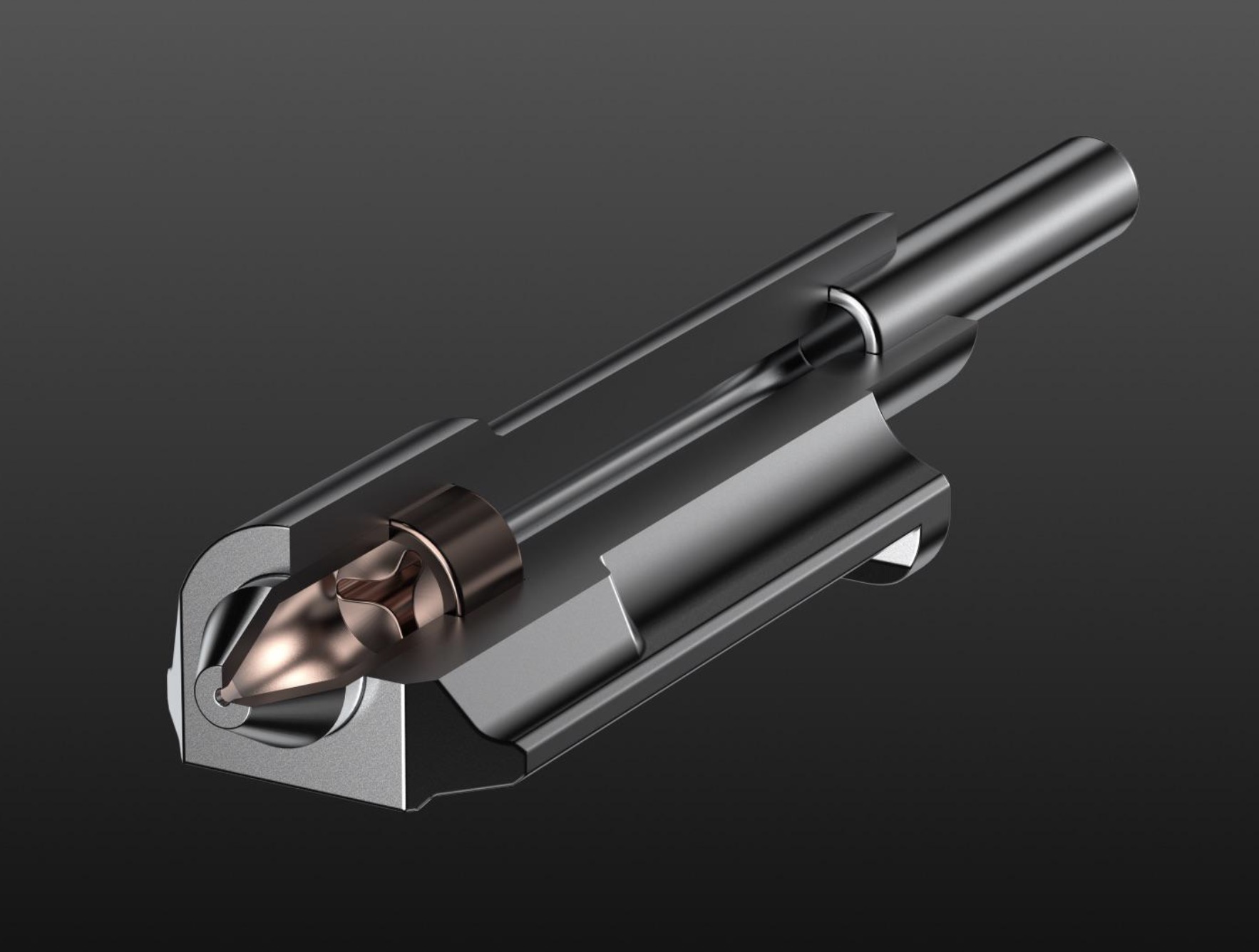
As far as i understand the high flow nozzles usually use split channel design to heat up filament more efficiently.
As far as i understand split channels tend to clog more from fibrous filaments.
That is why i went with standard flow for 0.6mm WC nozzle on my H2D. I am using Obsidian 500HF in right slot ad regular 0.6mm WC in left slot.
Trying to decide if i should have gone with HF version for 0.6mm WC nozzle instead.
May be upgrading to 0.8mm nozzles, or replacing OEM 0.4 nozzles… most likely will keep one obsidian HF and one WC layout, just trying to decide if HF in WC is legit or headache.
As far as I’m aware we’ve never seen the channel design of Bambu’s high flow hotends so we can’t conclusively know that it uses a multi-channel design.
I use 0.4HF and 0.6HF WC nozzles for all my engineering CF/GF filaments with no headaches or clogs. The HF design will give you better layer adhesion and stronger part strengh even when printed at normal speeds due to more even heating of the filament.
@maxim3D
What materials are you printing? The hardest one for me was pps-cf, it would sometimes clog the 0.6mm regular nozzle. According to google 0.6mm is the bare minimum for pps-cf and 0.8mm is much better. I am probably going to go with 0.8mm WC for left and 0.8mm obsidian 500HF or diamond (i don’t see HF version in diamond design, so might stick with obsidian) for right nozzle. Basically i am worried about high end fibrous stuff like ppa-cf, pps-cf, pc-cf etc in HF nozzle.
I’m not sure that the HF nozzles are really needed at all, because the standard nozzles are so good already.
I joined the party of current printers with a X2D a few months ago and I’m conducting layer adhesion tests regularly with all filament I can get hold of. Compared to the X1C I had before, the new standard nozzles are really stellar.
In my tests, almost all materials yield the same layer adhesion at 12, 20 and 28 mm³/s with the standard nozzle. Compare that to the X1C I measured a very noticeable drop going from 8 mm³/s to 20 mm³/s of roundabout 30% strength. I switched to an E3D Obxidian HF nozzle back then and strength stayed constant for all speeds. So there it made absolute sense for me. On the new nozzles not anymore, at least for me. I even bought 2x HF 0,4mm nozzles that I will probably sell unused.
I haven’t tested how fast you can go with the new standard nozzle because I don’t have much use for more than 30 mm³/s. If you do, then a HF nozzle might well make sense. If you use standard speeds or even go slow with the more expensive materials, I don’t think a HF nozzle has any benefit. With the Obxidian I needed substantially more purging to clean the last filament. That might be a benefit of the standard nozzle, but I don’t know it for the new nozzles.
Also solving clogs or doing a cold pull might be easier with the standard nozzle.
Regarding clogs, I wouldn’t expect a much higher risk with a HF nozzle. Even the split channels are still a lot wider than the orifice usually. The BBL design posted by maxim3D seems to even less reduce the internal diameter. And I think HF nozzles like the Obxidian are explicitly advertised for use with filled material.
That are just some thoughts without personal experience though, I hardly use anything more fancy than unfilled PC myself.
Alex,
Based on my youtube research bigger nozzles speed up the print and increase strength, but they can quickly become too fast, flow rate wise, for its ability to heat fillament, which is where high flow shines. The only concern / downside to high flow nozzle is clogging from fibrous filaments; hence this post.
Sure, but I think you should differentiate between general claims about generic nozzles and specifically the BambuLab gen2 nozzles.
When you want to increase speed and strength over what your standard nozzle can deliver, I would always switch to a HF nozzle before looking at a larger nozzle. In my experience, that increases achievable flow far more than a bigger nozzle size. If you think about it, it’s quite logical: The bigger nozzle doesn’t have a larger contact area to the filament to transfer more heat into it. But if the filament is molten incompletely, then it can easier be pressed through a larger nozzle. Yet if flow is limited by heat transfer, then you still print insufficiently heated filament and the larger nozzle size is just a band-aid, slightly increasing the possible throughput but staying well behind properly molten filament. Be aware that you can print wider lines no problem with a 0,4mm nozzle. In my experience, twice the nozzle size works perfectly fine. I’m convinced that a part with 0,8mm line width printed with a 0,4mm HF nozzle is always at least as strong as printed with a 0,8mm standard nozzle.
The big question is, if you need higher flow at all or if your standard nozzle can comfortably handle the flow you want to print at. And there the gen2 BambuLab standard nozzle sets the bar relatively high. As long as 20mm³/s is sufficient, I think there is little benefit in a HF nozzle. If you want to exceed 30 mm³/s then a HF nozzle starts to make sense.
With other nozzles you hit that barrier far earlier and it makes almost always sense to switch to a HF nozzle.
Printing fiber filled filament is a different task. Here a bigger nozzle can absolutely make sense to reduce the risk of clogging. I think it depends heavily on the size of the fiber chops. I have heard many that print filled filament with a 0,4mm HF nozzle all day long and others have regular clogs with a 0,6mm nozzle.
So in your situation I would only switch to a HF nozzle if you want to print faster than you currently do.
I print non-filled ASA at 35mm3/s using 0.6mm obsidian hf, but usually keep the non-high flow WC around 10mm3/s for filled and 20mm3/s for non-filled materials.
Sometimes i want to print 2 non-filled materials, so HF on the left would also make sense, but i am worried about clogs with PPS-CF.
basically if the HF channels in 0.8mm nozzle are bigger, so fibers wont clog, I’d consider going HF for 0.8mm. Basically that is the essence of the question.
For me personally no, they claim that it offer 50% more lifespan and cost twice as much, so it’s the same thing, i would prefer to have just two hardened steel nozzles, especially knowing that some parts can detach.
The better economical way of handling this i think to buy Phatus nozzles with special coating where you can replace the nozzle itself and they are very cheap and should last much longer than hardened steel.
Probably nobody knows for sure, but I think the channels are always the same, regardless of nozzle size. Yet, I think even in a 0,8mm nozzle, the orifice is the narrowest spot, so if the nozzle clogs, it will most likely clog in the orifice. If a particle clogs in the channels, it would also clog a standard nozzle. One advantage of a standard nozzle is, that it usually is easier to unclog, e.g. with a cold pull or a needle. But maybe even that isn’t an issue with the tri-wing design that Maxim3d has posted.
/edit: didn’t notice maxim3D’s last post, saying the same