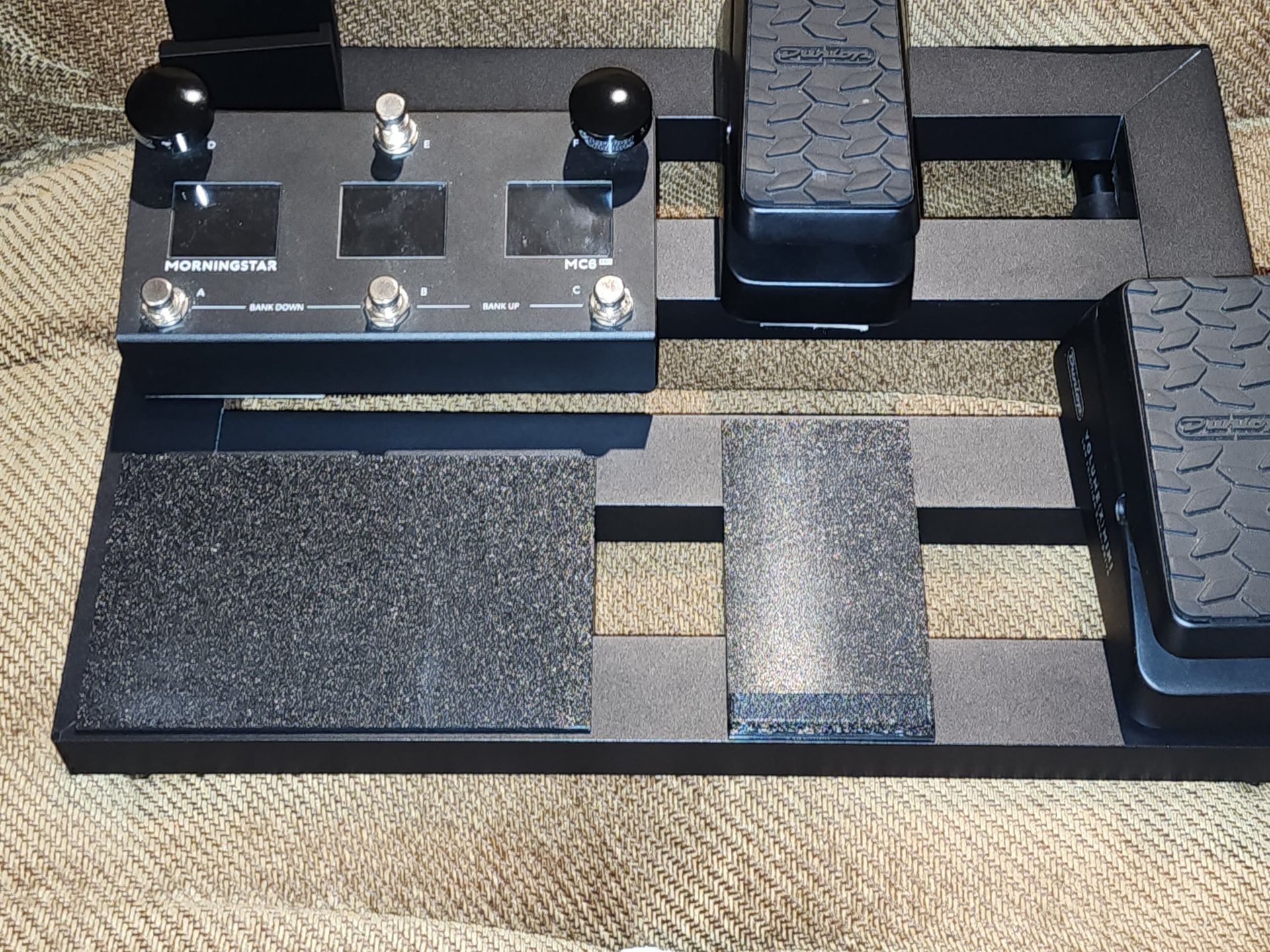
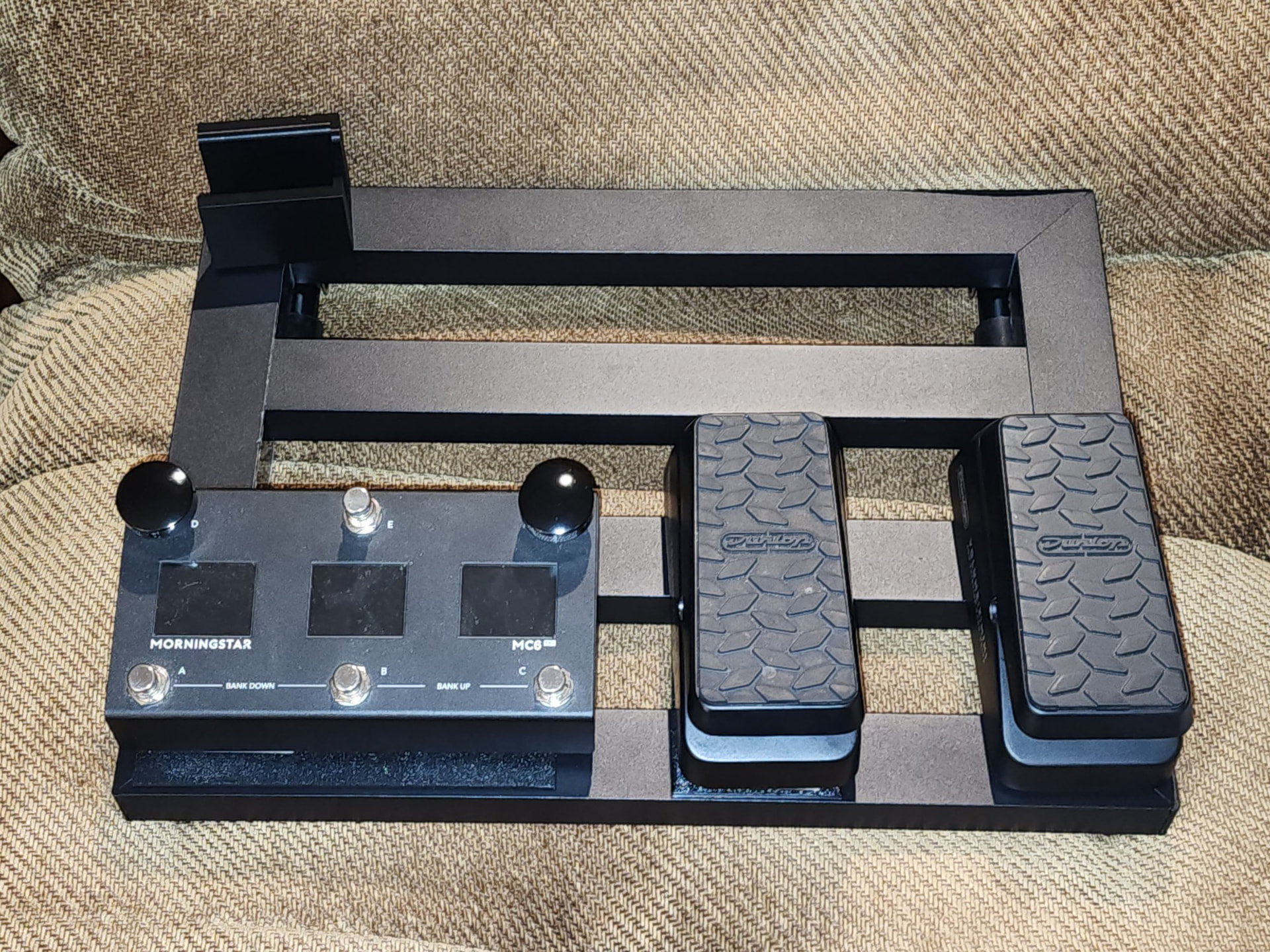
I am printing supports for a guitar pedalboard. The pedalboard sits on the floor in front of the guitar player, and you mount boxes (aka pedals) which provide sound fx for the instrument. Most are boxes with audio in/out, some ‘pedals’ are something like a gas pedal on a car, where you can control the volume, or some other effect, by press down in front, or pressing down with the heel. See pictures below. IMPORTANT NOTE: While a guitarist doesn’t jump up and down on the pedalboard, they do press on foot switches and press on the volume pedal to control their sound.
I am making "risers" or "mounting platform" for each pedal that sits under the pedal (the box or gas pedal-like object) and over the pedalboard.
Knowing that I do press down on the switches and the volume pedal… what filament should I use for these platforms?
Honestly, we’re talking about compression loading, literally any standard filament is going to work if you add enough infill and walls.
I will say, though, that 3D printing probably isn’t a great manufacturing tech for pedalboards in general. Most boards I’ve seen are far wider than typical print beds, so you’re already piecing together multiple parts. A good ol’ piece of plywood with a riser on the far end seems to work for most people, including the pros.
Are you just talking about the rectangular pads that sit on the frame and under the effects pedals? On a warm sunny day PLA can warp sitting in a car or the back of a van, while traveling from gig to gig. Nylon and some of the exotic filaments are probably overkill and not worth the cost or headache. ABS would work but it doesn’t print so well on larger pieces. Which leaves PETG which would be my first choice for such a project. PET-CF would probably be more ideal though.
I am only printing “risers” or “pads” that go under each pedal on the board. I am not printing the entire board.
I tried to show that with the 2 pictures.I showed a few pedals on the board, and then the other picture I moved the pedals and show the 3D printed pads or risers.
Do they make a PETG + or a stronger or higher temp PETG? I do live in Texas y’all.
PET-CF is the filament that has the greatest strength and heat resistance of all the filaments Bambu sells. It is also one of the most expensive. An alternative is TPU which is polyurethane. It isn’t as strong, but it can take a beating and cushion an impact.
Same from me. good old PETG should hold up plenty well. The filaments like PET-GF or ABS-GF withstand 100°C / 212°F or far more. The GF makes them very stiff. Both properties that you don’t need at all in my opinion. PETG is a bit flexible, so maybe it only bends when a stiffer material might brake. But haven’t used any of the two, so maybe that is not true.
For me, I would use PETG. This should be fine for most circumstances. Now if you leave it in a car on a hot day for more than a couple of hours you would probably see softening.
IMO PETG or PET. Its unclear from the pic, but if those pieces are only “spans” across the main platform, I would stick with pure pet[g]. If they are like a tetris piece, and extrude down to make contact with the floor for structure, I would use a GF or CF impregnated version. CF/GF introduce brittleness, but much higher strength. So as long as you dont have a span to fracture across, and is transferring load to the floor itself, something like a simple PETG-CF could be stomped on.