Not really, there’s a reason the most popular printers Bambu sells are the A1 series. Most people want cheap 3d printers that work well, not giant 3d printers that have laser engraving and 2 nozzles. And I doubt they will have it priced this low, their current highest priced printer (X1E) is basically an X1C with chamber heating and enterprise internet features and costs 2500. I doubt they will charge anything less than 3.5k
Those look to be more Data Matrix codes than QR codes which would make sense. They are used for automation on a lot of things, like the self driving floor-waxer in Wal-Mart. If you look around you will see them posted on stuff in the store. It’s for the machine to find it’s way basically.
That would correlate with the idea of accuracy.
I think maybe it boils down to simply how many unique symbols you can fit into a given size footprint. In that regard, it appears that Data Matrix is more compact than QR codes.
Exactly, X1E is marketed for enterprise use with capex. The prosumer probably is not paying +$1000 extra for an ethernet port and heated chamber, and we know this is marketed toward prosumer and they said themselves positioned above X1C not X1E. My guess is 1600 for base H2D, 400 for AMS 2 Pro, I think we saw leaked at least one laser add on is 250 to add later, I feel the cutter head would cost less than the laser but if we assume that is also 250 then about 2500 for full combo with everything.
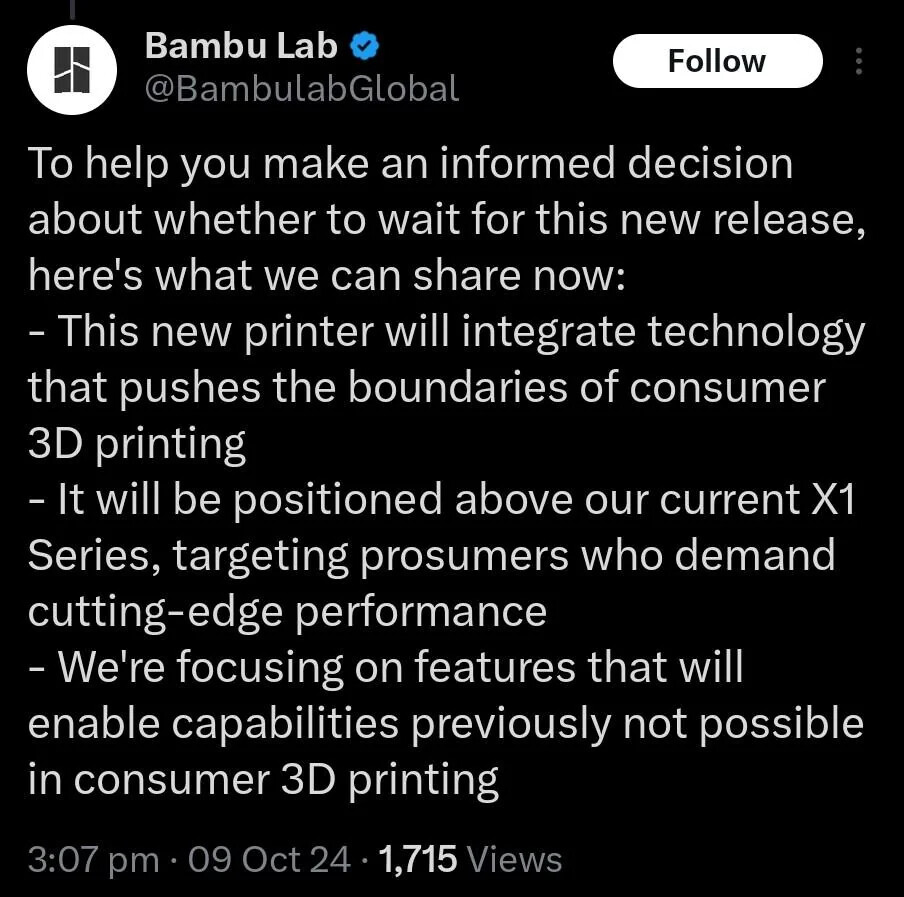
My bad I was smoking crack and misremembered it, but my point still stands that it’s marketed to prosumer not enterprise
I never said it was, I was just comparing it to the X1E because it’s the closest Bambu printer to the H2D.
I wonder if it will have a heat bed that will stay level. Mine has been replaced twice under warranty. I was told it was a “rare” problem.
By the way, everyone, the “QR Codes” aren’t QR Codes. They’re called fiducials. They are used by companies like Boston Dynamics because they are easy to track by cameras and software.
I know this is about accuracy, but when I first looked at the illustration, this was what came into mind: A shower of laser beams that clean the build plate.
So here’s a challenge to BL: find a way to use laser or some other physical means to break up finger oils and give the build plate an automatic “dry clean” before every print.
Even for me who rarely have to wash plates, this feature will be super cool and sell a lot of printers.
The “rotary tool” attachment actually rotates a little sponge ball on the plate and drags it around

I’m trying to think of how this might be useful, and I’m guessing: it can detect its own resonance artifacts in real-time? And, if so, it can maybe either correct them (similar to echo cancellation in audio) or at least move to reduce them through avoidance (maybe by compiling self knowledge of the conditions under which it happens). Just shooting in the dark, but this could be big. This might be the thing which brings something new to prosumer printing. What do y’all think?
A CV system like this does not have sufficient temporal resolution to correct for resonance.
What purpose do you think it might serve? Measuring shrinkage perhaps? Something related to auto-calibration? Anything else?
I’m just guessing, but if the axis motors are servos instead of steppers, there may need an “absolute” reference to set the motion scale. With steppers it’s mostly just steps and multiply all of the gear ratios.
And for printers like the P1 there isn’t an exact mechanical correspondence between bed coordinates and head coordinates, those are set by sensorless homing. That might be good enough for +/- .n mm, but if you could affix that plate to a bed datum then you could get an exact lock.
Might be a good way to determine and account for belt stretch and chassis skew as well.
could the scanner be for scanning 2d images or something of the sort?
It’s probably the same fiducial camera, yes.
but then like maybe it could act similarly to a 2d printer scanner and you could find the images on bambu slicer
I’d guess the main non-calibration use is to visually align laser engraving on a workpiece.