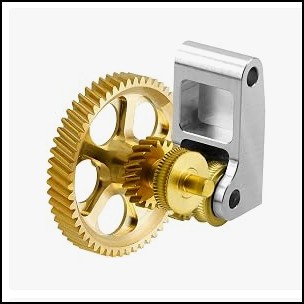
Does anyone know why bambu hasn’t offered a metal gear for the large extruder gear? I know it has the two smaller gears but was wondering why a metal gear isn’t offered for the large main gear.
Thanks
Does anyone know why bambu hasn’t offered a metal gear for the large extruder gear? I know it has the two smaller gears but was wondering why a metal gear isn’t offered for the large main gear.
Thanks
To be honest this really confused my as a novice, when I bought my A1 I was sure it said it was with the hardened extruder yet when I had to take the head apart I saw a plastic wheel so immediately thought it wasn’t the hardened version and I ordered the hardened replacement. I was shocked when exactly what was already fitted turned up as the replacement part. I to cannot understand why this main gear isn’t metal as well!
I’m just wondering what the benefit of that should be?
It’s a way for them to save on both weight and material costs. We mustn’t forget how quickly the print heads move. Even a small amount of extra weight can make a big difference.
Bear in mind that, in terms of kinetic energy, a few grams can quickly turn into a few kilograms - or, to be precise, Newton. Any weight that can be reduced takes some of the strain off the motor.
Edit: If this is difficult to visualise, imagine the print head as a car crashing into a wall at 100 km/h every second, only to instantly reverse direction at the same speed. This is where you want to save as much weight as possible.
There are several legitimate reasons Bambu may have chosen plastic for the large extruder gear.
Cost is certainly one, but plastic also provides lower rotational inertia, quieter operation, low friction, and a degree of mechanical compliance. It may also serve as a sacrificial component during a severe filament jam, protecting the motor, bearings, and smaller hardened-steel drive gears. The actual gears that grip and advance the filament are already metal, so the large plastic gear is primarily transmitting torque rather than contacting the filament.
Bambu placed considerable emphasis on minimizing moving mass when the X1 was introduced. The CoreXY architecture, lightweight toolhead, and carbon-fiber X-axis rods all supported high acceleration while limiting ringing. Input shaping reduces ringing by modifying the commanded motion so that it does not strongly excite the printer’s mechanical resonances. It does not eliminate the underlying advantages of lower mass, nor does it compensate for stepper-motor lag.
That said, replacing this one plastic gear with metal would probably add only a small amount to the total toolhead mass. The more relevant questions would be whether the plastic gear is actually a common failure point and whether a metal version would introduce additional noise, lubrication requirements, backlash, or wear elsewhere in the gear train.
I would support Bambu offering a properly engineered metal gear as an optional durability upgrade, particularly for heavily used P- and X-series machines. However, I do not think the case is strong enough to conclude that plastic has no remaining engineering advantage or that metal should automatically be standard on every printer.
That is an honest oversight but it’s likely you saw “hardened nozzle”.
Because it’s a worse material choice.
The tooth pressure and rotation speed are such that there will not be any appreciable wear on the driven in any reasonable amount of time.
In some odd misalignment or extreme wear scenario, you want the cheaper part to be sacrificed, not the pressed-on gear that is part of the extruder motor.
On the other hand, if it were hard metal on hard metal, wear would be higher to both the extruder drive gear and the driven gear, and the driving gear would fail first, and much earlier than if it were driving a plastic gear.
It doesn’t need to be a steel gear. Even if made of aluminum, would still be better than plastic. I’m just looking at durability. If I’m not mistaken, well if googles not mistaken lol, it’s the smaller gears that actually drive the filament into the extruder but alot of clogs wind up with a small piece of filament in the large plastic gear. I just think all metal gears would be better to handle the constant moving of filaments for hours if not days. Plastic will give out long before metal will.
As always in life: it depends!
Actually, Olias has already explained it really well.
Simply throwing various materials into the topic isn’t very productive. Why? For example, aluminium isn’t necessarily a better material for gears since it’s extremely brittle compared to other materials. The teeth can break off very easily - at least in my experience.
Aluminum’s limited load-bearing capacity and lower wear resistance are clear disadvantages.
But before we get sidetracked talking about materials: What’s your point here? Why did you bring this up? Do you feel like your gears don’t last long enough?
Maybe we should focus on that.
I can’t answer that but there is a remedy which I apply to my extruders.
While generally not a fan of BIQU electrical products, they make a part, the BIQU Panda Claw which is two parts. The extruder (big) gear and the spring loaded tensioner for the assembly. In the event I need to buy an extruder, I also buy the Panda Claw, remove the plastic gear and put the metal one in its place. There may be a friction issue as the reason BL uses the plastic gear but that depends on what that plastic gear is made of. PTFE would be too soft but but maybe that is why they do that.
No it was definitely advertised as hardened extruder and they actually sell that part Hardened Steel Extruder Gear Assembly - A1 Series | Bambu Lab US Store
Just I couldn’t understand why the main wheel was plastic. I can see the arguments as to why its plastic but I just feel the description is misleading.
Technically the extruder wheels are steel, just the drive gear is plastic
Nah, it was more out of curiosity. Nothing more than that. I appreciate the responses!
But it isn’t - the part that actually benefits from being hardened is.
Hardened steel nozzles are not solid hardened steel. Just the narrow section at the tip needs to be hardened, as that’s the part that actually wears. Solid hardened steel would be a much worse hotend than a multimaterial one.
E3D’s Diamondback nozzle, same story. It’s the very tip that’s diamond only, because that’s the only part that matters.