Do you mean dirty in the sense of becoming dark grey?
In that case it could be the composition of the brass nuts. Also the H2 series lead screw nuts seem to wear out faster than normal.
Some lubricants can interact with the elements in the brass, causing this dark color.
Precisely. It becomes dark grey super quickly. You explanation is quite good. Any additional info on what lubrication can exaggerate this? So far I’ve collected so many bags of BL lube that I just use it anywhere, including my Prusa haha.
We might have found the issue of the fast deterioration of the nuts.
Some greases contain sulphur. This starts to react to yellow alloys at temperatures between 38C and 60C. Given the fact that the H2 series has a heated chamber, this might be the cause of the fast wear and the extreme fast grey coloration.
Are you printing a lot with the heated chamber?
Edit:
Some further research suggests that the grease of Bambu is inert. So it should not be the reason for the additional wear.
By itself it also wouldn’t explain why there’s faster discoloration on the H2D than on other machines.
It’s a much bigger plate, and therefore heavier. That might point to faster metal wear, at least as a hypothesis. It’s the z-axis lead screws that show it most. With 3 of them, maybe they’re slightly overconstrained if their alignment isn’t perfect? Perhaps to get less slop, Bambulab accepted more part wear as a favorable trade-off?
Just spitballing here. It’s not all going to be gold.
Bambu’s grease is one the things that I would really want to understand it’s content and who makes it. But in an infinite Chinese proverb “■■■■ you, just go and buy it” (btw that’s “almost” the quote from supportassistant)
90-95% Hydrocarbon alkane - CAS Number 90-95 68919-17-5 - Lubricants
5-10% Additives - CAS Number 126104-53-8 - Chemical substance called TH726
Here’s the information on the oil, just for the sake of completeness. Lubricant Oil:
…and this is exactly where Gerrit is right:
CAS 126104-53-8 = TH726 (Vanlube 871)
A specialized lubricant additive based on sulfur-containing thiadiazole chemistry, used to provide wear protection and high-pressure stability in industrial oils.
At least in the context of TH726, I haven’t been able to find any references indicating that it reacts with yellow alloys at those temperatures. The TH726 chemical grade does not show reactivity toward copper alloys until much higher temperatures. Typical ranges reported for TH726 are around 120 °C for the first measurable copper corrosion, and roughly 150–180 °C for a more noticeable reaction.
I’m not saying it’s impossible - only that I, and the emphasis really is on “I”, haven’t found any evidence that supports this theory. However, what follows makes it “interesting” again:
One thing I can confirm is that many companies don’t rely on TH726 when copper alloys, types of brass, and varieties of bronze is on the playing field. There are simply better solutions. Manufacturers therefore avoid using an additive such as TH726 in a universal, standard product.
It for sure will, thank you, but I honestly didn’t have the intention to go into a rabbit hole of learning about all the chemistry surrounding greases and reactions with metal
I can understand that. Personally, I believe that before an axis or lead screw ever fails because of less‑than‑perfect lubrication - as long as there is some lubrication - the servo or its components would have worn out many times over. An axis or lead screw can easily last twenty years, and even then it might only need a bit of polishing to keep going.
If an axis, shaft, or lead screw breaks, it’s usually due to completely different reasons - often issues that already started during manufacturing.
Or simply because the workshop is so messy, dusty, and full of metal chips flying around. Under those conditions, someone could ruin any axis or lead screw within just a few months.
The biggest enemy of a mechanical part is not forgetting to relubricate it, but forgetting to clean it of dust, metal chips, etc. It acts like rough sandpaper.
That’s why I made the edit later. The inactive sulphur in TH726 doesn’t respond in that temperature range, but more likely >100C.
The amount of TH726 (5-10%) is quite high though. Still it shouldn’t react with the brass at the temperatures it reaches under the conditions in the heated chamber.
The fast dark discoloration of @Advocado is still a but of a riddle here.
It might be that the chemical composition is not exactly what it states. But that is hard to verify without a suitable lab.
Why does Bambu use it in the first place? There are better solutions out there.
Is it simply cheaper? Easier for them to source the raw materials?
They must have had some reason for choosing this approach, especially since other manufacturers don’t use it - but Bambu does. I couldn’t find any well‑known lubricant manufacturers that use this particular combination. Most manufacturers avoid using it because of potential material incompatibility.
But just to be clear: the fact that I couldn’t find it doesn’t necessarily mean it doesn’t exist at all.
One way to settle it, or at least get more insight, would be to completely remove all the bambulab grease at the next maintenance interval and replace it with krytox. Krytox is advertised as chemically inert toward metals below 288°C. This way if the Krytox also quickly turns gray/black, we can rule out a chemical reaction with brass as the cause.
Besides the Krytox you mention (no experience with it), the Super Lube Multi-Purpose Synthetic Grease seems to be a good alternative.
But cleaning is very important here.
The rods are fairly easily cleaned, but in the nuts some residual contamination might still be present.
When new grease on the rods enters the nut, it might drag the dirt out on the rod.
FWIW, I’ve already been using the Superlube 92003 for over a year now. I haven’t been paying enough attentioin to say whether it turns dark slower/faster/same as the Bambulab lubricant, but in an absolute sense I’d say it darkens way faster than I would expect after a fresh change-out at the maintenance intervals. I hadn’t paid attention, because until Advocado mentioned it, I hadn’t seen anyone remark on it, so I thought it must just be par for the course.
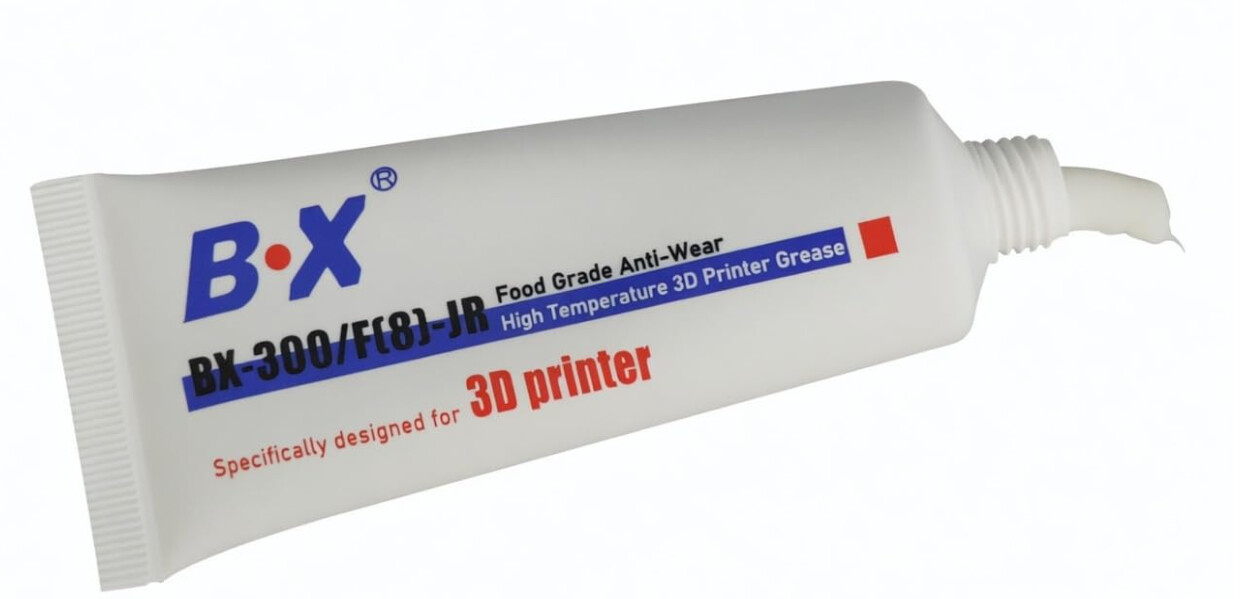
All that said, I bought a tube of BX-300/F on amazon and was planning to try it next. However, since then I found out that BX-300/F refers to a product family, not a specific product, and there are different formulations with different properties that fit under that heading… BX’s present technical page lists, among others, a specifically identified BX-300/F(8)-JR “3D Printer Grease,” with a semi-synthetic base, approximately NLGI 2.5, and an operating range of −30 to +120°C. Other BX-300/F(DF) variants are NLGI 1 or 2 synthetic greases with much higher advertised temperature ranges. So, at the moment, I’m not sure which of those is what I purchased off of amazon, or whether it even matters. Opinions?
Looking at the product labeling, assuming it can be believed, it appears that what I received was, in fact, the BX-300/f(8)-JR.
I’m thinking this should easily be good enough, because I can’t imagine the leadscrews ever reaching 120C. Can anyone else? Maybe I lack a rich enough imagination, but I don’t feel any worries about it. In contrast, superlub 92003 is rated to a much higher temperature, but that may be a “so what?”.
[Edit: @Gerrit Of particular interest for your sulfur question, BX publishes:
which demonstrates that it “qualified” (which I assume means “passed”) a particular copper corrosion test performed at 100C for 24 hours. Maybe you can tell me whether or not that would exclude it as a possible brass reactive compound for our purposes, but it’s the only lubricant I know of from Bambulab’s recommended list of lubricants which has a published test result of any kind for copper corrosion.]
[Edit2: Way back when the X1C was first released and Bambulab was then recommending BX-300/F as the lubricant, it was unobtainium without paying through the nose for it. No way you could buy it on amazon then. Since then its price has fallen dramatically, especially over the last year or two, to the point where Superlube 92003 is now only about 2/3 the price of the BX-300/F on a price per ounce basis. ]
The BX-300/F sounds like a good option here, so maybe worth a try, though it costs me approximately triple the price due to added (import) taxes and shipping to the Netherlands.
As it is food safe, I could also use it for my coffee machine.
Still I keep hammering on the fact that the fast coloring might have nothing to do with the aggressive behavior towards kopper/brass, but just accumulated dirt that has been caught in the nuts.
After about 1800hrs, I currently have approximately 0.6mm backlash at my rear nut, while following nicely all the maintenance intervals (which seemingly pop-up more often now) in the last 16 months I own my H2D.
So is the discoloration caused by a chemical reaction or just dirt and brass brass particles gathered in the nut?
To come back to the topic, someone provided the key insight - which also sheds light on something I had overlooked regarding temperature.
MiamiJerry provided the key piece of information: Pressure
Seriously the nut are very very thin, the grease changes color to black very quickly.
If everything goes smoothly, there shouldn’t be any noticeable temperature increase from pressure. But if the tolerances are too tight or the parts are even slightly misaligned, significant pressure can build up on the nut.
That’s definitely a point I overlooked because I was literally assuming everything would run smoothly. In that regard, using too much lubricant might actually enhance the effect, because more material (grease) is compressed into that area.
But I don’t know if the pressure is enough to generate those temperatures, so I don’t want to make any assumptions. Others surely have more experience with this.
I cannot verify anymore how tight the nuts were when they were new, but keep in mind that the rods are not guided on the top side.
The nut itself is the 2nd guide.
So when the bed moves down the nut and the bearings at the bottom get closer and a deviation in position between the rod and the nut could become an issue then.
The 3 relative locations of the nut and rods are determined by sheet metal parts that are in general quite accurate. Nevertheless at lower positions, it might cause additional pressure sideways.
The grease however, is a High Pressure variant, and imho the additional pressures are not causing extreme temperature increases. Definitely not with the limited motion of the Z-axis.
The one thing you can definitely do is change which lube you’re using and see if you notice a difference. It’s probably also the easiest thing you can do.
It’s like the “Check Engine” light in the older cars. Or changing your oil every 8000 km. Probably wont hurt your car to delay it for awhile but eventually it will bite you. I use a regular maintenance schedule for my printers. Remove the gunk from the z-rods, regrease them and inject Klüber Microlube GL261 into the linear rail carriage (on my printers that have a port for this).
Yep it is. It fired a notification just because 3 months have elapsed. Difference to cars is while cars have oil in proximity to coolant out in the environment the car drives in, with the 3d printer it is enclosed and sitting for on the bench. So the exposure to contaminants is almost exclusively from printing - and there hasn’t been much.
My feel is these reminders need to be more driven by printer usage exclusively ( eg engine running time ) and not sitting there doing nothing time.
I am unsure why you are so adamantly against the idea that calendar aging directly translates to oil evaporation but if anything it should be accelerated by in-use hours and still have a time-based reminder on top of it. The entire “sitting there doing nothing” time the oil is literally vanishing into thin air.
X hours of printing OR 3 months, or similar.
We also can’t be sure of every single environment. Some people have extremely dusty houses, or their printers are in a workshop full of sawdust, or whatever.