Oh yeah there was also the whole “Why can’t I view what my Bird’s eye/toolhead/nozzle camera sees on my 3D printer while it’s printing?” which really sucks because I paid for four cameras and I can only view out of one of them. What’s up with that? The H3C can view through it’s Birds eye camera during print so why can’t the H2D? Why can’t any of the machines (H3C/H2C/H2D/H2S/X2D) let you access what the toolhead camera is seeing down on the print? I mean, it doesn’t have a whole lot of use since its moving around a bit fast, but I would still like to see what it is seeing, and it would definitely help those who don’t have the birds eye camera to look directly down on their prints, same goes for the nozzle camera on the H2C and H2D.
I should be able to work every part of these machines to the fullest capabilities of their hardware, and no, I’m not some AGPL license advocator (even though I do support it and think it could help Bambu in ways it would most need, such as open source helping Bambu out with this whole mixed nozzle printing update taking super long dilemma and also helping Bambu roll out updates faster in general), but if Bambu is making some big moves in the market and it doesn’t want to embrace open-source, which I understand why they’re doing and the marketing strategies they are executing, they are going to have to make software better than the community can. Which is pretty hard!
Maybe hire a whole lot more for the programming team. Bambu should REALLY be focused on software as ever before, they have leeway, and they REALLY SHOULDN’T release another 3D printer for a good six months at least since they’ve already got the H3C out, which will hold out in the toolchanger race for a good period of time. So long as there are absolutely NO distractions, I FULLY believe Bambu can put the mind to the metal-
Might be a hardware CPU limitation. For example the P1s camera was only limited to the low frame rate due to the weak chip, video processing takes up a lot of overhead.
Keep in mind that the frame-rate of the H2 series birds eye view camera seems to be quite low, so that would be a restriction.
But low frame-rate images could be useful in some sense.
You also mention access to the other cameras should be possible.
I can imagine that it’s interesting to see what those cameras record, and then you probably stop looking at it as the data is useless anyway.
Also keep in mind that handling all those data streams demand more resources from the CPU.
And I personally prefer that the CPU focuses on correct motion and failure handling, than producing useless images.
The sinical side of me thinks they are hoping that anyone really wanting / needing this feature may buy the H3C rather than wait, but those that do wait received after sales improvements.
I own an “H2C Laser” device that I purchased for hobby usage.
After using it, I realized that such hybrid machines—which combine FDM printing with laser capabilities—are essentially non-functional due to the smoke and contamination generated during laser operation.
Now, I see that the “Vortek” technology has been shelved with the introduction of the H3C model.
Ultimately, I ended up paying the highest price for a device with the shortest lifespan.
Has the H2C stopped working?
I presume not, so it still does what it did a week ago. Nothing has changed.
Is the H3C better? Sure! In most cases it is, but that doesn’t make your H2C worse.
I bought one of the first H2D’s with laser. That took only 8 months before that was bypassed by the H2C. I still use it, and it still does what is was intended to do.
I still use the laser, but only for engraving stainless steel and anodized aluminum.
No smoke, so very functional. I am definitely not planning to cut wood or acrylics though.
And you could have known that cutting wood or acrylic would have caused smoke and required regular cleaning if you read the reviews of the H2D Laser combo.
My biggest disappointment is the rapid abandonment of the Vortek system. Because of this, I suspect that in the not-too-distant future, I’ll struggle to find spare parts—or even nozzles; I suppose time will tell. In essence, the H2C turned out to be something like a beta-test device—deemed a failure and subsequently discarded.
The fact that this system was used in only a single device and then abandoned is, frankly, both saddening and disappointing to me.
This is drifting rather off-topic, but the Vortek system still has the same advantages (and disadvantages) over a tool changer as it did at release time. Nothing changed in that respect besides BL now offering a tool changer option as well. I have no idea if BL will make another printer with Vortek, but declaring it “shelved” seems premature (and “a failure?” really? mine works great). The support timeline for H2C is clearly stated.
That H3C being a completely different approach is not really all that impactful to concerns about H2C parts and supports anyway. “Direct successors” like P2S ← P1S nevertheless don’t share a lot of parts, especially ones that wear out, it’s the same. In terms of overall support, old products are old products the incentives to corporate decisions are not all that different. Of course, unless a product is such a unique hot potato to upkeep but that’s beside the point.
The main ‘concern’ I see would be if they don’t make another machine using the Vortek nozzle, this limited adoption could reduce the likelihood that varieties like Tungsten Carbide gets released (can just get one for left nozzle but, some convenience loss)
Either way, already EoL X1 is getting spares until 2031 so I don’t see anything to worry about yet.
I gave it some thought, this seems like something the slicer can pretty surely compensates for. In terms of tool path logic it’s just a swap out using a direct offset of the bigger nozzle so. Improvements down the line hopefully.
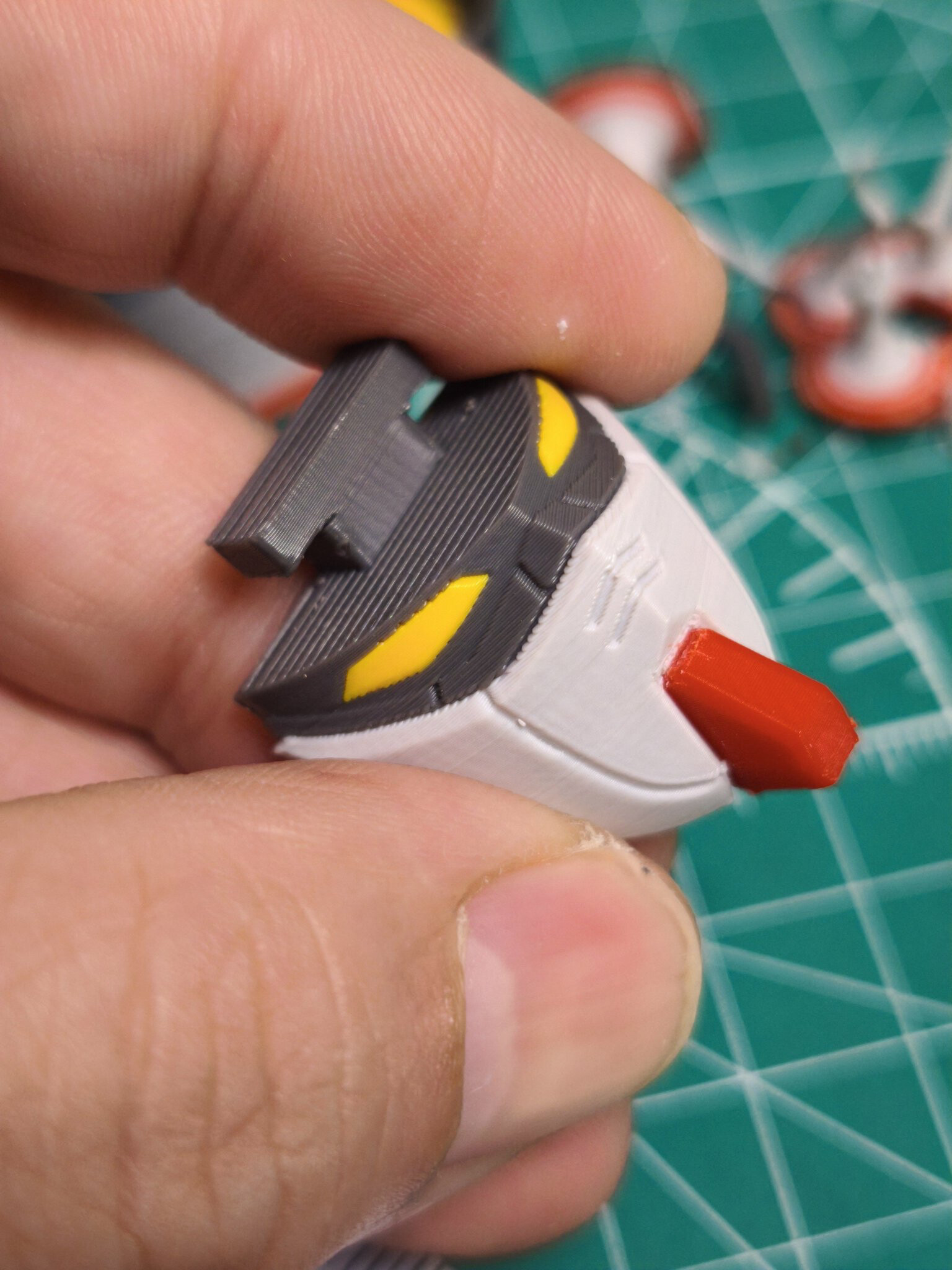
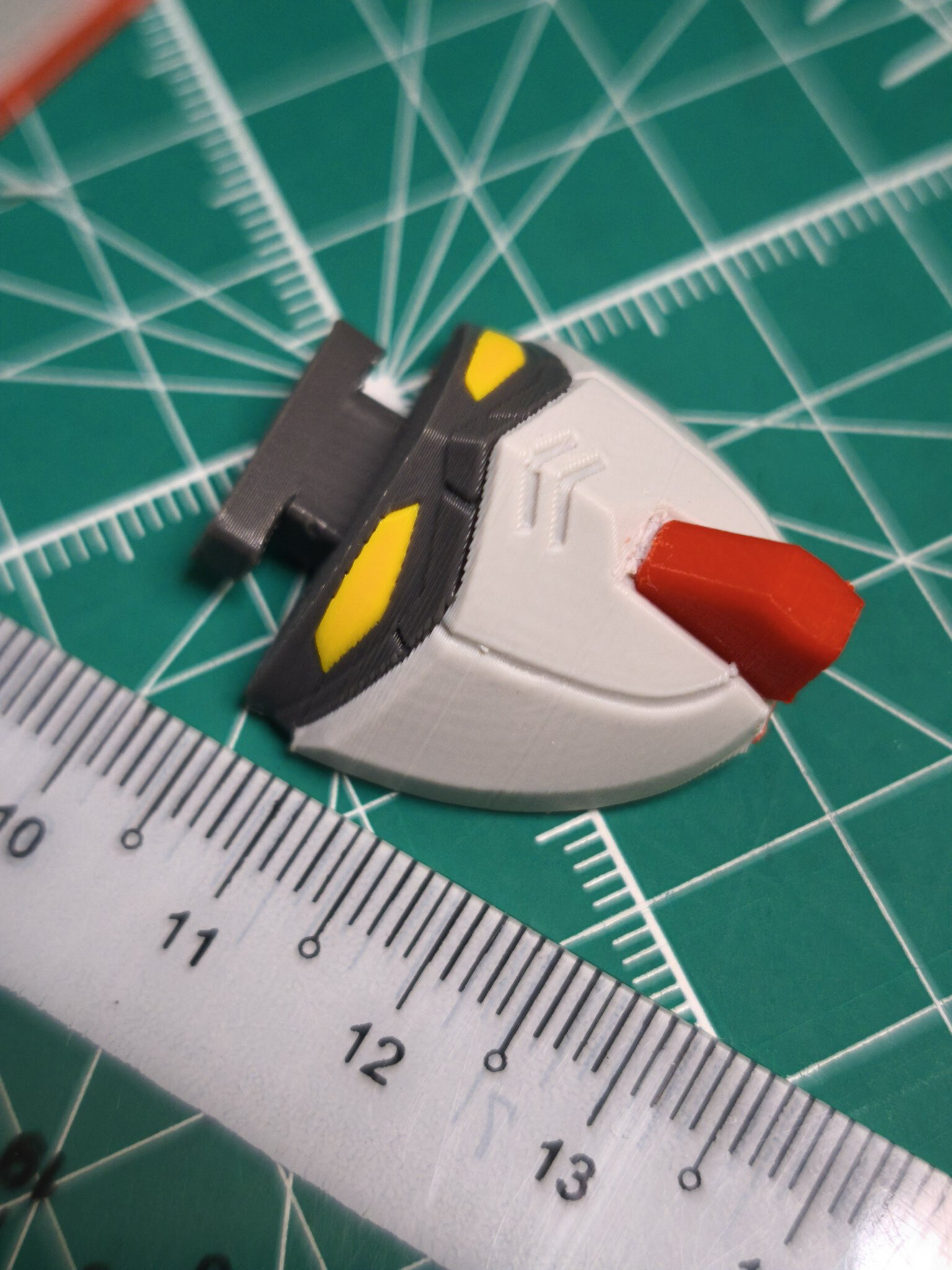
I don’t know if the graphics are exactly representing the actual implementation, but I would say that the higher layer path, could be slightly closer so the sides meet each other.
Theoretically that is possible, I would say. But we are still looking at a simple stack here, and the slope drawn here is only 45 degrees.
In the model on the photos that slope is even worse.
The order of the layers could be optimized in such a way that that the last thin layer is printed after the thick layer, but wouldn’t really change a lot.
By slightly over-extruding the thick layer you might get some material pushed under the thin layers? But that might give issues on the other side.
As was mentioned earlier by some people, the complexity is way higher than most people realize. For a vertical wall it’s simple, but all the edge cases make this a complex topic.
I am sure more improvements will come, though I don’t expect the developments around this multi-size printing to be finished in the coming decade.
I am impressed to see the current solution, because afaik Bambu Lab is so far the only one that supports multi-layer heights.
And I have to also mention the development of the Cadenceslicer which is a one-man job (credits to @HMITCHR) who has put a huge amount of effort into making it work for his H2D.
Besides these 2 solutions I am not aware of any other slicer release that are supporting multi-layer heights.
But please anyone, correct me if I am wrong on the last statement.
I hadn’t thought of that one anymore. However, in that case the interface is not so critical as you will never see it when the print is finished.
Same for independent support height. That also doesn’t have an interface, so that is not so much of an issue either.
Even the interface shown could look different when the neighboring materials are the same and of the same color, then the empty spaces could be filled with the smaller nozzle.
As mentioned already, we will see more in the future.
Generalizing, but it should be on principle at least similar to features already doing similar geometrical manipulations (like how inner wall path gets generated).
The alternate layer method bambu used here is pretty mature, the same way infill combinations handles it.
Tho thinking about it, in terms of shallow slopes there would be a challenge if like the illustrated figure, thick layer lies on the “bottom”, so either there will be slight overhang sagging on the thinner “top”, or there will be a limit before nozzle scraping becomes a thing. Maybe the eventual solution will be some kind of interface offset modifier and a hover warning about value safe limits. Just some thoughts.
Ofc none of that takes into account the complexity or lack there of from the slicer being built on top of something on top of something else, so it’s not prudent for me to estimate the workload.
Surely a slicer built from the ground up with the knowledge of the current and possibly future requirements would give developers the possibility to make it best in class.
But it also is a huge investment in resources. So as long as the existing architecture (which is around 15 years old) is still usable by making the required changes and maybe even taking compromises for granted, I don’t see this happen unless there is enough budget to do this.
Nevertheless, this is a good start and (though I haven’t tested it myself) seems like a well-thought-through solution.
Hoping to test it myself soon on the H2D, though only with 2 nozzle sizes.
Do you actually have anything useful to offer here, or is spouting misinformed nonsense all you’re good for?
The CEO of Bambu is on record saying this was in development for the H2C and H2D. It’s a slicer development that can be extended to any dual nozzle machine.
I don’t know why you’d want fellow Bambu owners to not get additional features that were suggested would be coming to their machines. What kind of damage do you have where you want people to have less, not more?