ive read some says its fine with a filter and some day its not even with a filter LOL. Im too new to anything other then just pla/petg
i have the vento box on recirculate and a Fnatr external filer. Would this be enough to catch all the possible cf strands or should i hold off till i have a better place to do it ?
Nah, not even close to insulation dust… there are no loose fibers at all, they all stay encased in the plastic (both in the filament form and during/after print). The usual cautions for sanding CF would still apply though (the dust could be harmful).
Not sure if its safe or not but having the machine printing just PLA in my room makes me feel uncomfortable so I made a box with fan inside to suck away all the bad air.
You should understand that the results you’ll get on a message board from this kind of question may be dominated by those who think precautions are for wussies and by those who are “too cautious”.
Instead of relying on who can tell you what you want to hear, it’s not hard to look this stuff up yourself and make your own decisions.
Nobody can tell you if your fan/filter setup is safe just by your very sparse description. To give a useful answer you would need to supply diagrams and measurements, etc, and it would still be difficult to say.
As to carbon fiber in 3d fdm models, where it seems to be more of an issue is in handling the models. Little bits of fiber that are sticking out get broken off and can then float around.
There are issues with inhaling those kinds of fibers. They don’t break down. They embed in tissues and cause irritation not that different from asbestos and other sharp/rigid fibers when inhaled. They are indeed a hazard but not one that produces immediate effects. Effects of CF inhalation could take decades to appear.
Might consider verifying this stuff on your own. It’s your health and you will be the one paying any consequences. Might as well go in eyes open.
First place to start is do you really need CF filament? If you do then you can dig deeper if you choose to into CF exposures and what they mean for you and anyone else in the household. And you can mitigate things with masks, filters, etc. But it’s your health and your decisions. Might want to make good ones.
You are going to get different answers from people, and what they regard as “safe”. If someone want to wear gloves and a face mask then go for it. Whatever they are happy with..
I use PETG CF and have never worn gloves while handling the parts. I have never had an issue with hand irritation… up to now. I don’t use any additional extraction fans, but then again, our printers are in their own room that no one hardly goes into.
I really do like the finish of the PETG CF filaments.
The bento HEPA13 filter would have captured these.
But ignoring filters, assuming direct ejection/leaks of chamber air,
AFAIK there’s a lack of end-to-end research on this that can be applied in a realistic room. But couple facts. Correct me if wrong, feel free to add.
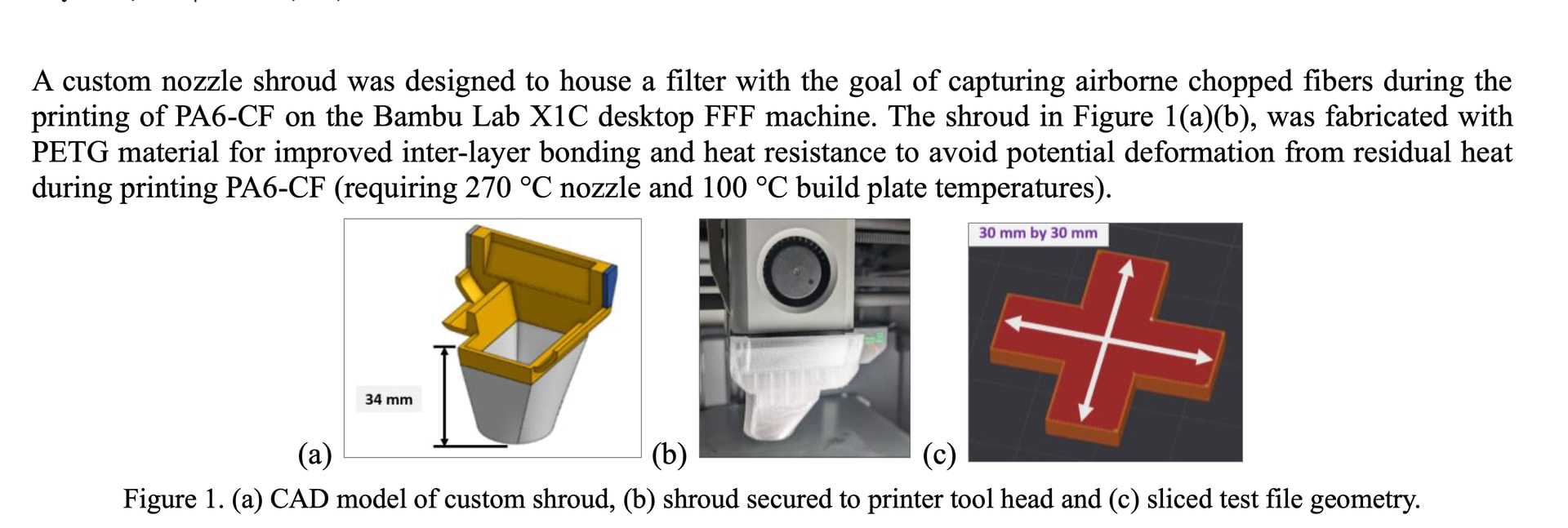
Fibers do get “splashed” from the nozzle, there’s a paper on that. They strapped a filter right next to the nozzle. That’s different than the question OP asked. The paper proved the first step but did not put capture filters in the ambient air around the printer.
Fibers produced in this scenario should be big enough that they won’t float indefinitely. They will take minutes or hours to settle, depending on size and shape (assuming pure fibers not blobs of fused polymer), and how the air in the room moves.
There are researches on airborne fiber safety but these mainly focus on extreme conditions, not chopped fibers used in FDM.
this type of info didnt show up when i was researching. Ill be reading more on that at lunch.
I know about fibers from working with insulation and fiberglass. Just not in the 3d world. I know if i sand/cut or handle it theres a higher chance of getting fibers in the lungs and skin. The concern i was getting at was just from the filament being heated and sent through the nozzle.
Yeah i probably should have been more specific in the op i guess..
I figured you would take exception (but didn’t care). When dealing with things that can cause health issues down the road way too many are happy to make light or minimize the risks that others may be assuming.
When someone comes here and asks for advice about something that has potential health consequences, if you’re going to reply you are taking on some amount of responsibility for their health. It’s a responsibility more might take more seriously.
And I would be in the too cautious camp. That’s why I said he/she should look into it themselves too. All the search engines give detailed responses now with AI summaries. AI has its own issues but it’s a pretty good source of information for questions like this.
I tried to give a short but balanced reply that would get them doing their own digging. Not that your sage advice is any slouch - “what doesn’t kill you…” - but for these kinds of questions with potential real issues, it’s really best if people at least sanity check the advice total strangers are offering up, some just out for a laugh with some snark, on potential health issues.
i knew what you meant by all of it and i just like having many different opinions/sources to go off. Ive seen the ai stuff also which has helped.
I took that post as a joke either way.
When new to possible hazardous materials like fiber infused, tpu, abs i stay on the side of over cautious. Where i have the printer now i wont run tpu etc. just wasnt sure about infused petg rhats all. I mean i have been these filters just running on low with pla, petg lol.
I think it was pretty obvious that was meant as a joke. If it wasn’t, then I apologize.
Personally, it looks like they are already being cautious and are doing a great job at minimizing their risk.
They have already purchased a good filter (the vento box) and a great filter (the FNATR). Combining that with the internal filter of the P2S, they have 3 levels of filtration.
The H13 filter on the FNATR is more than enough to take care of any particle concerns they might have. The carbon particles that can come off would measure 5 to 10 micrometers, while the filter they are using is good down to 0.3 micrometers. And as already pointed out, most if not all of those fibers are going to be trapped inside of the filament.
With modern filtration, I would not worry much about particles. Even the cheapest of filters are great at trapping them (if they follow HEPA standards).
I would be more worried overall about VOCs, but that’s a completely different discussion.
I understand your point about taking responsibility, but telling someone to go do their own research defeats the purpose of a public forum.
Yeah I guess if you ignore all the parts where it was clearly stated that it varies depending on whatever OP’s non specific details are you could boil it down to exactly one specific point to be upset about.
The comment also made reference to several points for op to consider on their own. That’s valuable, even if it’s not a clear cut “do this and you’ll be fine”.
Your best bet with printing anything, is to vent it outside. preferably filtered first because microplastics.
At one time I had my printers racked on a white shelving (these were my open air delta printers), I checked on them one day at saw this black dust had developed in a distribution field around them after a ton of printing in black filaments. gave me the shivers.
Luckily most of todays printers are enclosed, but the small particles are still being created.
In my printer room, I have 3 HEPA/ carbon filters chugging along nonstop to reduce pollution density. I wouldn’t recommend sleeping in the same room as your printing room. The filters help a lot. If you’re ever concerned about the quality of the air in your space, you can get particle meters that will give you a particle density (it wont tell you what, but they will tell you presence)
Currently planning a build to vent each printer to a central large format filter and carbon filter into a window insert. Likely going to build it from furnace filters and carbon cannisters from a grow store. It’s worth doing if you do a tonne of printing. the room filters I have work for now, but they aren’t perfect as they essentially dilute the space after the fact (which is why having 3 is a sledge hammer approach)