Well. There’s always this economy bargain system for only $8k. Just found this a minute ago lol
And the product page doesn’t even say what it is able to do. Does it dry the air at all?
@Alex_VG: -40C dew point so very dry. I’m guessing it’s a freezer style dehydrator with the -40 dew point.
@Short_Shot - That’s a nice find. Not much information unfortunately. But that industry sees dry filament is best for printing is a challenge to those who think it doesn’t matter. And it bodes well for Sunlu cabinet demand if it holds up and works as well as the reviewers say.
Expensive but the cabinet looks very sturdy.
Added - MatterHackers has it for just $9,993.75(!)
Not sure if you missed it, but given your interest in rotary desiccant wheels, as well as pre-built dry cabinets:
If nothing else, it’s another point of comparison and cheaper than the $7,995 model you’re looking at.
Given the roughly 280 watts of power rating I can make the conclusion that I have no idea what method it is using.
280w is enough to regenerate a modest desiccant charge or run one hell of a compressor.
We make drying cabinets and found the same thing in our own testing. In a humid room, open spools pick up moisture within days and prints start stringing. Sealed storage with desiccant fixed it completely for us.
Could you make some cabinets with 0-10 modules in them instead of 25-60?
Was looking at your cabinets and was curious what limits your cabinets to 25% RH? Any chance you can get that lower?
If my PETG hits 25% RH at room temperature, I start seeing water effects so stay well below 25%.
If your dehydrator runs in an otherwise sealed, known-tight box, how low can it go?
@VCGGAIP Welcome, welcome:
Is this you? And, what do you think of the i10? Strengths, weaknesses, etc.? And, if yours is better in some way, I’m sure we’d all like to hear.
Do you have any offerings that go to 10%RH? Lower than 10%RH? A quick looks suggests your offerings on amazon are at best all more than 20%+, maybe 25%+.
25% RH is the lowest target the current dehumidifier core can be set to (range 25-90% RH, default 35%). How low a cabinet actually goes depends on two things: how tight the box seals, and the performance of the core itself. A sealed cabinet with a good core holds its target. A leaky box or a weak core loses ground.
We are working on a lower-RH version right now. No release date to share yet, but lower is coming.
On PETG: if a spool still shows water effects at 25% RH, it is almost always wet before it goes into the cabinet. A dry cabinet removes moisture gradually. It will not instantly fix a soaked roll, especially one that sat in a humid room first.
Thanks for the welcome. And yes, that is us.
On the i10: we are not going to trash a competitor, it is a different tool. Ours is a storage cabinet first. 40 rolls, sealed, quiet, with a display. It keeps filament dry over weeks, not just during one drying cycle.
On lower RH: our current core rates 25% RH minimum. A lower-RH version is in the works, no release date to share yet. Two things decide how low a cabinet goes: the seal of the box and the performance of the core. We are pushing both.
0-10% RH is a different class of dehumidification, closer to industrial units. Most home printing setups run fine well above that, and going that low can be hard on some materials, not just filament.
That said, a lower-RH version is in the works on our side. No release date to share yet, but it is coming.
Ah, that comment about PETG didn’t involve a cabinet. It was from when I was first exploring water in filament. I use Praki cereal containers with good desiccant and hygrometers now and dry with a dry air purge. Hoping to ditch most of the Prakis and the occasional maintenance they need.
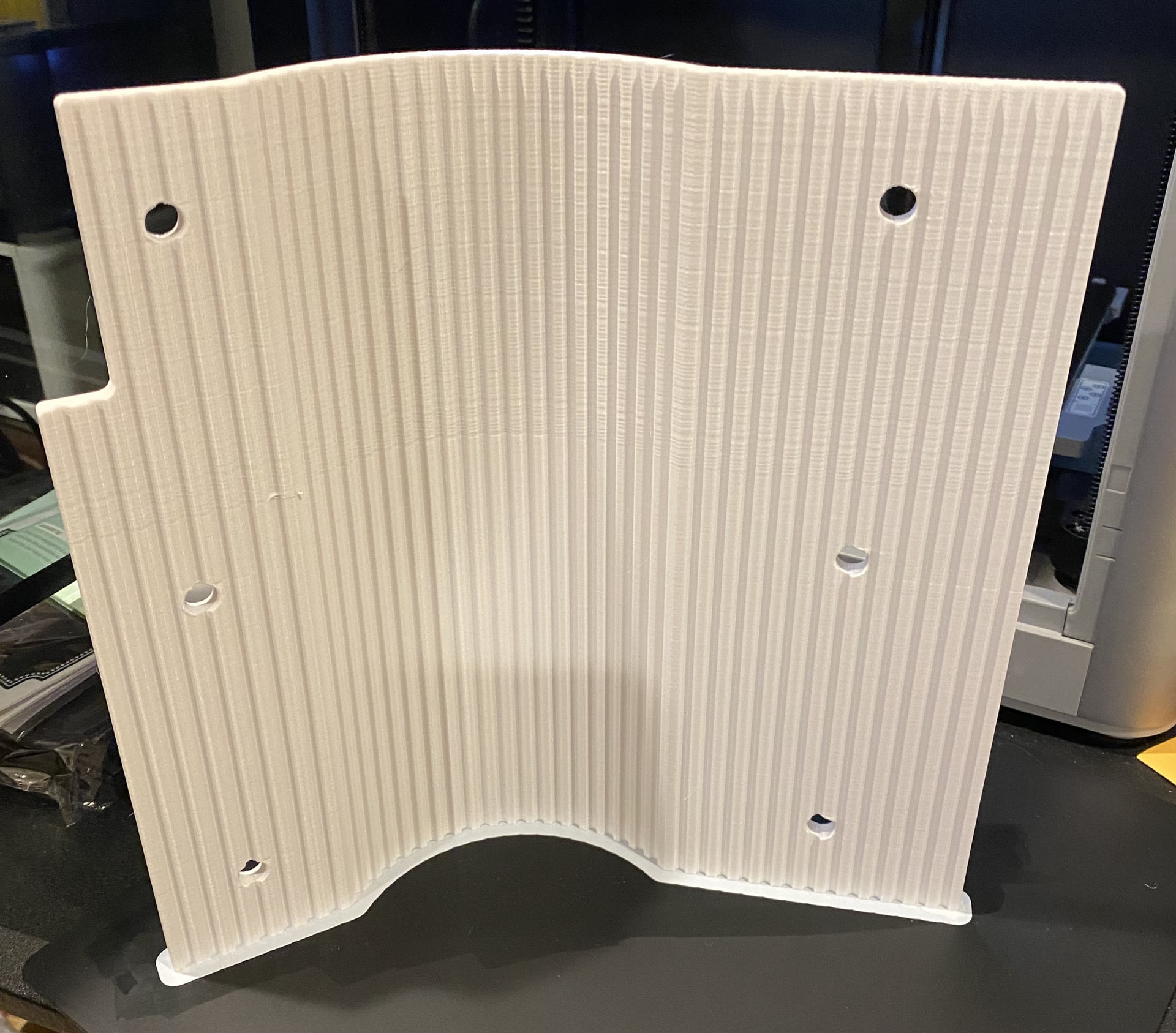
This is a part to fix a friend’s ice maker. I had a dried spool of PETG HF that I started the print with and had started another spool drying but it was a rush and the 2nd spool wasn’t dry in time. You can see right where the 1st spool ran out with a little filament wisp near the middle hole on the left. Looking close you can see the changes in the print. I tested the humidity value of the spool afterwards and that’s where the 25% came from. It was a partial dry. Enough to print that part ok but still just wet enough to see water effects.
Looking forward to seeing what you’re working on for lower humidity.
Update on the Drierite stuff. At the Drierite website they mention a 5% moisture capacity but don’t give curves that I’ve found.
I had a couple of bottles of it so am using it up to get rid of it. I put an old reservoir of Drierite on my air dryer and have been using it to re-dry some filament that had leaked up in humidity in Praki boxes.
In an early test using my humidity logger the old Drierite out of its original container was able to provide dry air at 2% RH at about 20C as reported by the SHT45 humidity sensor. The down side is it was being used up fast. Some of that may be from it having leaked up a little and possible lost capacity.
I let it use up the indicator and sure enough, the humidity started climbing after the Drierite all turned pink (wet). When I tested it this morning with the humidity logger, output air humidity was in the low 40s% RH. It quit working pretty hard. I wasn’t monitoring with the humidity logger during the final hours of the Drierite reservoir because the output was being used to touch-up dry a spool. That’s a test I’d like to do to watch as the Drierite runs out of water capacity.
But the take home for me is Drierite does produce dry air like a bandit and the water-grabbing kinetics are fast (good), but the low water capacity is a liability. It can be regenerated but takes high temperature, it produces dust, and uses a cobalt indicator.
It can certainly be used as a reference dry air source but for drying where significant water may be involved, it’s maybe not a good choice. The color change does seem to be a good indicator of when it can’t hold more water.
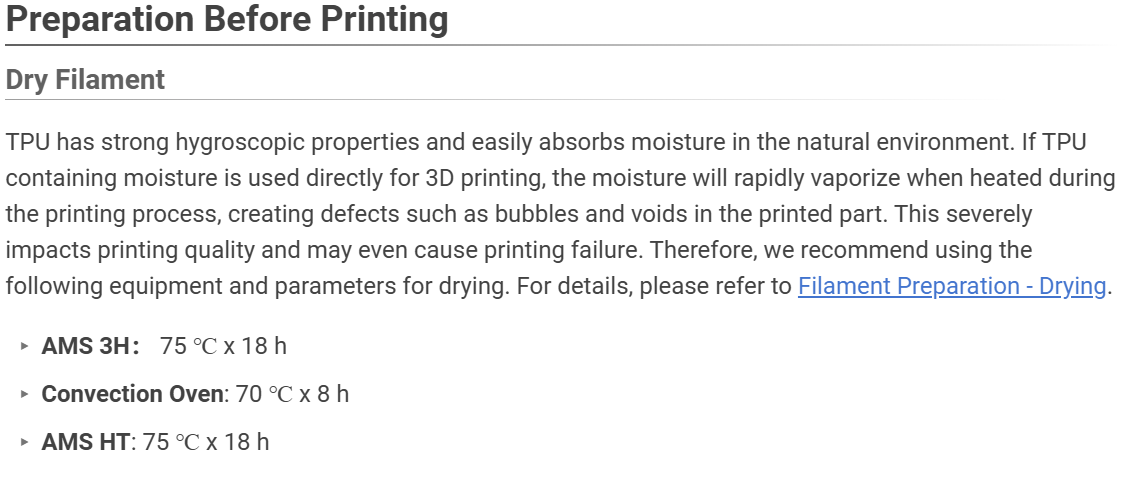
That’s been my opinion. The time differences are just a bonus.  And I’m not a fan of “dry at this temperature for this long” for drying instructions. Different dryers (they do specify dryer in this example) produce different results and the ambient environment also affects drying. They either need to specify what dryer, ambient temperature and RH, or a measurement everyone can easily make.
But I really prefer separate drying, storage, and printing functions. No dealing with different filament types or moisture contents. No issues with temperature limits.
And something to check with a convection oven. Ours is pretty tight. When I open the door on it with silica gel in there I get a big humid waft of air out. Need to vent those occasionally during a dry for most effective drying.
How different are they from typical filament dryers that are not convection ovens?
I don’t think I’ve ever seen a round-up review comparing how long it takes different filament dryers to dry a spool of filament.
I notice that MyTechun seems to like the Elegoo H1 HT.
In the graphic, Bambu says TPU takes 8 hours @ 70C in a blast oven, and 18 hours @ 75C in the AMS HT which is 2x as long and 5C hotter, so pretty crummy drying in the AMS HT. I’m guessing the difference is just due to trapped humidity, but the HT has that vent mechanism so I would have thought it would do better. The Elegoo has active vents also, right?
There is such a wide variety of dedicated dryers, hard to say.
It was to answer such questions that I was interested in getting a humidity sensor that can operate at higher temperatures. Luckily both HDC302x and SHT45 can do so.
Answering your question, yes the Elegoo H1 HT has “active venting”, if by that you mean it opens venting to atmosphere while in a drying mode and then seals off the ambient atmosphere when it’s finished drying.
It also can spin the filament spool when it’s drying. While it’s a nice feature, it’s also a tacit admission that the temperature in the chamber is not uniform, right?
Let’s brainstorm together all the reasons why a blast oven might outperform:
- Hypothesis: better at expunging moisture from the drying chamber
- More uniform temperature.
- More accurate temeprature.
I suspect #3 could be quite significant. Consider: (i) Tot the degree that it overshoots the target temperature during the heatup process, you have to dial-back the target temperature to compensate, or you risk melting your filament (assuming you’re running as hot as you can). However, the temperature stays dialed back even after recovery from the overshoot. Then, also: (ii) if the temperature accuracy is poor, you likewise have to dial-back while assuming worst case in regards to its temperature accuracy. However, if the actuaql temperature isn’t worst case, then you’ve dialed back too far.
@MZip 's Arid Air addresses reason #1, but I’d be curious to know how much of the speed benefit comes from using dry make-up air as compared to just regular ambient air. Maybe @Mzip has already run an experiment to answer that quantitatively?
What do you all think about the significance (or not) of the various factors?
Airflow.
Moving a ton of hot air around the filament transfers heat in and moisture away dramatically faster than still air which has to do so by convection.
There’s 3 primary variables here, plus the quality of each variable: Heat, airflow, and dew point. One could get into discussions of VOCs plugging up desiccants but that’s trivial for us.