I believe you. I just don’t know whether to attribute that to old age per se. I too have a number of pre-pandemic spools. They are in their original wrappers, but I now know that’s no long-term guard against moisture intrusion unless it’s thick mylar packaging, which none of mine have. Although I’m able to revive them to some degree, they don’t print as well. On the other hand, none of them are high speed rated, which is what I print now, so that may be a factor as well. I prioritize them now for throw-away prototypes that I need to iterate.
Anyway, based on your description of your desiccant use, it doesn’t sound as though in your case moistur was a factor. In my case I unknowingly neglected them, and it might be.
In my personal experience, I get better results from new filament than 6 month old filament that is identical in every way.
I have a spool of Bambu turquoise PLA I stupidly bought to get the bulk discount on 4+ spools and that spool will be used entirely on fitment prototype prints. Since that purchase, I now buy 2/3/4 spools of colors I use because I will churn through them quickly, unlike the turquoise sitting on my shelf.
I discovered about a week ago that Bambu Lab is standing up an Amazon storefront which is great. They probably recognize that Amazon doing logistics is better than Bambu Lab doing logistics.
We have both a big Amazon Distribution Center and a Amazon Fulfillment Center about 10 miles from my home.
Recently I have been getting Same Day delivery on Amazon orders. If the distribution and fulfillment warehouses start keeping a hefty Bambu Lab Filament inventory that will totally negate the need for me to carry that inventory in my home. If Bambu Labs puts every type and color filament in their Amazon storefront that means I will get my filament faster, across the board. I will only need 2 days worth of filament on hand.
I wound up with 6 of those plastic totes. I tossed in 2 good sized bags of desiccant (I purchased some sealable bags and filled them) and then tossed in a hydrometer. After a few days I checked it and my hydrometer is reading 10% while my room is 48%.
I may print up something to hold the bags and the hydrometer.
Thank you so much for the help. These totes rock, and sre super easy to use. I’m done with vacuum bags that leak.
The amount of silica gel to use is somewhat subjective. What it does is scavenge water that permeates or leaks in before it finds the filament. All putting lots of silica gel in a container does is give you capacity. The more gel, the more water it can hold at a given humidity level. Only use a little gel and humidity in the containers will rise faster than if there was more gel in there.
So less gel and you’ll be regenerating more frequently. More gel and it will take longer for humidity to rise but you’ll have bigger batches of silica gel to regenerate.
40-50% RH is very similar to where my humidity runs. When I got my X1C it printed PLA great for a few months and then prints started showing water issues.
My old printer never had water issues with PLA from open storage but the X1C did - big time. Why?
I can’t say for certain but I think the difference is speed. With a slow printer the filament has more time for water to leave as it warms up near the extruder. With fast printers the water doesn’t have as much time to leave so gets carried into the extruder and vaporized to then force out blobs and cause flow rate issues and spikes.
If that’s right, it’s not straightforward to predict no problems based on experience with a different printer if there is a fair difference in printing flow rates. It also possibly fits with why printing at half speed solves some printing issues.
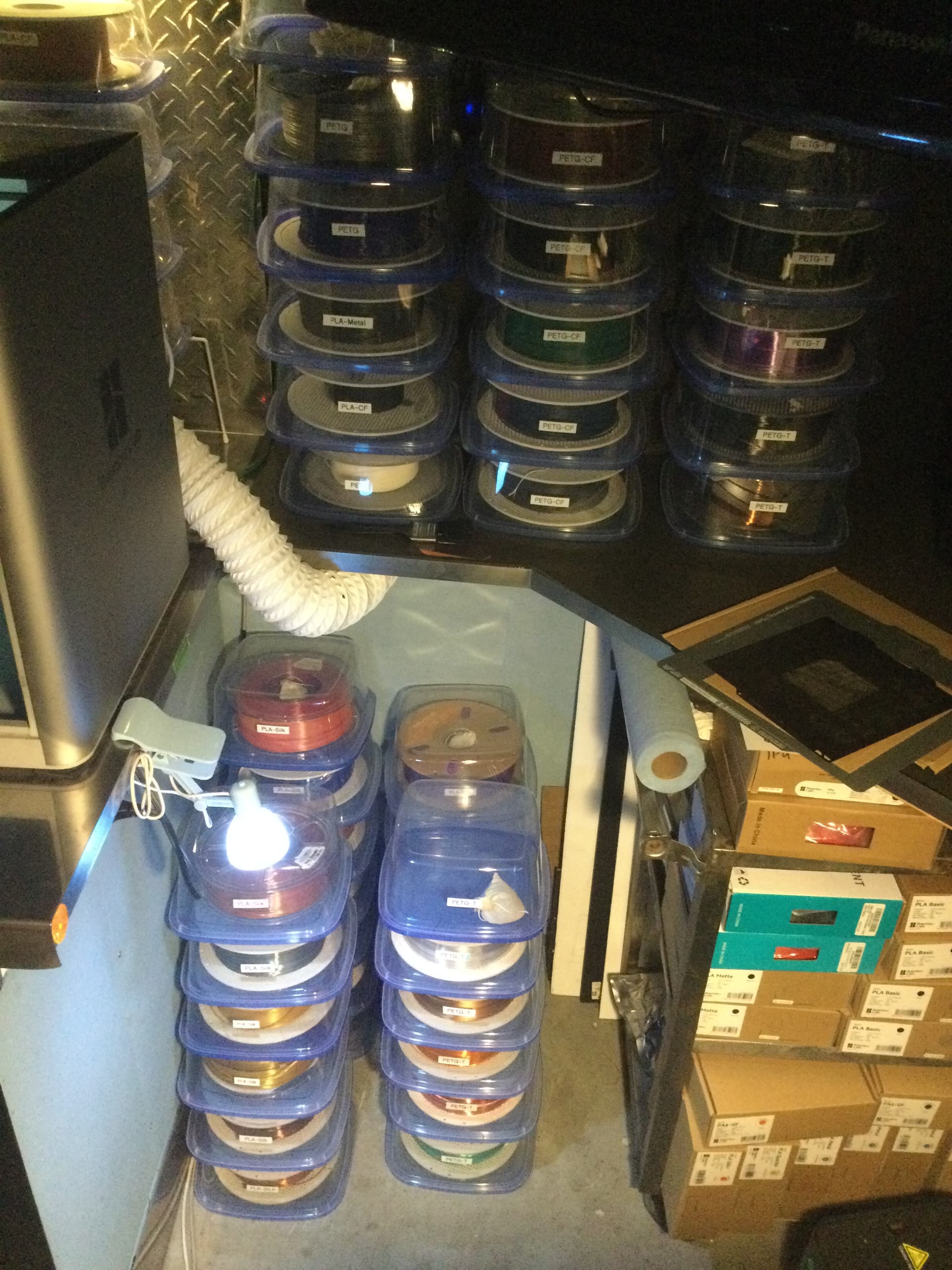
$2.50 Canuckian at the Dollar store, 3L Sterlite food containers and cheap muslin drawstring bags from Amazon each half filled with color indicating desiccant. Hygrometers in several to monitor show they hold humidity to less than 20% when stacked.
I’m up to ~ 80. Not perfect but cheap and effective.
Wow, nearly 300 posts since yesterday when I first looked! Now THIS is an active thread. Just starting out and learning a lot here. What I found, those Ziplock double zipper bags, don’t stop moister. I had a spool of blue in one, put it in this morning and the humidity in the AMS went up 10%. The Vacuum sealed bags fair better, as long as I put desiccant in them. My shop is in the basement, with leaky concreate, when it rains, the floor gets wet, so that gives you an idea how humid it gets. On average, 68%.
On my AMS2, the average was 38% with the factory fill of desiccant. I made the desiccant boxes for the AMS 2 and those dropped it to 10%. I have a dehydrator I use for drying Lavender in season, so it sits the rest of the time and wonder if that can be used to dry the spools and for how long and temp. Its got a 24 hour clock on it for max dry time but I dont know the temp range since I only dry Lavendar at 95F, too much higher evaporates the oils and makes them worthless.
Space is at a premium for me, so I store in bags on a cart that holds 36 spools. Its on wheels so I can just roll it to the machine for changes, but vacuuming the bags is a royal pain and giving thought to a Foodsaver pump, provided the spools fit in the 11" bags.
So far haven’t had any moisture issues with the PLA or PETG, but you never know what gets absorbed when its so humid here.
I need a better dehumidifier, one that doesn’t need an outside vent.
Or $10,000 for a new HVAC system for the whole house, it died 3 years ago and we use Mini Splits for the living parts of the house, while in the meantime the basement gets damp from lack of air movement from the HVAC.
Think I have about 40 of those boxes. I love them. They are the best money I’ve ever spent. They keep me organized. And I was lucky, live in the Midwest, so I got them at Menard’s for around $9 each. One bag of 100g desiccant keeps the filament dry. Olias is a genius for finding these.
The test is straight-forward.
You take a sample of filament, weigh it, put it in oven for a predetermined time, bake it, weigh it, calculate the difference.
Problem is in the details.
What is the proper sample size?
How long do you bake sample?
You end up with a percentage value.
Build an Excel or Google Sheets (free) spreadsheet you can determine how long filament can go without having to re-dry and the characteristics of the types of filaments you use.
Some people are sort of doing that already. But maybe not capturing the data?This question comes up pretty routinely on the forum and when people talk about weighing the filament and writing it on the side of a spool and then weighing it at some later period prior to use is doing a very rough percent moisture/dryness test.
That is probably how the filament manufacturers come up with the values on the side of a spool. The filament table in the Bambu Labs wiki likely has done this and when the make the product is probably part of their routine QA/QC testing.
I’m going to start experimenting with a few new spools. I’ll dry them together, weigh them before and after, then store them in an open space. I’ll record the relative humidity and weight every day for 30 days.
No I do not.
I am retired now but when I was working we had to run the test but was not filament.
That is why I put the bullet point items in.
The concept is simple but the details need to be determined based on the material tested.
You don’t want to be measuring the spool itself because it has to be tared out of each calculation.
What type of weigh scale is also an issue that needs to be resolved because a scale that is capable of weighing an entire spool of filament may not have the fine resolution needed. What is the +/- accuracy of the scale. A scale that can weigh 0g - 500g probably has finer resolution than one that can read 0 - 2000g
Time is an issue because if you’ve looked at how long BL says to dry a filament, you have 12 hours for some if using bed as dryer
Can you take a 1g, 10g, 100g sample dry it in significantly less than 12 hours and get a good result? Probably.
Benefit is you can pare down drying times
Well, that’s an interesting idea, but I think there’s an easier way: put the spool of filament by itself inside a sealed cereal container (or similar minimal container without a lot of extra space) along with a TH sensor, and let it sit until the RH value stabilizes. Use that number as the indicator for whether to dry or not. Assuming 20C for ambient temperature, then, allegedly, <40%RH is already dry enough for PLA, and <20%RH is good enough for a lot of other common filaments like PETG, ABS, and some others. This was the finding of a youtuber who went deep into the topic. The numbers might be different for more exotic filaments that need to be much drier than these more typical filaments.
You could get more accurate by doing your own profiling, but supposedly this works. With custom profiling, I’m quite sure it does work.
Note: it won’t work if you have desiccant in the container, as that would skew the measurement low.
My biggest problem with the storage containers + desiccant is the lack of circulation across the desiccant beads.
I took an existing desiccant holder model of the type that goes between the primary feeders and modified them (3 per AMS) to accept a 30mm fan to blow through the desiccant. Made a pretty significant impact on the RH number in the AMS units.
The other thing is that those containers are subject to the same migration of water molecules as the bag the filament comes in from the manufacturer.
If you have ever watched a helium filled balloon deflate, that is helium migrating across what seems like a solid but thin membrane.
The desiccant capacity inside the AMS is a joke. That’s why I pump desiccated air into mine from outside the AMS. Then the sky is the limit as to how much reserve desiccant you can have and use. Use a lot and then you can set and forget for a long time. It only requires maintaining a slight positive pressure inside the AMS to keep outside moisture from intruding through cracks and whatever else. It’s the next logical next-level step after using the fan, as you suggest.
Absolutely true, but generally speaking the thicker the plastic the slower the diffusion. The only good bags are the mylar ones, because of the sputtered aluminum. Even with those, though, the thicker generally the better. Just ask the preppers who seal away food for 25-30 years at a stretch, and they’ll point you at the thicker mylar bags.