That’s what got me interested in the 20 gallon IP68 gasketed containers. I can easily fit 10kg of filament (typically the minimum number of kilograms to get a hefty discount) plus desiccant.
Nonetheless, I concede @user_1005844886 's point: it’s time to throw out the older stuff to, at minimum, make room for the new stuff.
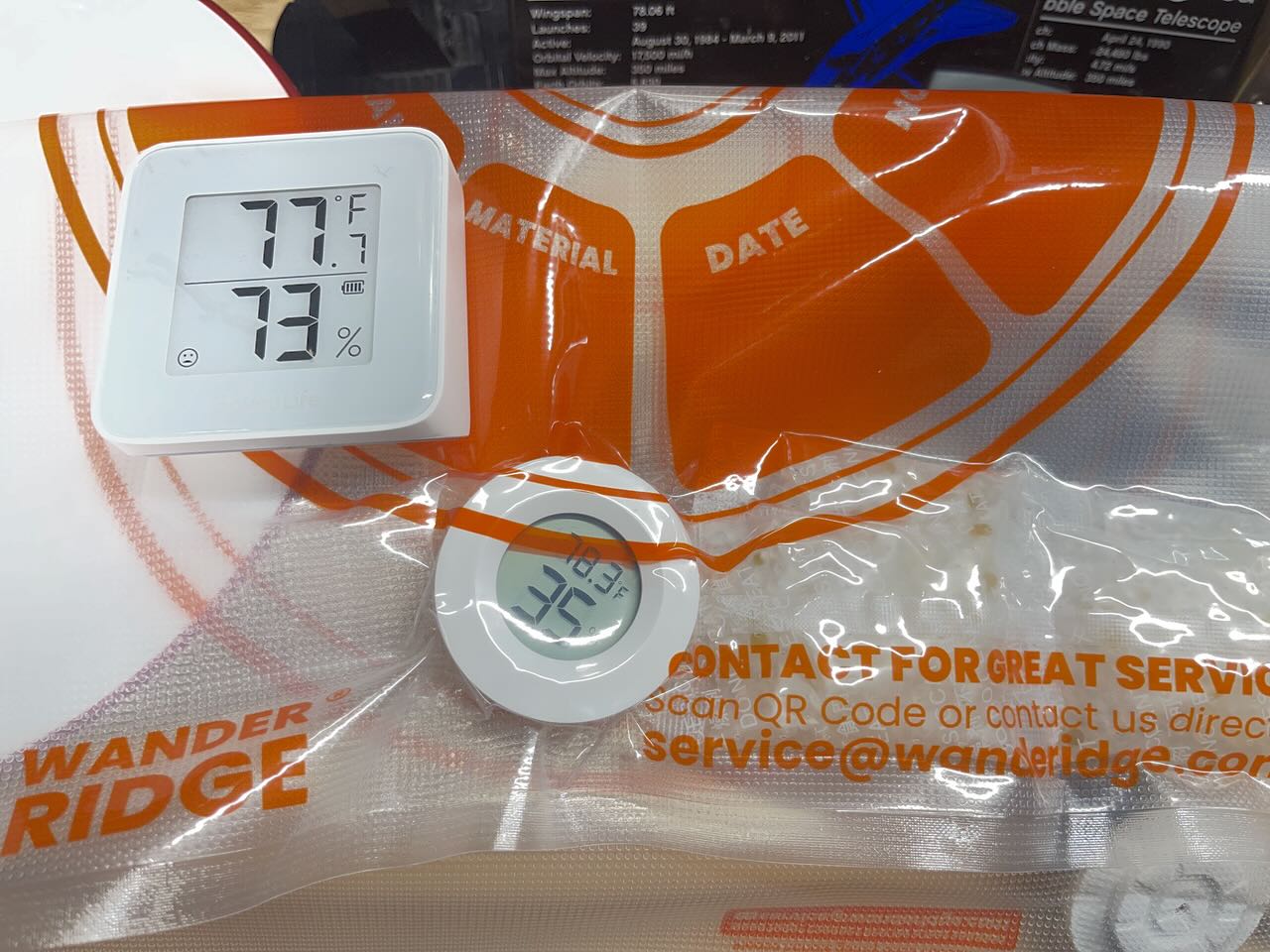
For giggles last week, I stuck a partially-recharged silica gel packet into one of the vacuum bags I use for filament, along with a cheap humidity sensor, and pumped out most of the air.
The ambient humidity has been ~70% lately. Within a few hours, the sensor in the bag was reading 25%. It stayed there for a few days. Then it started climbing back up; one morning I noticed it at 30, then 33 the next day, and 35% by last night.
I’m leaving it there to see if and how quickly it stabilizes at some value. Ultimately it should hit 70% (ambient) but I suspect it’s an asymptotic timeframe. Doubt I’ll have the patience to wait that long.
Summary:
1 week at 70% ambient humidity
25% humidity at start
35% humidity at end
and the vacuum bag has not leaked.
Conclusion: science was correct and water migrates through plastic just fine. Darn you, science.
PS – follow up on the Wander Ridge bags – after the first two that didn’t hold a seal I haven’t had any trouble with the others. So the failure rate is, at least for the two boxes I bought, much better than the blue ring style.
A savings/discount is not a savings if you don’t need the filament. I’m mostly focusing my comments on these pictures of literally probably collections of 100 + spool type images I see posted. It is actually sound business practice. If Bambu Labs data says they sell 50 printers per month on average with expected increases around Christmas for example, they aren’t going to fill a warehouse with 1000 printers
If you zoom in on those photos of 100+ filaments, I’d wager that most of the photos aren’t of 100+ new and not-yet-used filaments. Most often it includes a sizeable percentage of partially used filaments. That’s why they accumulate. As they accumulate over time, the numbers get large. I’m guilty of this as well. If I have the space, I tend to hold on to a partial spool of some unusual filament probably far longer than I should, “just in case” I might need it in the future. The money is spent, so if I have the space and didn’t need to concern myself with keeping it dry, it’s technically a free option. Or so I tell myself… But when I factor in maintaining that dryness, it’s not so free anymore.
 But when I factor in maintaining that dryness, it’s not so free anymore.