I was checking out something unrelated and stumbled across this video. It’s a discussion of a homebuilt aircraft crash that luckily wasn’t fatal but easily could have been.
Somebody was going to fly-ins and selling a 3D-printed air intake piece for certain aircraft engines claiming strength, light weight, and temperature resistance. They claimed it was carbon fiber-filled ABS.
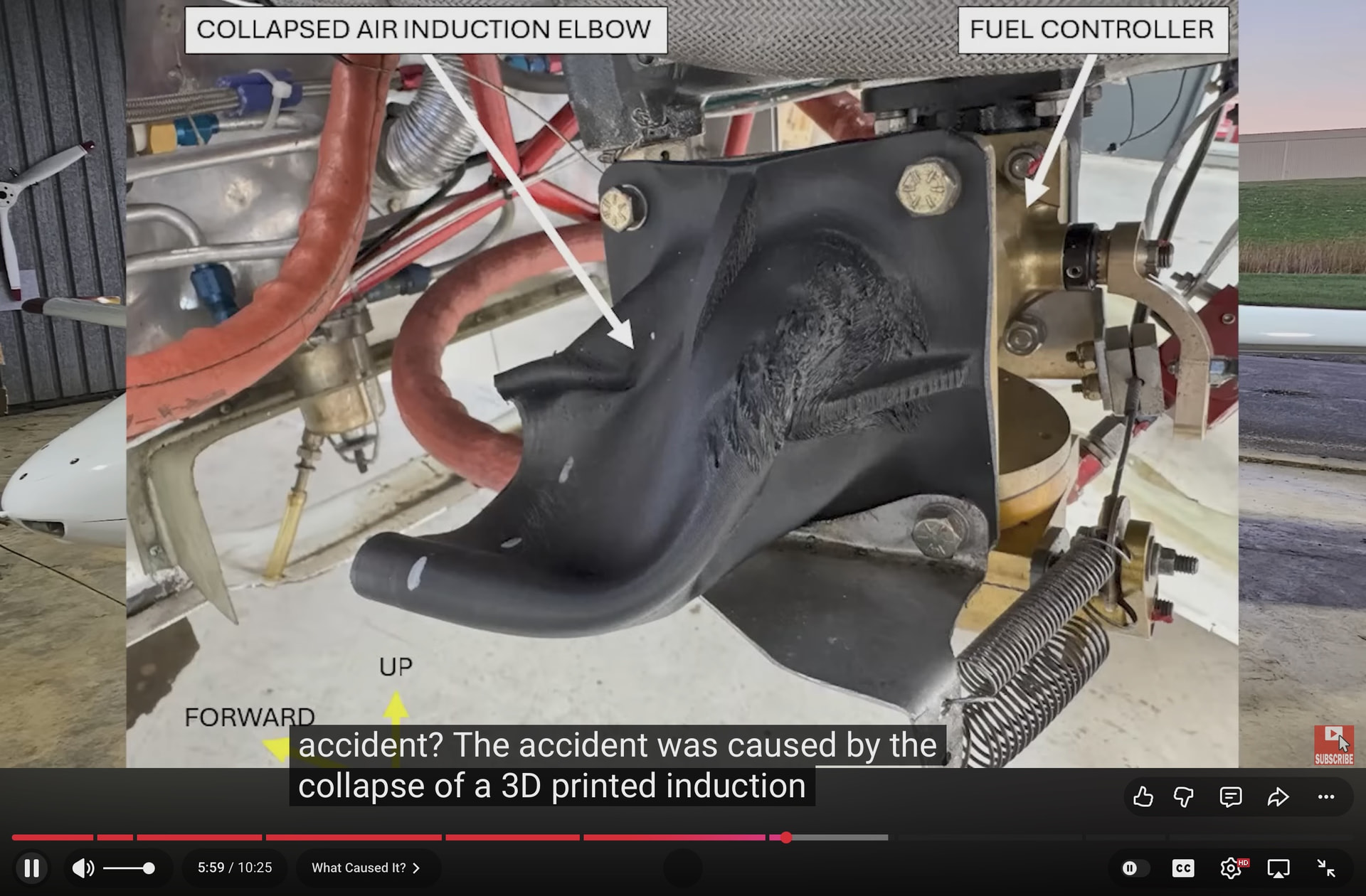
It turns out it wasn’t ABS at all. It was PLA and during a flight the engine compartment got warm enough that the PLA softened and collapsed from the pressure differential across it. With no air the engine quit and the pilot was only able to glide to the airport but crashed into runway approach lighting.
I doubt the person selling the parts is here, but for (name your diety’s) sake, you don’t 3D print important aircraft parts - especially engine parts - out of the wrong plastic and even then, make sure plastic is even appropriate. Go substituting 3D prints for critical parts and you can endanger your own life or others.
The swapping of PLA for ABS should have been obvious to anyone skilled with ABS and PLA so I can only assume the swapping was intentional and the person selling the parts thought it could make printing easier and “mo money, mo money, mo money”. It’s for an induction part so not really hot right? They failed on about every aspect of making something safe for sale and nearly killed someone.
There’s likely a number of aircraft out there with this same time bomb ticking away. The person who decided PLA = ABS could still kill people with this. It wasn’t even a good print. There’s support defects big time visible in the photo. Likely just some inexperienced clown with a 3D printer that thought he could pay for his trips to fly-ins. Bad print out of the wrong material sold for aircraft use. What could go wrong?
Here’s the after crash photo of the collapsed intake part and a link to a video about the crash. Video is from last December. That flattened area is supposed to be a tube.
This is not the topic I expected based on the title. Additive manufacturing is used all the time in the aerospace industry. I was hoping to read something awe inspiring.
3d printing and aviation is still great. I made a IFR gauge mounting set for by buddy’s Cessna 132 last year. But messing with engine components (especially on a single engine aircraft) is dangerous and idiotic.
On one hand: wow, what ignorance, malice, and greed; and he will get away with it too.
One the other hand: who the ■■■■ buys untested safety critical parts from the back of a van, suckers truly are born every minute. I guess these rich kids with planes have never had the life experience of the “stereo van” in the back of the parking lot.
I don’t know about the UK, but in the US FAR 21.303(b)(2) allows non-certified parts to go on certain aircraft, provided the owner meaningfully participates in the fabrication of the parts - meaning they can’t just buy the parts and slap them on. A similar rule might have prevented this in the UK.
That said, if the aircraft was registered as experimental, pretty much anything goes.
While I agree whoever fabricated the part should face consequences, in private aviation it’s always on the owner/operator to work with certified A&P mechanics and those mechanics would never risk their license putting parts of unknown provenance on an aircraft.
So the owner was either going the experimental aircraft route and failed to do their due diligence, or there’s a much bigger problem.
Oh, I actually heard about that story, and it can really be summed up in a nutshell: Parts that keep you alive? Don’t 3D print or buy 3D-printed parts.
I don’t buy my car brakes on AliExpress or print out my own brake pads, either.
On the other hand… there were also companies that got into the U-boat business with a cheap gaming controller… we all know how that ended.
Strictly speaking, this doesn’t even have anything to do with 3D printing - it’s just people shooting at their own lives as well as those of others. In the past, this was called a crime; today, it’s often referred to as “temporary prototyping”.
They were basically at the depth of the Titanic when the sub imploded.
The Titanic is at about 12,500 feet/3800 meters at a pressure of around 380 to 400 atmospheres - about 6000 psi.
So the air and people in that sub went from 1 atmosphere (or a few depending on if pressurized) to around 400 atmospheres as the water collapsed and breached the hull.
A 25:1 diesel engine compression ratio is considered high with 23:1 more common. That 25:1 would be like a hull collapse at a much shallower depth and result in pressure heating to around 900F. The occupants in that sub were subjected to pressure around 16 times as high as what you get in an exotic diesel engine at top dead center.
Temperature in that sub would have skyrocketed in that instant and some part of them likely combusted. If you compress air at 25C and 1 atmosphere to 400 atmospheres, it heats to around 2500F - about 1/4 the temperature of the surface of the sun.
But it was all over so fast they wouldn’t have seen or felt anything. As far as they knew, one moment they were there and then time stopped.