Adventures in using the cutter tool without a birds eye view camera

I’ve been really frustrated trying to use the cutting tool and drawing tool. It seems like no one really knows how to use the Bambu Suite software because whenever I ask questions like how does it know where to cut on a printed labels paper, nobody can answer. No one knows! I asked someone if it used a paper printer to print the design with marks it can read in order to cut them and was told yes that is how it does it. Nope. Then I thought maybe the nozzle camera scanned the printed design paper area but nope! It cuts blindly!

You have to put the paper in the exact spot with the perfect size settings or else it cuts wrong. You’d think it would be easy to import a “11 x 8.5” paper with labels on it, and that it would find the labels easily on a transparent png without messing too much with setting, set the paper size, line up the paper on the plate, and cut. But no it is not so simple, especially w/o the bird’s eye view camera.

First, it imports my 11 x 8.5 design huge! Probably because it is 600dpi. So I size it manually entering paper size in mm to resize the design sheet. You cannot tell the program that you will be printing on 11” x 8.5” paper until the prepare step and doing that sometimes does nothing. In every single other graphic design program sizing your canvas is the first step. Not here. The area where the laser works is overlayed on top of the area marking where the cutter cuts. It doesn’t matter if you have no laser. So I finally get the program to correctly trace my labels without selecting inside the labels which it loves to do. Then it tells me I can’t go to make because it is too big?? 11” x 8.5” is too big?? It’s inside the marked area! So I decide to just cut one label by cropping it. I go to prepare and for some reason it has TURNED the design while keeping the paper horizontal! So I turn the design label back using shift and the mouse, and it snaps back. It will not turn the label back to its rightful previous position. I go back to the main screen and the design is turned normal, but I go again to the prepare screen and it is turned. Well if the design is turned but the paper is not, it is not going to cut correctly. So I quit the project.

Somehow I was able to restart the process over and got it to cut the 2 design labels at the correct size in the prepare/preview and get ready to hit make. I put the paper in the left top spot just like it is on the screen. Hit make but it cuts way over to the left. Since I do not have the bird’s eye camera, and the firmware to allow it on a non-laser H2D is not here yet, I cannot properly line up the paper exactly. I give up.

So basically the software is only good for creating designs on it like making words and using the picture library and cutting them out on colored paper for birthday parties. As graphic design software it is poor so I’m not going to design anything on it. I have only seen people use this thing to cut example images. Seriously I have seen no one actually use this thing for a real project which I tried to do with 2 different projects. $90 wasted. I regret buying this thing. I’m better off using my metal paper cutting machine or scissors.
Yeah, everyone agrees it sucks rn. Only advice I have is wait for the firmware to get good. All the hardware the printer needs for proper cutting calibration is (like you said) already there using the toolhead’s camera, and it can just calibrate itself as though it were doing a 3D print, but surprisingly it doesn’t. The cutting and laser stuff is all Bambulab’s little “experiment”, and the best part? its not you.

If you aren’t willing to wait that long for Bambu suite and the H2 firmware to get upgraded, learn coding or something, bc its gonna take a lotta time for Bambu to finally learn how cutters and laser cutters work, and if you or someone you know already did, do some tinkering. Maybe Bambu printers aren’t the best when it comes with that kinda stuff, but 3D printing at its core is tinkering, and you can’t change that.

(PS, if you give up, just return the cutter add-on and get a dedicated miller or laser cutter)

2 Likes

Make a “jig”.

Whatever artwork you want to cut, surround it by a rectangle. When you go to do the cutting, tape some paper down and cut just the rectangle. That’ll leave you with a hole. Align the material you intend to cut with the hole you just made. Cut it.

Alignment should be guaranteed without having to have an accurate absolute position reference.

This is how I do stuff with my laser cutter. Which has a camera. Ruined one job with a slight misalignment and I refused to trust it ever again. So I just tape a piece of cardboard down and cut a rectangle that bounds what I want to engrave, and then I drop the actual material in the opening and run the actual artwork. Works great.

8 Likes

@BambuLab released a course on Bambu Suite.
He explains what to do at the Academy Bambu. I’ll let you take a look.
Afterwards, we are still waiting for the “Bird Eyes” update which is announced by @SupportAssistant but without a release date.

1 Like

This is a really great tip!

2 Likes

I know, I can only speak on coming from my little cricut machine that I cut little symbols for my RC canopies, my name on the airplanes and decals for my car windows.

I installed the module, the bed, ran the calibration, opened Suite(excitedly) 3 times, and I’m short order, closed it each time. It’s far worse that working on Photoshop, illustrator, and I can’t even begin to, in my worst nightmare even bring cricut into this… I hope they improve it for “dummies” like me…

1 Like

Is this what you were trying to do? I even did not care about the placement of my sheet of paper which I skewed on purpose…

The only thing is… I played so much with the different options that I don’t remember how I did it :laughing: so I cannot give you a walkthrough yet. I will try again, recording my steps this time. I still need to improve my tracing options a bit…

2 Likes

OK, I’ve got it :wink:

I was messing around with many options but it’s actually very simple.

I recommend that you first add a thin frame around the labels that have white inner area connecting to the white background so that outline detection in Bambu Suite works well. I did not use a fancy editor but just Windows Paint.

  1. Open Bambu Studio and select “New Project”
  2. Load your picture
  3. Select “Edit in the pop-up menu
  4. The “Auto Remove” tool should be selected by default, click in the background between 2 labels to set the background as transparent, click “Confirm”
  5. At the top left drop down list select “Print then Cut”
  6. Click “Prepare”
  7. Select your material
  8. Load your blank sticker sheet in your 2D printer
  9. Click “Make” then “OK, I know”
  10. Click “Send”
  11. Make sure your 2D printer is selected then click “Send”
  12. Go to your H2D and stick your printed label sheet on the bed .Do not worry too much about its placement, put it roughly so that the top left corner is aligned with the corner marked “blade” on the bed, the target points will be read by the toolhead camera to cut exactly where it needs to.
  13. Launch the task

Et voilà!

4 Likes

Man this is genius! Great idea I will try it!

1 Like

If you have read my walkthrough above before I edited it, forget it. I changed it a lot because I had totally messed up before… I edited it as it’s actually very simple, no need to precisely place the sheet on the bed, no need to trace anything, the cutting process will use the targets to cut at the right locations. It’s very straightforward.

The file I used (just a cut-out of your original file with a frame added around the 1st and 2nd row labels).

1 Like

The toolhead camera is used to locate the registration marks, not the birds eye.

I just minutes ago finished doing a print then cut with 8.5x11 iron on vinyl paper and used the sticker paper material preset. I had to clean my toolhead cam before it found the registration marks because I had too much smoke/dust on the cam from earlier work and it wasn’t seeing the registration marks.

Thanks man I really appreciate you trying to help me out but I got stuck at the edit part. The auto remove tool would not work. See video

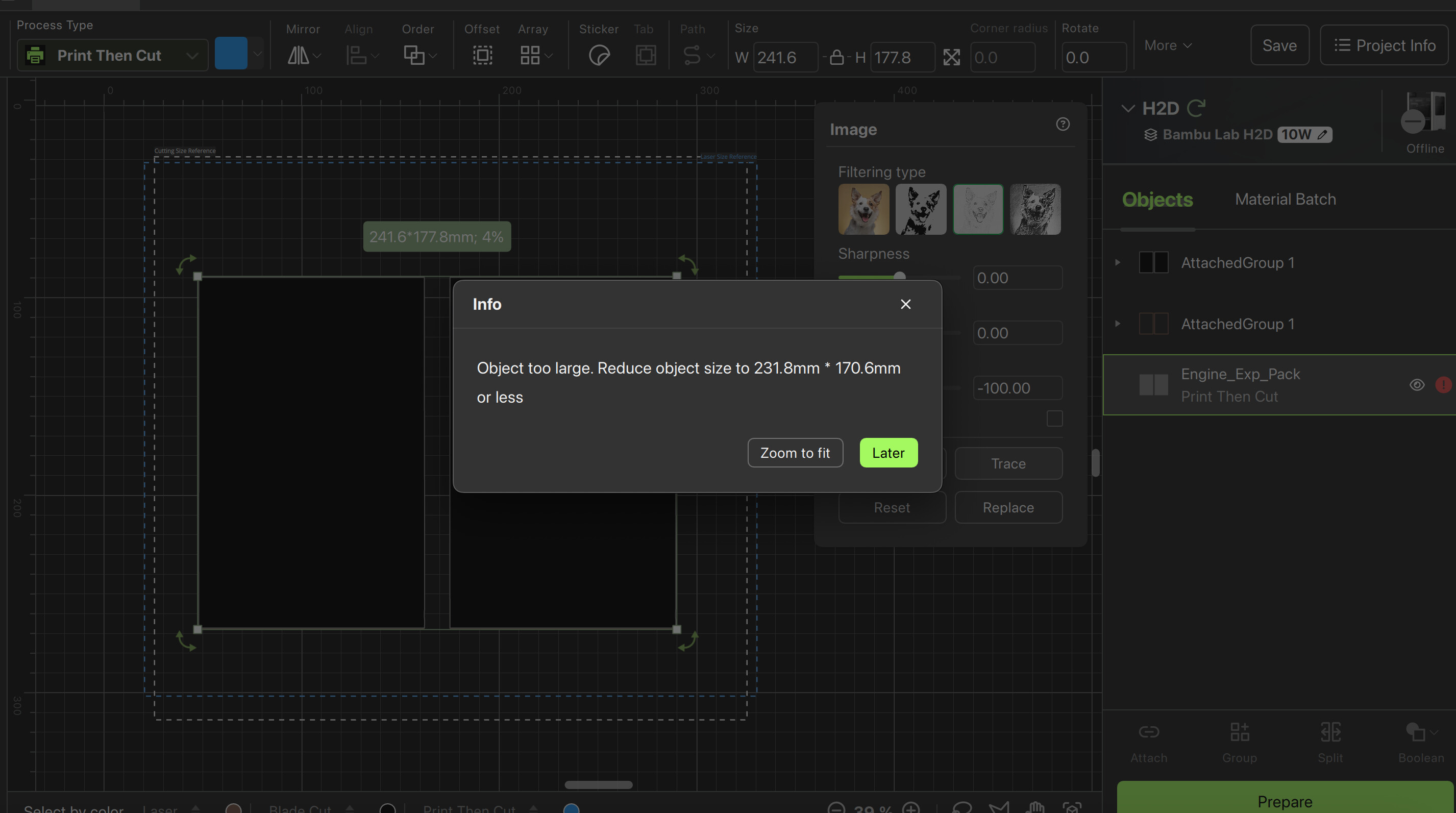
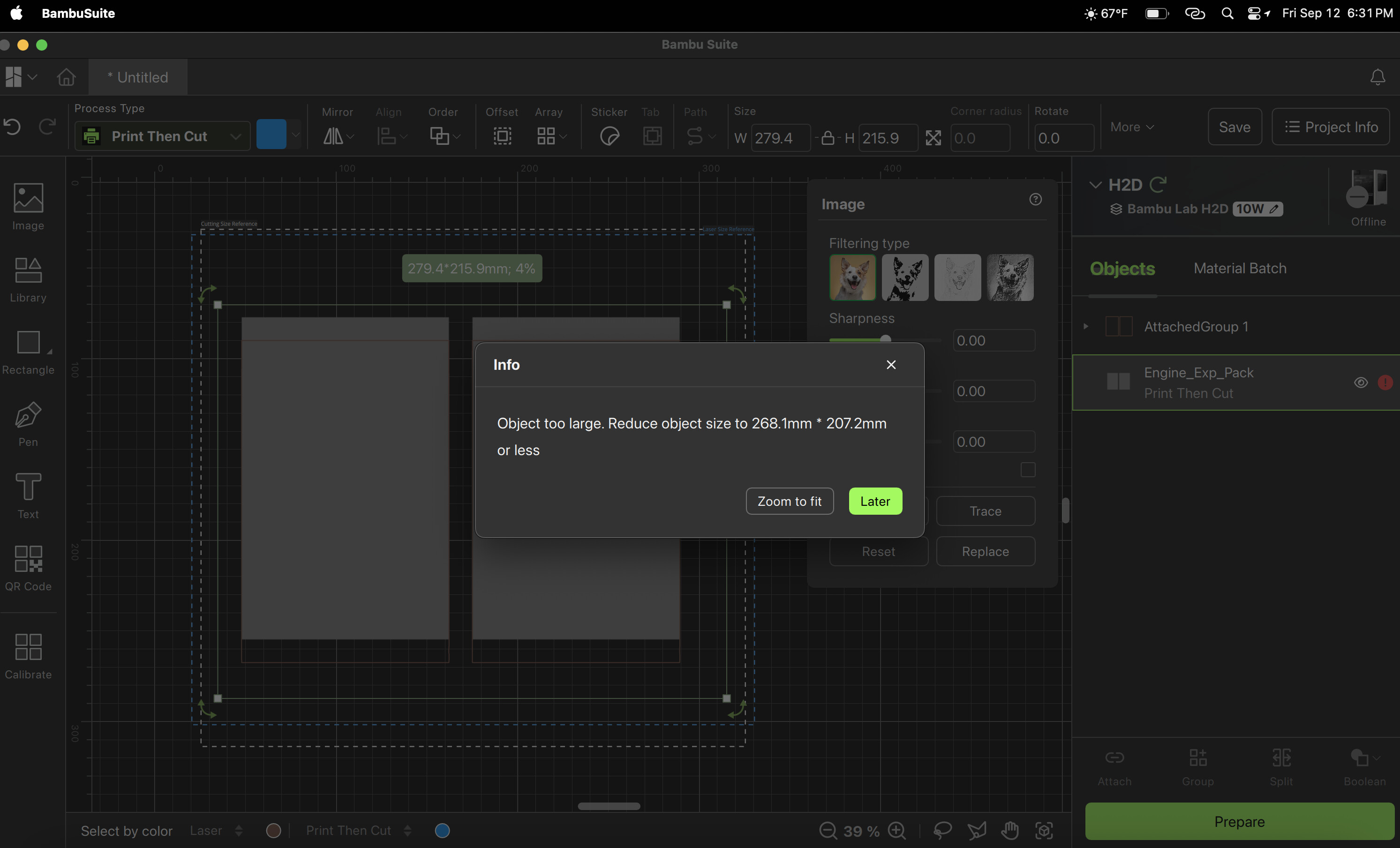
I’ll start from the beginning. I imported the labels, which are done on a 11” x 8” canvas at 600 dpi. This is done in order to print out at the perfect size onto the same size 11” x 8.5” paper. After importing it into Bambu Suite it tells me it’s too large because it imports it at a huge size perhaps due to being 600dpi. So I ignore the error and type in the size of a 11” x 8.5” paper in mm which is 215.9 x 279.4mm. This gets it within the marked work area.

Using edit I was not able to select the transparent background. Clicking it with the auto remove tool did nothing. So I had to cancel. I put the contrast all the way down making the labels gray so only they would trace. Then I got the error “object too large. Reduce to 228.4 x 176.5mm or less.”

I also converted the transparent png to vector format and doing that it traced the labels automatically on import.

I already finished the project by using scissors but still would be nice to have this figured out.


Here’s the project files including the Bambu Suite project file
https://drive.google.com/drive/folders/19Zr5u5i5dRw6yu7qlCPsgpYvjOzHcMBq

Yeah but in that case there was nothing to line up such as paper printed material. I have yet to experience the nozzle camera able to scan printed paper designed labels and cut correctly along the design.

I’m not sure how you did it but looking at your lac file, it seems you were overthinking it and used the trace tool to outline your label rather than just let the print and cut process to work, hence the laser line process in addition to the print and cut one

So let’s go back to basics :slight_smile: .

First, your image already has a transparent background, png or svg so no need to use the edit tool and remove the background as it’s already done (the checkered pattern is how you know it’s transparent).

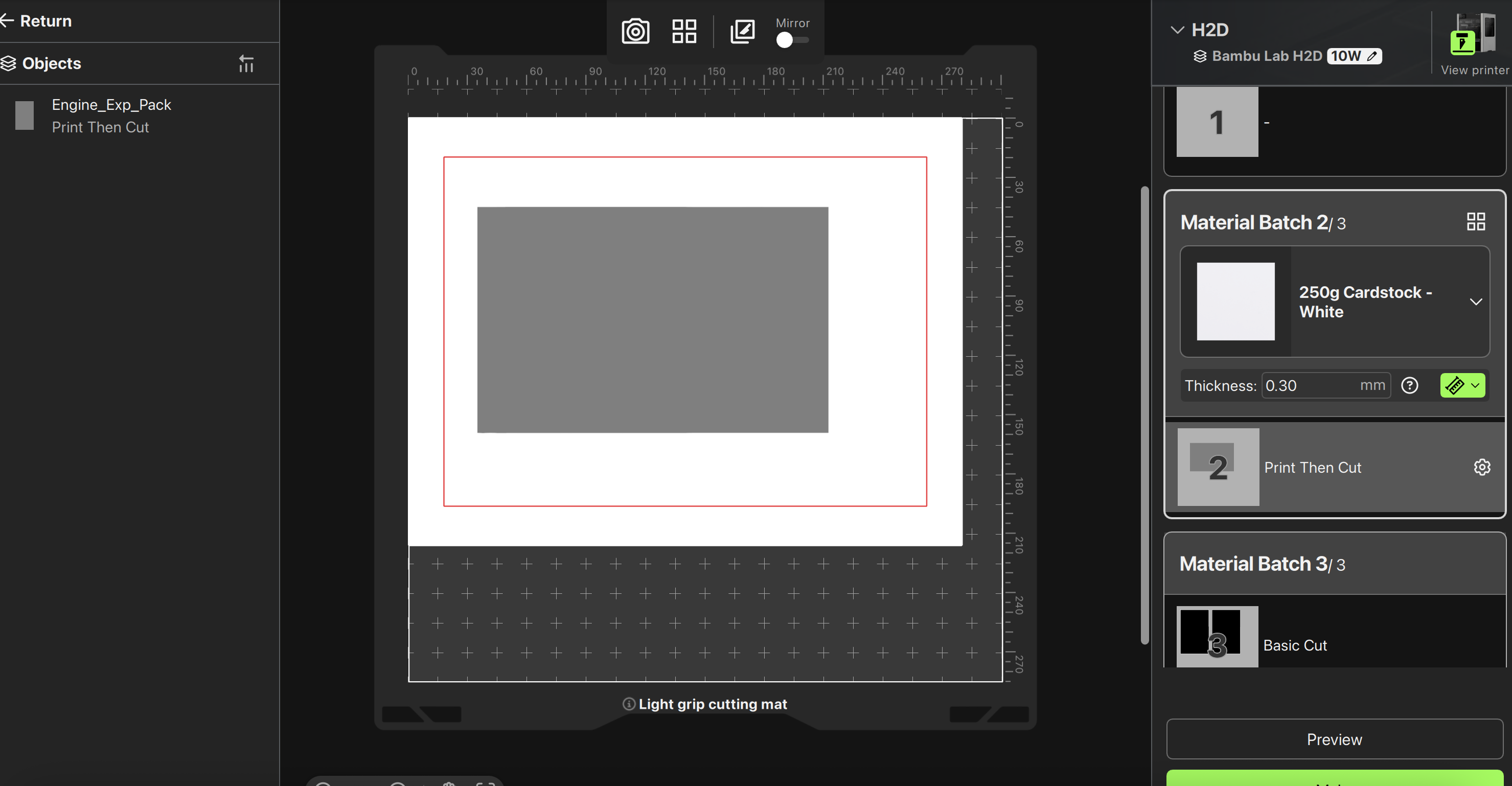
Second, given your answer in an other topic, it seems you misunderstood how the print and cut process works. It works in 2 steps, when you click make, it will first send the image to your 2D printer (your regular HP or epson or whatever) to print your image on a sheet of paper or in your case a letter format printable sticker paper. The 2D print will print the labels along with the calibration marks.

You will then stick that printed sticker sheet on the H2D cutting platform and lauch the cut, this is when the calibration process occurs, not in bambu suite. The camera will look for the calibration marks and will then cut around each individual label.

Re-read my process steps above which gives exactly (and only :slight_smile: ) what you need to do to make it work. I added 2 videos at the bottom of this post to show what the H2D will actually do, calibation and cutting.

As for the size, it is somewhat buggy. It requires resizing which is OK given your 600dpi original but you cannot size it to 279x216 (btw, letter size is actually rightly recognized as 279x216mm despite the prepare size option which is referenced as 297x216). If prior to import it in bambu studio, you resize the image to 8.5"x11" (279x216mm), you can import it, it will request resizing but you can size it to 279x216mm with “more” and it works.

Calibration Video

Cutting Video

Edit: now that i’m re-thinking it, the way you were trying to do it, is it because you already have you label sticker sheet printed (from a 3rd party sticker maker may be) and trying to cut that label sheet with the H2D? In this case it will require an entirely different process which I’m not sure will work with the BE camera alone when we could use it.

So in short the reference is given by the printed marks, readen by the printhead’s cam, not the birdseye one.
i imagine the plotter also can be used succesfully with just placing the paper straight on the surface

1 Like

Yes and yes :wink:

252525252525

1 Like

The image is that size already, at 600 DPI. But it imports at 1,746.2 x 1,349.4, so I have to resize it to 11" x 8.5" in millimeters, and it comes up with an error saying the size is too big. It WILL NOT allow me to continue to the next step unless I size it down further.

Sizing down messes up the sizing. In your image the labels are printed too small so it looks as if you sized them down or printed on larger paper. I designed the banner to specifically hit the end of 11" x 8.5" paper. If there is space after the banner it means it was printed at the wrong size, too small. Every label in the print is perfectly sized in millimeters to fit miniature bottles. If it is printed at the wrong size they will not fit.

I’ve never seen any option to print on a paper printer from Bambu Suite. By experimenting and sizing it down I’ve gone to prepare and then make and it just goes to cutting. Never asks to print on a paper printer.

OK, I will do it step by step and record my screen, hope it will help

OK, first of all, you’re right about the max size of the project, it seems eventhough you can select a A4 or a letter size (8.5"x11") sheet, the max size for the image is about 7"x9".

I did not notice that when I made my cut, I just used the size bambu suite wanted to use. When I tried again, it seemed to work but I must have selected laser line rather than print and cut. I think the max size is due to the positionning of the calibration marks, I hope this can be improved in future revision of the software but it now has its limits…

So, what I did and you can use my file for that, is to cut your label sheet in half. I did not use your SVG or PNG as eventhough I have Acrobat and Photoshop, I don’t master at all the software or the format… I then used the JPG file you posted a while back and worked with it (this format although lossy, I can work with :slight_smile: ).

As it’s a JPG format I also had to remove the background prior to prepare using the tool.

I attached it here for you to play with.

Below are the pictures of the print from my HP printer with the reference targets, the paper sheet on the H2D bed and the result. Below these I attached the screen capture of the process. You’ll notice I had to turn the picture lengthwise because I run into the same max limit if I kept it vertical. I sized the picture at 139.7mm which is exactly 5.5" to keep the original size of your labels.

Try it, play with it, if your 2D printer is on the same network I can’t see why you wouldn’t see that 2D printer pop-up.

Screencapture video

1 Like

good good, it has released now in eu, insta bought it with some transfer sheets, vinyl sticker sheets and also the heat transfer :+1: