Hi everyone!
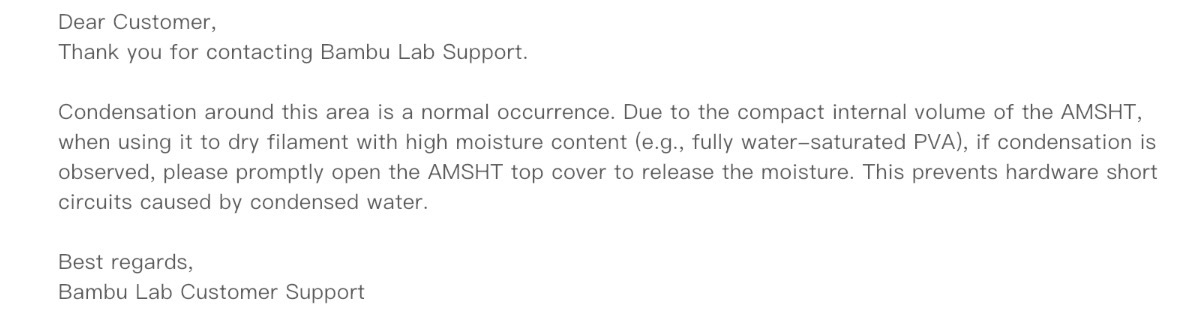
I received my ams ht last week. I wanted to dry some pva filament for supports, but when it has gone through 2-3h, the humidity is 50%, because the walls are full of water condensation. How can I solve this?
Hi everyone!
I received my ams ht last week. I wanted to dry some pva filament for supports, but when it has gone through 2-3h, the humidity is 50%, because the walls are full of water condensation. How can I solve this?
Wow, that’s pretty bad. Have you dried other filaments in the HT? Do you have any other way to dry?
I’ve not tried PVA, but so far I’ve given up on the HT as a dryer (but it might be useful as a steamer if I ever need that…  ). I got mine beginning of December '25 with H2C. When it was supposedly working, I “had to” open it up every hour or so to let out the moisture (the humidity reading would drop several % right away then slowly creep back up). I was getting good prints until part way through the rolls, then quality would drop and I’d need to re-dry (most noticed with PETG HF & Translucent). (It is winter here and very dry, room with printer is 15-25% already and all filament stored in vac bags/dry boxes/AMS with lots of alumina.) The issue seemed to get worse with the next batch of filament I bought ~3 weeks later.
Then after drying ~20 spools total (some high temperature, some not), the HT started throwing an error about the exhaust valve being “stuck or indeterminate.” Maybe it never exhausted correctly (I could hear valves clicking, but  ). When I went to get warranty service, turns out BL support has a whole category dedicated to the faulty exhaust valves (that can be selected as the reason for support request), so that tells me something also. They did send a replacement valve right away, but I haven’t been bothered to replace it yet (bought another dryer in the meantime).
Just my experience… not to turn this into a HT-bashing thread. But perhaps the exhaust on yours is faulty as well. And/or perhaps try venting it manually.
Cheers,
-Max
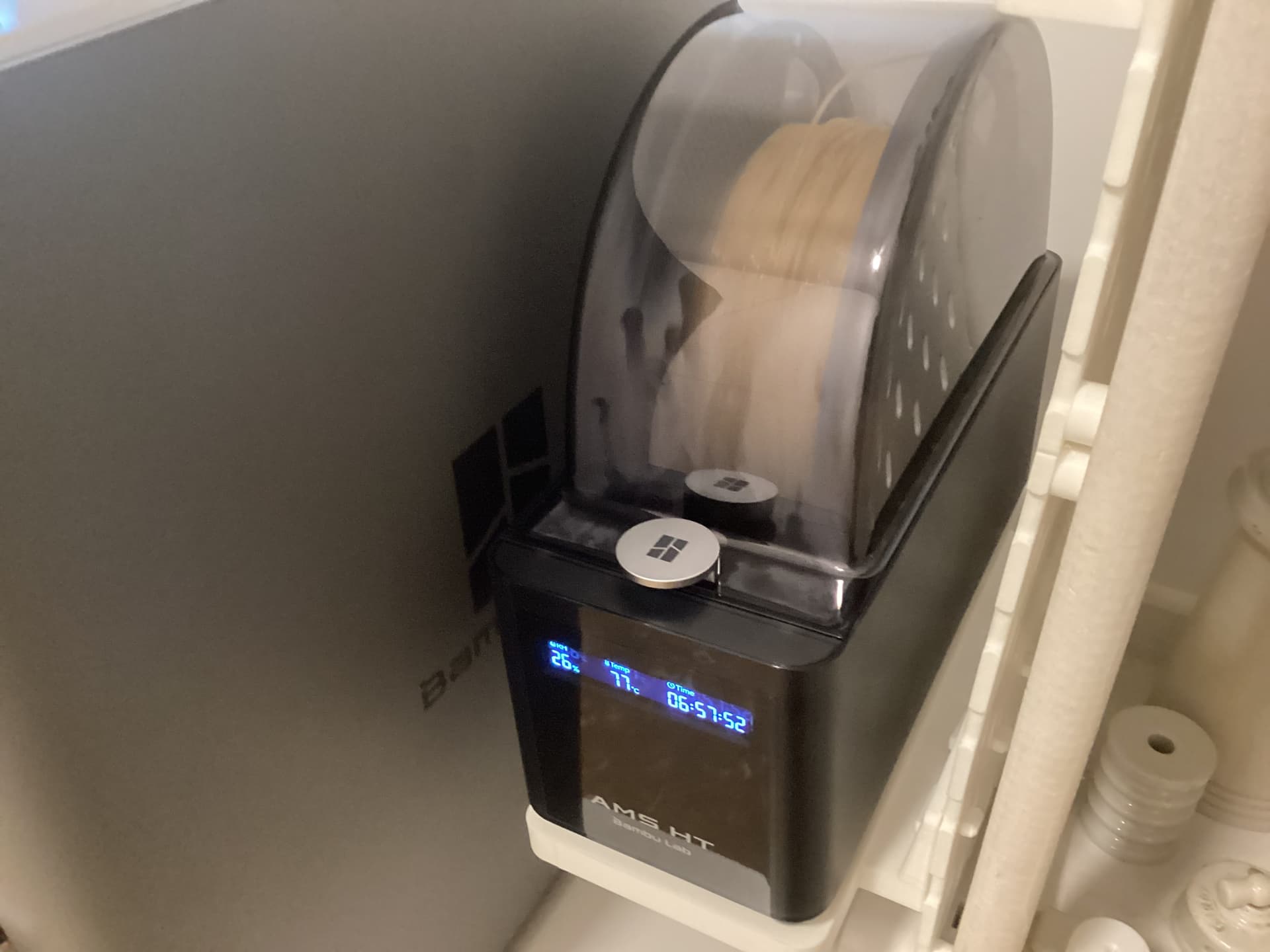
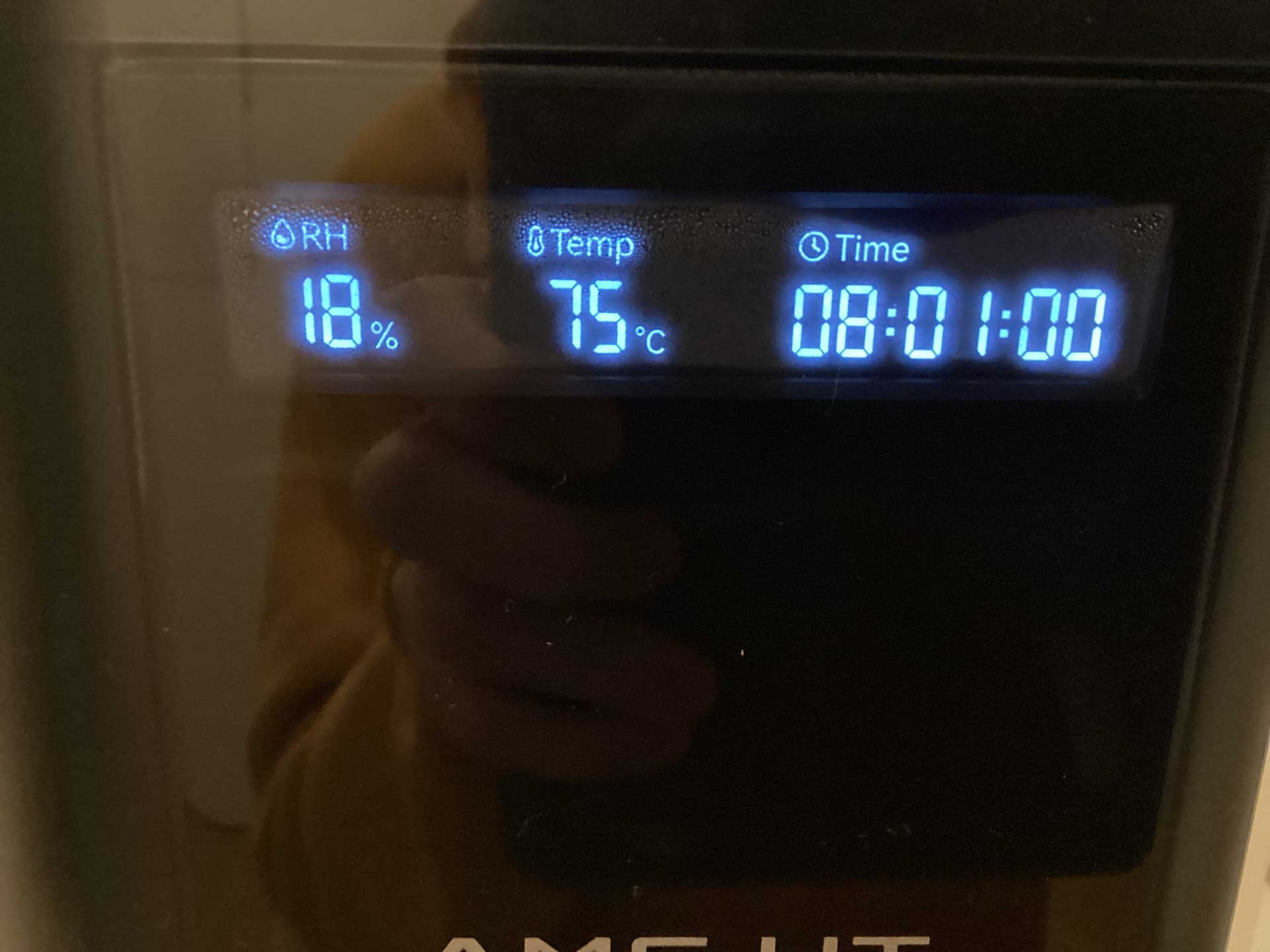
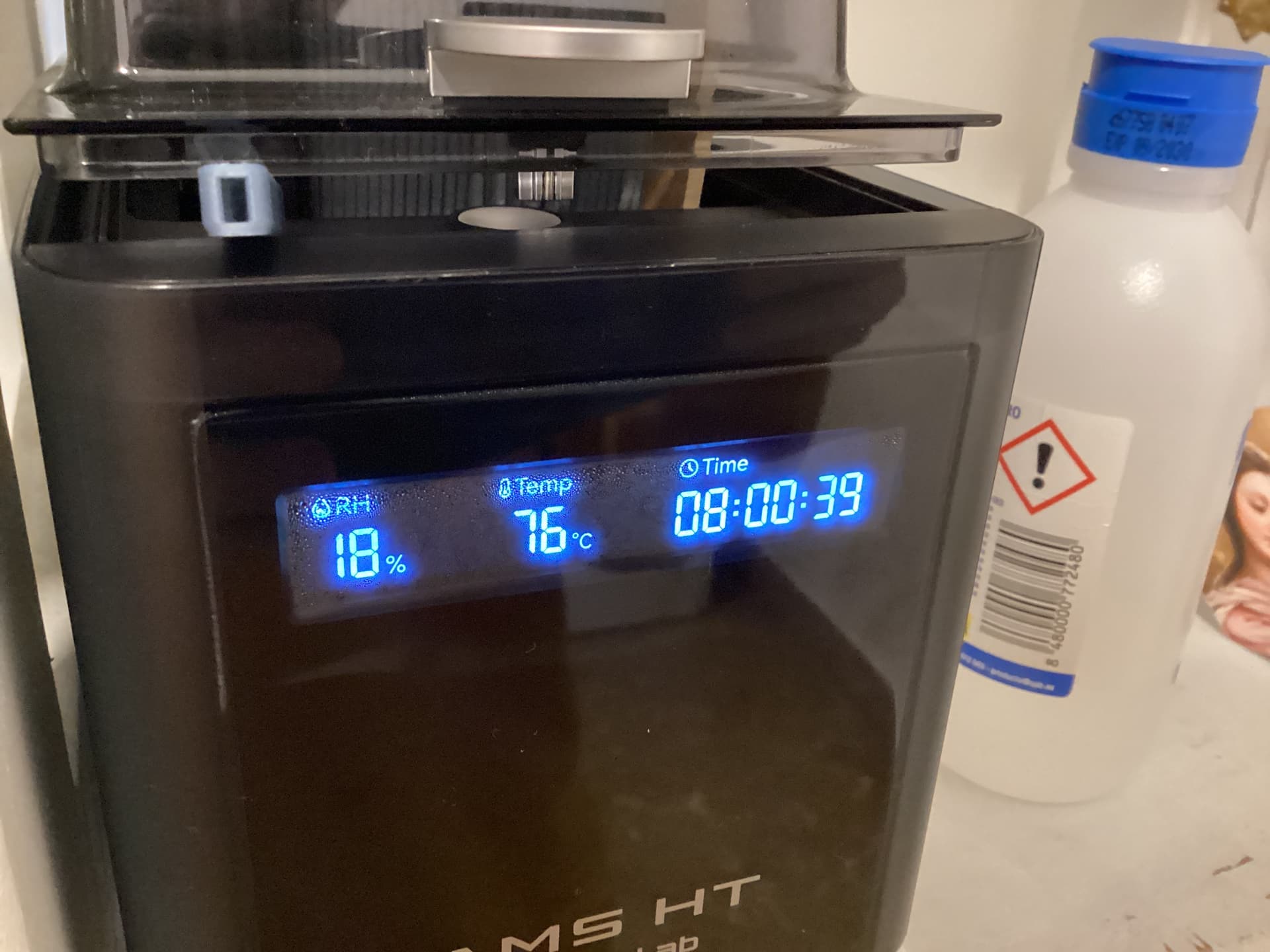
These are 3 of my 4 AMS HT units.
The left and middle units haven’t been opened for some time, but the right one has recently dried Gembird PVA to bone dry.
2-3 hours seems too short for a filament that absorbs water as readily as PVA does. Why did you only dry it for that duration?
Regarding your problem: remove your PVA and replace the desiccants with fresh ones. Run the AMS HT without a spool at maximum temperature for at least 24 hours to dry out the machine. After this, I would recommend checking your desiccants again just to be sure.
Then, place your PVA in the unit and run it as follows:
If your RH sensor is functioning correctly and providing accurate readings: set the temperature to 50-60°C for at least 12 hours (weigh the spool before and after the 12 hours). If it has lost weight, run it for 6 more hours and perform another weight measurement. Repeat this process until there is no further weight loss.
Normally, opened PVA should be dried according to the manufacturer’s recommendations. This is typically at 50-80°C, depending on the specific PVA formulation, for approximately 4-12 hours.
However, it seems unusual that you’re experiencing condensation on the inside of the unit, as PVA becomes sticky as ■■■■ when wet, which you can easily detect by touching the filament.
My HT never shows <10%. With fresh desiccant packets and a can of activated alumina in a spool of dried (or drying) filament. Or w/out anything in it. In a room that is already like a desert. In contrast the AMS 2 Pro next to it often goes down to 0% and is almost always < 10% (by its built-in hygrometer). Which is what I’d expect given the environment and amount of desiccant in there. Perhaps the valve on mine is stuck open, though that doesn’t explain the humidity buildup I observed while drying. I’ve read here other people reporting similar buildup while drying in the HT, though not to the point of condensation. Or the hygrometer is just off… haven’t seen specs for that anywhere… is it even accurate when that low?
-Max
What i meant is that i would set it for 18h and at the 2-3 h, the walls would be very wet.
The dessicant was new, just opened
RH is not very meaningful in this context, as it does not tell you how much moisture is actually present in the system. AH is the key parameter here, as has been discussed on the forum before.
I have never claimed that my sensors are perfectly accurate, but when I insert a newly opened spool, without changing temperature or anything else, the indicated RH quickly rises to above 20%. However, this only reflects how saturated the air inside the system is and does not by itself provide any truly useful information. What I do know is that my spools are dry, because I weigh them before and after drying.
Also worth noting: activated alumina will release part of the moisture it has adsorbed when you increase the temperature, since that is exactly how these desiccants are regenerated. So if you heat up the system to dry the filament, you are not only driving moisture out of the filament, you are also driving moisture out of the alumina itself, which affects the moisture balance in a closed volume.
In short, both silica gel and activated alumina are solid desiccants, but they behave a bit differently when heated. Silica gel typically regenerates well at relatively moderate temperatures and has good capacity at lower humidities, while activated alumina is more thermally robust, can handle higher temperatures, and is often used where frequent high‑temperature regeneration is expected.
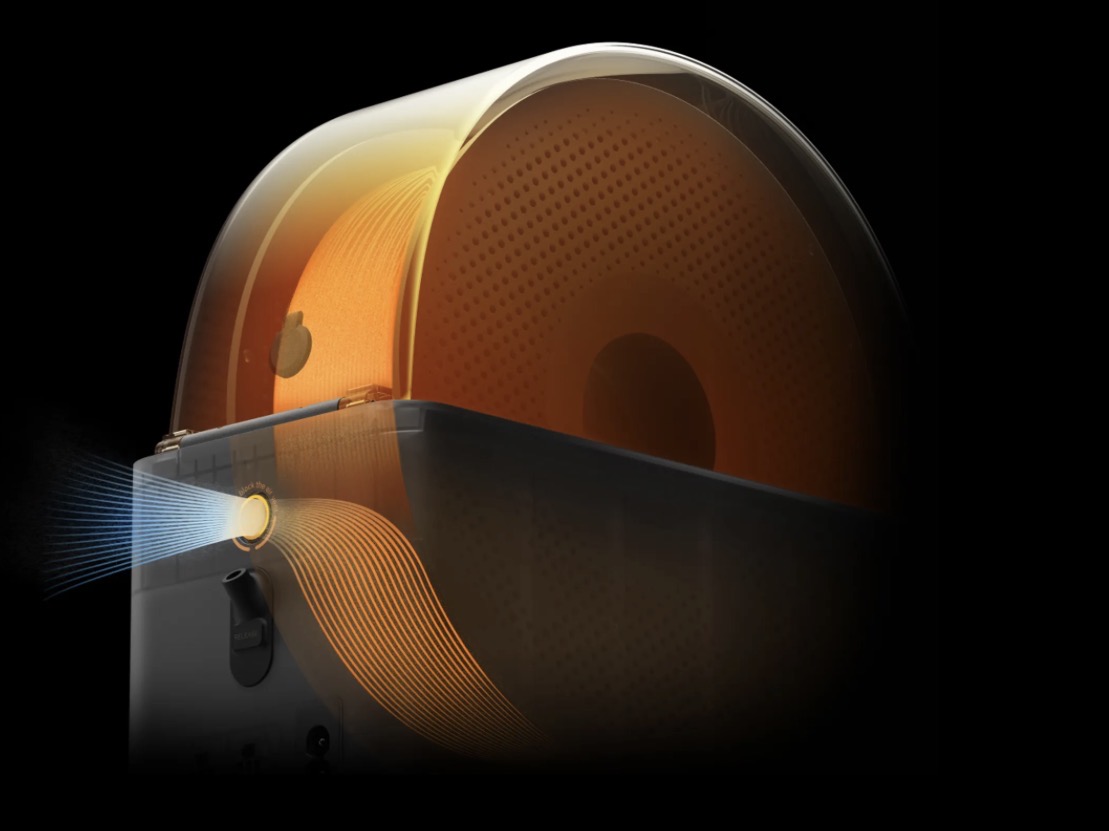
double check if both vents are open
I had a vent that got stuck and unit filled with condensation when drying filament
and how did you solve it?
It actually does provide useful information but there is a big caveat. RH and AH are related by temperature. If you make your RH measurements at the same temperature you can compare them directly.
That weight difference method has a dangerous hidden issue. All it tells you is how much weight was lost. It’s not related directly to filament moisture. If you know your drying technique removes enough water to print well then you can use it just fine. But if a drying technique is unknown for that, a zero weight difference can happen because the drying techniques doesn’t work well and it can’t remove any more water.
Especially for people trying to troubleshoot drying, the weight difference method can give misleading information and have people thinking their drying is good when it may actually not be.
Bambulab sent me a new vent and I installed it.
In the interim, you can slide the vent open and then block the vent open with a piece of teflon tube
I actually had beads of water inside the base unit on the walls while trying to dry some very wet dessicant.
On the weight part: what I am doing is just a simple loss‑on‑drying measurement. You weigh the spool, dry it at a defined temperature and time, and weigh again – the mass difference is dominated by water loss for PLA at around 50–55 °C, which is exactly how gravimetric moisture methods for plastics are defined in industry standards (loss in weight before/after drying).
If I repeat the same drying process and the weight no longer decreases, and the material prints without typical moisture artefacts (popping, heavy stringing, poor surface), then for that process the filament is effectively “dry enough”.
You are absolutely right that this is not an absolute ppm moisture measurement and that a zero weight change with an unknown or insufficient drying routine can be misleading, but that’s a limitation of how the process is set up – not of the weighing principle itself
I completely agree. The problem comes in with drying setups that are inadequate. They also reach a point where the weight stops changing but that might not produce well-dried filament.
And absolutely, weight loss is used in many standard laboratory tests. I used to do them. The thing there though is procedures and equipment are specified such that the end result tells you what you want to know accurately about water content (or whatever you are doing gravimetrically).
I think I can say without exception that the weight loss/difference method is presented in this forum without the qualifying information to allow others to duplicate results with good numbers. Not even any caveats. It’s presented as simple and infallible and even as a way to troubleshoot drying which it really can’t do.
As long as people know their drying technique produces sufficiently dry filament, the weight difference technique is fine, simple, etc. But it’s inappropriate for those that are trying to sort print problems that could be from moisture if they don’t have known-effective drying nailed.
The thing that got me was the phrasing: “What I do know is that my spools are dry, because I weigh them before and after drying.” Technically you know they are dry because you know your drying technique reliably produces filament dry enough to print well and you just use weight difference to know when it’s done.
I know that seems to be a picky distinction but it seems the more informative way of saying it. Unfortunately this weight difference stuff took a wrong turn when some thought a zero weight difference was itself proof that filament was dry when all it is is an endpoint for known-effective drying. With drying that can’t produce sufficiently-dry spools it gives bad answers.
Cheers!
Did you file a support ticket? Seems clear that the venting isn’t working. Like I said they have a whole support category for broken vents, so I’m guessing it’s fairly common.
Though I guess no-one asked yet… are the round vent holes on the bottom and back free and clear of obstruction? Or packing tape (don’t remember them having any but maybe). There are also the grilles on the inside bottom at front and back which it is supposed to vent through… nothing covering those.
In another thread someone mentioned packing tape that was left on the humidity sensor inside the unit, presumably during assembly, which made the hygro readings be off. Wonder if someone left tape over the vents inside or something… might be worth taking a look. But I’d ask support first.
https://wiki.bambulab.com/en/ams-ht/maintenance/disassembly-and-assembly
-Max
I’m sorry to hear that. If you’re doing everything right with that unit then that sounds like some BL BS to me. Earlier here someone posted that BL replaced a vent on their unit. W/out knowing intricacies of both situation, seems like same issue with a stuck valve. And seems obvious this is a problematic part of the unit.
Before the vent officially died on mine I was putting it up on blocks so the vent underneath had more breathing space. It seemed to help a little, but mine never got that extremely wet either. I guess they put that intake vent on the bottom so it gets a little “heat exchanger” effect from all the heat leaking out of the HT and getting trapped underneath…
I already expressed my opinion of the HT as a dryer, and opening it up for my own vent issue didn’t help. The smell of overheated electronics inside actually overpowers the smell of hot/baked plastic, which is saying a lot. The thing has zero insulation. Baking it at high temperatures is not going to do anything for it’s longevity as an AMS. TBH it’s the only BL purchase so far I mildly regret… ended up getting another dryer anyway and this HT could have been another AMS 2 instead. Oh well, relatively minor for me in the scheme of things, but I imagine others may feel differently.
I hope you can resolve this!
-Max
i undersand you, but I mostly print in PETG, ASA, PA, TPU…, and I wanted something to dry it well and act as AMS
The first gen filament driers all seemed to have insufficient “exhaust of saturated air” - because that means they needed higher and more balanced heat to replenish it - $$ - and so we used to just drill holes in the case to add some extra flow. Problematic for storage, but sure solved the problem during drying.