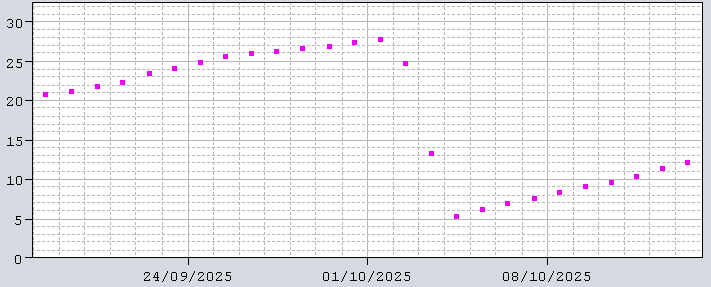
I only use my X1C occasionally. The AMS2 Pro remains closed for days, with additional ~200g of silica gel dried in oven and dried filaments inside. After an AMS’s drying cycle, the humidity is reduced considerably, but starts to increase regularly a bit less than 1% point per day. I built a wireless humidity logger for this purpose, and its readings match the printer’s value pretty well. Room humidity is 50-60%.
Do you observe a constant humidity rate with a closed, idle AMS 2 Pro for weeks, meaning that my AMS must be leaking somewhere? Or is this behavior normal?
FYI, I tried disconnecting the tube that goes from the AMS to the printer, closing its open end, to see if that was the source of the leak, but it didn’t change anything.
Here is a picture: One point equals one daily average value and the graph includes one drying cycle:
Is there nobody willing to share their experience of how well their AMS holds low humidity over time?
I have the original AMS and it does slowly draw moisture. I just take it as a fact and I keep track when it hist 20% I redry all my filaments and change all the dessicant.
Assuming your monitoring are on an empty AMS so there is no possibility of moisture migrateing out of filament or spools I would think you would get change over time just from changes in the surrounding air and temp changes/fluctuations. Just running the dryer seems like that would increase the pressure in the AMS which would fall as things cooled which would slowly bring in air from the outside. All speculation on my part.
OK, so I’m not the only one doing this 
Could you tell how often you need to dry approximately?
FYI, I am monitoring my AMS with 3 spools in it currently. But they have been dried before.
I am also monitoring the ambient temperature & humidity and they both go up and down while the AMS humidity is steadily climbing.
The AMS is not at all that airtight that running the dryer would increase the internal pressure.
Again theory, but unless drying a (full) spool of filament actually dries it equally from filament end to filament end I posit that there is a good chance that the filament near the spool core and close to the center (away from the edges) can have a higher moisture content then the top layers (wieghing during drying rather than really on a time factor can probably help offset that). So as you are printing and get down to those layers there can be some moisture transfer to the dryer AMS air. And if you are using cardboard or fiberboard spools there is an even greater potential.
The fact that the AMS is not airtight just allows for an air exchange. Heating the air in the AMS will elevate the pressure a little (even if the exchange is not enough to give a shower curtain effect), warm air expands and holds more moisture.
If the humidity in the AMS never goes higher than the surrounding room then you are proabably just looking at air leakage.
If you leave the AMS unused for a period of time, and you have the additional desiccant holders at the front , be warned!
The desiccant in mine liquidised, flowed through the Ams and caused an awful mess that was difficult to clean up.
Also I think it’s a corrosive salt that may well destroy the chip legs over time.
I wait to see.
Are you talking about silica gel (solid grains) or the older type that comes in powder form?
I have lots of silca gel bags from old packages that are many years old, and there has never been any leakage.
Hi
It was the beads placed into printed (from makers world)containers placed at the front of the Ams.
First I thought they had absorbed too much water. But I had just had the Ams on a dry cycle overnight; next morning Bambu studio reported AMS heater 2 having abnormal heater readings.
On inspection the unit was super hot.
I think that it must have got super hot and melted the beads.
It’s still under warranty but other than the heater I doubt I can make a claim.
I can now only use slots 3and 4. 1 &2 are reporting lack of signal
Interesting. May I ask where did you get your beads from / what is written on the container? Because silica gel melts above 1600˚C.