@krellboy@MZip
According to Grok the oxygen concentrator retrofit would work with 4A, but activated alumina would be better. Without modification it might run for months before the alumina needed removal for baking. A more proper modification would involve replacing a fixed orfice with a needle valve so you could dial-in a larger amount of purge air, and you’d want to increase the time between switching between the cylinders. If those last two conversions are already baked into @krellboy’s ebay find, maybe that would be the easier conversion.
An alternative might be to pass through oxygen concentrator’s dry output through one side of a membrane as a sweep gas to pull moisture out of an ambient airstream on the other side. That would be an indirect way to get leverage the oxygen concentrator to get dry air without the concetrated oxygen. Or, apparently, the more usual way is to apply a vacuum to the sweep side and skip the oxygen generator altogether. Or you put the wet side under pressure. Doesn’t seem to matter: what you need is the pressure difference. If you were to buy these membranes new, they would usually be cost prohibitive. The surplus market on ebay might afford an opportunity around that if you can adapt to what’s available.
The membrane I referenced, when put under pressure would eat through 50L of air per minute. You can throw away the unused part, but because it’s driven by the pressure difference, you can’t really throttle it. The smallest unit in that line is 10L per minute, which is still way more than I’d need, but at least it wouldn’t be as demanding on a compressor. A filter matched to 1L per minute would be ideal, but allegedly not available from that manufacturer.
Dalton’s law of partial pressures. The only thing flowing a gas gets you (which is significant) is there wouldn’t need to be a big pressure differential. For water there still is a big pressure differential since one side would be dry, but gross pressures could be equal.
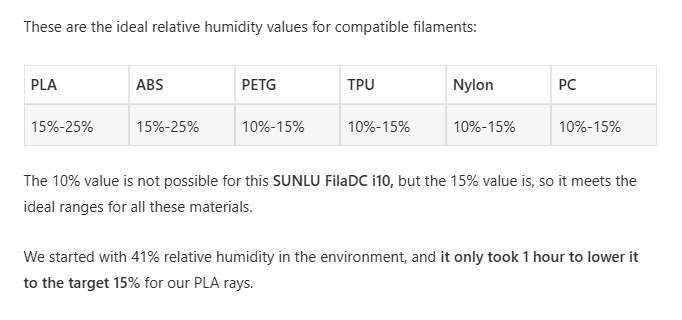
Should I start a separate thread for the Sunlu? It’s of a similar nature to the OP’s, so I thought the comparison might be interesting. I’ll let the OP decide. Meanwhile, the first “real” review came out today, and according to it, 15%RH is the lowest settable target, not 10%.
I’m OK with you adding the Sunlu here. Makes the two comparable, sort of.
The variables need to be watched though. Capacities are different. So you can’t really say the Sunlu dries faster than a cabinet of greater volume. An HT is going to dry faster than either.
But the nature of forums is to allow thinking to free flow, as long as it doesn’t become Apples to oranges, and then throw in banana’s. Capece?
My 40 spool capacity no more comparable to a 10 spool than a 10 spool is to a single spool.
Yes, I wouldn’t put much stock in their “it only took an hour” comment, but for a different reason: if their PLA spools were bone dry, then not only would they be displacing air in the cabinet, resulting in less air to dry for that reason, but no less importantly they would themselves be acting like desiccants and assisting with the rate at which the humidity lowered in the cabinet. For that reason, a more interesting number would have been how long it took the Sunlu to pump down the humidity in an empty cabinet, beginning with it equalized to the ambient humidity in its environment.
[Edit: This is speculative, but I’d wager its desiccator could, in principle, make the interior RH% lower than 15%, but allowing that setting creates an expectation that it be met, which maybe it can’t do with the “half baked” way a lot of people dry their filaments prior to storage. Call it a hunch. ]