And the saga continues, A dryer cabinet

Normally, I used to request the engineering specifications on an item when determining the suitablity for my needs. For a simple example, I was designing a sample timing circuit and wanted to know the repeat accuracy the engineers had put into the timers I wanted to use. It was 2%. And a 10 million plus life expectancy (cycles). The specifics were a sample every 20 minutes, 24/7, 7 days a week.

In reality, after I had built and tested my circuits, and my guys had installed it. it proved to be so close over time, it became a moot point to check the sample cutter timing and to simply observe it had functioned.

The end result was far better sampling of the process, and far better lab results of the process. Narrowing the window for error.

I pretty much don’t know at this point the intimate details of this cabinet and dehydration system. But I trust that if it is advertised as a dehumidifying cabinet, it’ll be dryer inside than outside in vacuum backed boxes sitting on the floor.

I’d expect it will do something towards drying the atmosphere within the metal cabinet. And that, to me, is a good thing. Much better than stacked on the floor, or on a rack in the open air like so many images portray. My goal is: A. Store more than 1 to 4 rolls in a controlled environment and out of my way. This booger is advertised to hold up to 40 spools. B. It’s a better way than my present system, or redesignating other storage options, which I also considered. C. I like to take something, then perfect it to its optimal. It’s a funny bone that so many employers liked so much about me. And why they would use me for “Special Projects”.

If you’d like to come along, you are welcome. MZip is and has some great input. But if you want to be a Debbie Downer, I’m apt to ignore your comments.

But if this proves out (either way) it may be of some value to others who may be in the same pickle with their filaments. Quite possibly it will pan out to be better than expected.

Let go of the grab bar and throw your hands in the air and enjoy the ride. It’s free. :wink:

Thank You MZip, I’ll keep you informed. Great input!

I’m not trying to ding it. I know the principle works and used to use an industrial dryer/CO2 remover a lot. It operated on pressure swings. It ran on compressed air and just had a timer that would configure the valves where one reservoir was being reconditioned while the other was in use. Simple, simple.

I think that cabinet has every chance of doing well. The only questions I have are in the details. How that regenerator actually operates and how low it can go. And of course, if that plastic housing is telling us something. If someone decided sieves made for better marketing, it might be sabotaging performance and might go lower on humidity on a different desiccant. Or it could be fine as is. But got to know the regeneration temperature before putting silica beads in - if truly designed for sieves that would likely make a mess and damage the unit.

Other things that will influence performance are how well it’s sealed up and also how well the regenerator is designed/built. Just rotating a perforated desiccant container won’t do the best job of separating dry and wet so could limit performance. A lot will be revealed when you get your hands on it.

And just like how rates and quantities are important, so is time. If 25% is as low as it goes, it just depends on how you use it. My ambient is being reported at 49% right now (storms in area). Storing at 25% is still hugely better than open storage at higher humidity. But the absorption of water isn’t immediate and it also takes a while for any readsorbed water to work its way deeper into the filament. When I find a dried spool in a container that has leaked up, it re-dries in about half the time it took originally. That’s still a win.

I’m really interested in how it goes.

This may be of interest…

This is cool and they have a section explaining what I was getting at with separating regeneration from drying:

“As the desiccant wheel rotates, stationary seals divide it into 3 distinct sections: Drying, Regeneration and Cooling. This continuous process ensures that dry desiccant is always available,”

The separation of those regions is important or else you can have moisture work its way to the dry side decreasing effectiveness.

And:

“Desiccant wheel dryers are entirely different in that the desiccant is pure molecular sieve desiccant that is literally grown onto a synthetic substrate, which is rolled into a round shape and encased in stainless steel.”

They use sieves too so maybe the sieves bit is correct.

That site looks like a good source of plastics drying information in general and why controlling humidity/moisture in plastics is important. They are targeting injection molding but that’s not so different than FDM.

I can give you a really good example. Modern refrigerators dehydrate the contents put into them. Without losing you in technical details, the condensation created in the container is expelled into an evaporator pan under the refrigerator where the heat of the compressor evaporates it into the air. Creating a colder area that is also dryer inside the refrigerator.

Now as I read it, this device removes the moisture inside a controlled space with a desiccant in a chamber. That chamber is rotated (Probably continuously) and exposed to a heated environment where the desiccant gives up the moisture it has absorbed and is expelled to the outside (or room) air. Nowhere does it lead me to believe it is drawing in outside (room) air. It is removing the moisture within the cabinet the way desiccants always work. The big difference is this does the treatment of the desiccant automatically. For the user. Making the interior dryer and dryer.

Heating the desiccant makes the water molecules expand and “fly out” of the desiccant, dispersing them away from the interior of the cabinet. So the interior (controlled space) gets dryer and dryer. And the contents gets dryer and dryer because it is exposed to the dry environment.

You guys are looking at how filament dryers conventionally work. My AMS’s dry in air with a fan, heat that air and circulate it through the AMS chamber, then expel that air with whatever moisture (boiled off) of the filaments within. Underneath my AMS’s are little ports the moisture laden air is expelled. So in reality, yes the “wet” air is recirculated to an extent. But when it blows out it cools and some, or a lot, of the moisture get dispersed.

If you put an AMS in a fully enclosed cabinet, the dispersed air couldn’t unload the moisture it is carrying. So it would recirculate back and the gain would be nil.

So as I see it, this cabinet is absorbing the internal moisture, and dispersing it to the outside, without drawing in any outside air in the process.

Of course, this becomes null and void if you open the cabinet, or AMS for that matter, to stick your eyeballs in it. The dry inside is immediately dispersed with ambient wet air. So it has to start over drying the chamber.

My only wish at this point would be for a glass panel so the filaments could be easily inventoried for planning or curious eyes that want to see what flavors of “Ice Cream” are available for an item to print. That is why I have a little swatch box of my currant filaments. The kids can look at the pretty colors and decide befor I go pulling spools out of boxes.

Incidentally, I recently got a box that has in it a spool in a Mylar bag. I do not like it, Sam I am, I do not! I want to see the color through the plastic without having to open it and destroying the factory fresh seal. My goal with this cabinet is to preemptively dry my hoard. That way it won’t give off too much when brought into use.

You may grow to like it though not seeing the filament is definitely a drawback. That coating that makes it largely opaque also greatly slows water diffusing into the bag. It’s used generally on very hygroscopic filaments even though the bags cost more and hide the contents.

It would be very interesting to do the hygrometer test on it immediately after taking it out of the bag to see what the moisture content was like.

I’d bet it’s very hygroscopic filament. What is it?

Thank You MZip for this information! Knowledge is power! Or, for us, dryer filaments.

They seem to claim this thing is metal, sealed, industrial grade, and on and on. I’m sure it will be better than the floor of my home office/man cave. LOL! If not, I’ll try and make it better.

And I will keep you up to date and follow your advice. Now, back to exploring your links.

Thank You!

That is the TPU I picked up two days ago, (or 3, CRS). I am familiar with Mylar as it is used in MRE packaging. Where food has to be kept dried to maintain its palatability. MRE’s (Meals Ready to Eat) are actually good in my opinion. I like to take a bucket with me on desert excursions. Just heat water, add it to the Mylar bag and enjoy a hot bag of unformed turd material. I’m odd, I actually like them. Anyway, that is my familiarity with Mylar packaging. It’s good enough for freeze dried eats.

It would be good for light sensitive materials, I think. But not for the curious who would like to see what’s inside. Dumbo’s like me. :wink:

Yeah, I wouldn’t really feel confident trying to do any meaningful test on a spool’s dryness. I know my limits and I think that might be above my pay grade, Sir.

Wow! those links are very enlightening! Great and informative reading,

It will be a fun adventure when the new cabinet arrives. Great minds do think alike. I think a good test run to see what it does empty would be a prerequisite to actually piling a bunch of unknown dryness filament into it and setting back drinking beer and waiting.

But if, IF, it can come close to the ad writers hype, it may be a good item. At least, IMHO, it’ll beat me stacking it on the floor. Somebody needs to try these things. I’ll be your huckleberry… :melting_face: .

Whew! I Bar-B-Queuing a batch of Grandpa’s Ribs for the family for dinner. Tonight, and it is 100 degrees outside with a 22% RH. So… it’s a dry heat. Yeah right. I’m all sweaty.

Time to pull the baby backs and start Phase 2 of my magic.

Thanks for those valuable links! :wink:

Have your cake. I get you are enthusiastic about this, but it might be useful to listen to experience to set your expectations.

A filament dryer and a dry box serve two different purposes. Just understand which one you are getting.

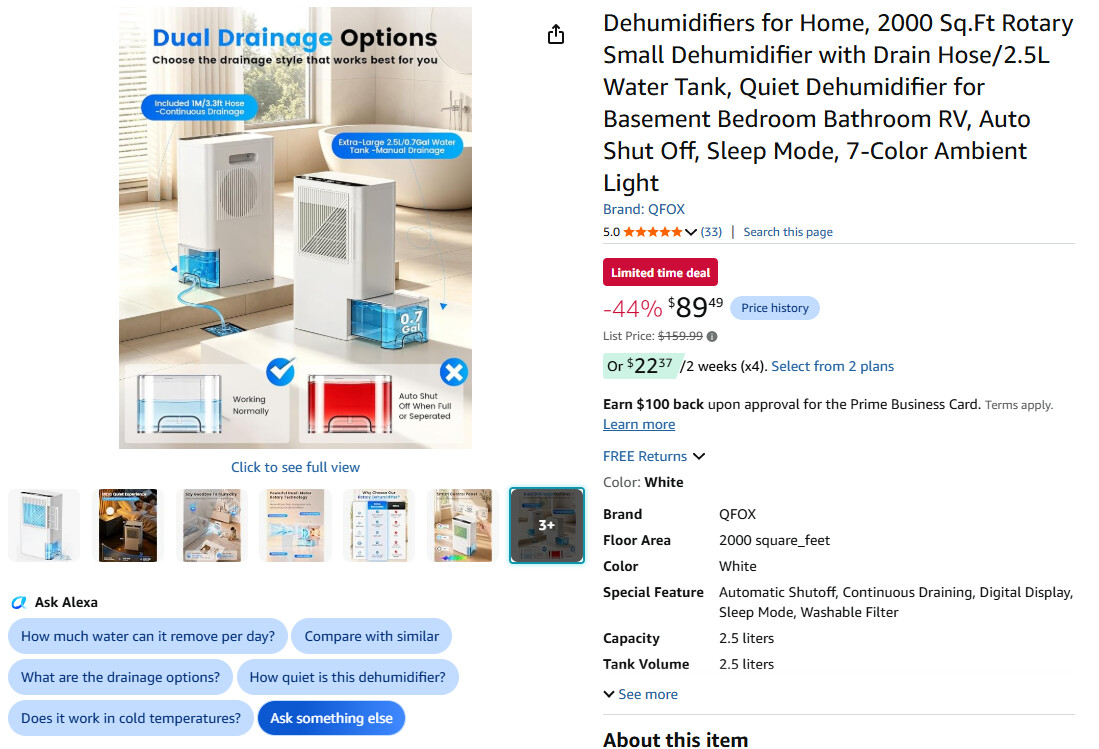
You can buy these rotary desiccant dehumidifiers for not much money:


I bought one in 2024 just out of curiosity, but it gave off an unpleasant smell. I ran it for more than 24 hours in my garage to see whether the smell might off-gas and go away, but the smell persisted even after that. Unfortunately, that dissuadedme from looking into it further, but if it weren’t for that, it would have been interesting to see how low a humidity it could have achieved inside a confined space like a filament cabinet, where you could have a dripline dumping water outside the cabinet. Maybe rather than running it continuously, you could just fire it up on a schedule or as needed to maintain a certain humidity level inside the cabinet.

Maybe I was just unlucky with the one I received, and maybe some of them don’t have unpleasant odors. If anyone found a good one, I’d be interested.

Meanwhile, what I’ve settled on just recently is packing 11 spools into a 54 quart IP67 rated tote with 2.5kg of silica gel desiccant and a yolink hygrometer. That brings the internal humidity down to 2%, at least initially. I’ve put them in my humid garage, and time will tell how long that lasts before it needs a recharge. There’s still plenty of space left for adding more desiccant if I wanted to. Costco is running a sale until the end of the month where you can buy these totes with free delivery for cheap:


If all goes well I’ll likely use the same method for storing other things too, like perhaps tools that I want to ensure don’t rust.

They are not very common in the US though. They are not as efficient but they are cheap to make.

Funny thing is that they tend to draw about the same as a compressor condenser dehumidifier, but only take about 1/5 th of the water out of the air.

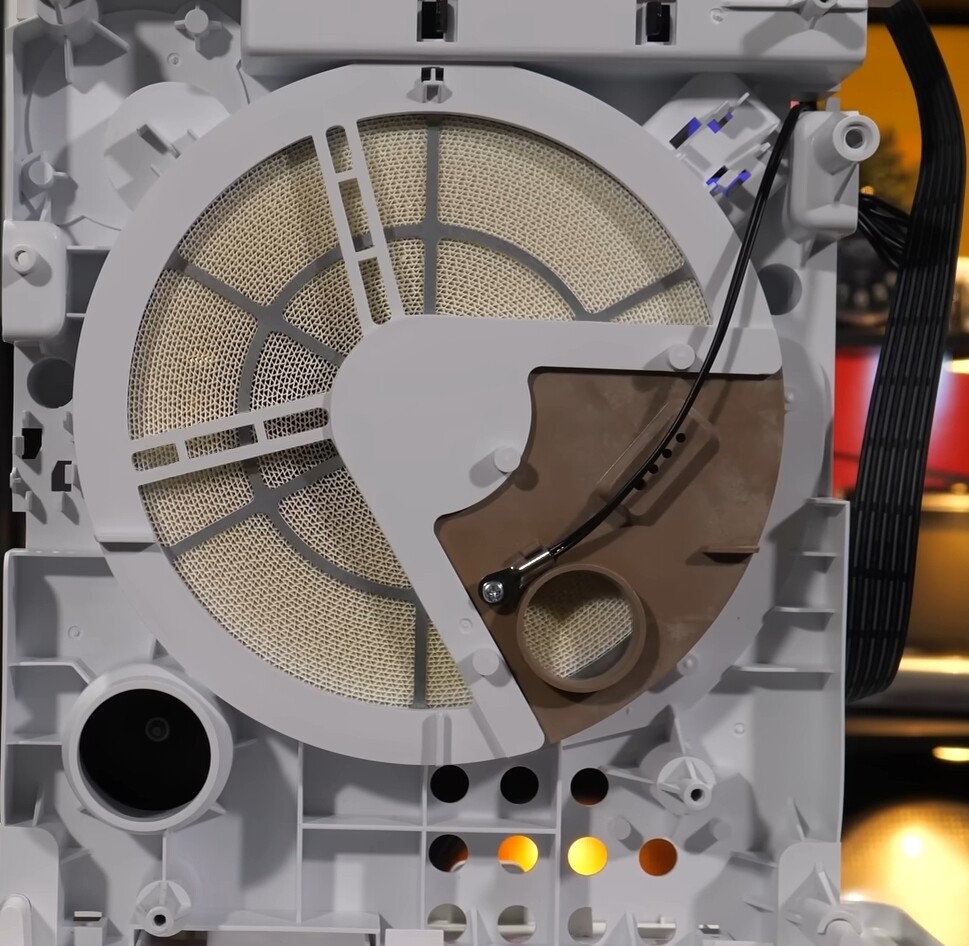
Heres the inside of one of those if you are interested.

Its actually kinda neat.

Yeah, their use case seems to be removing humidity when the ambient air temperature is less than 40F, which is the point at which cheaper refrigerant dehumidifiers will cut-off and are no longer effective at all because they don’t want to risk ice formation. The desiccant also seems to work more efficiently at lower temperatures.

Maybe you could stage the two to extract more humidity?

I would definitely agree that the dream machine would be one that you just plug in and forget about, where you don’t have to ever think about manually renewing desiccant. A first world problem, to be sure! :smiling_face_with_sunglasses:

They have their purpose. The thing is that if you are running them in a modern home with air conditioning and heating, this is not really an issue since they will most likely be running somewhere around 70F anyways.

The issue with the one in the cabinet is that instead of using a rotor (which is a continuous cycle), it is using stages of heating and cooling. So you are taking an already inefficient system, then only running it part of the time.

Also at lower temperatures, the air holds less water anyways. Just my opinion based on my experience, I do not see it as a good method, just cheaper.

All these talks make me think that BL should really get into the filament drying and storage business. I bet the profit margin of that cabinet is higher than that of an A1 mini.

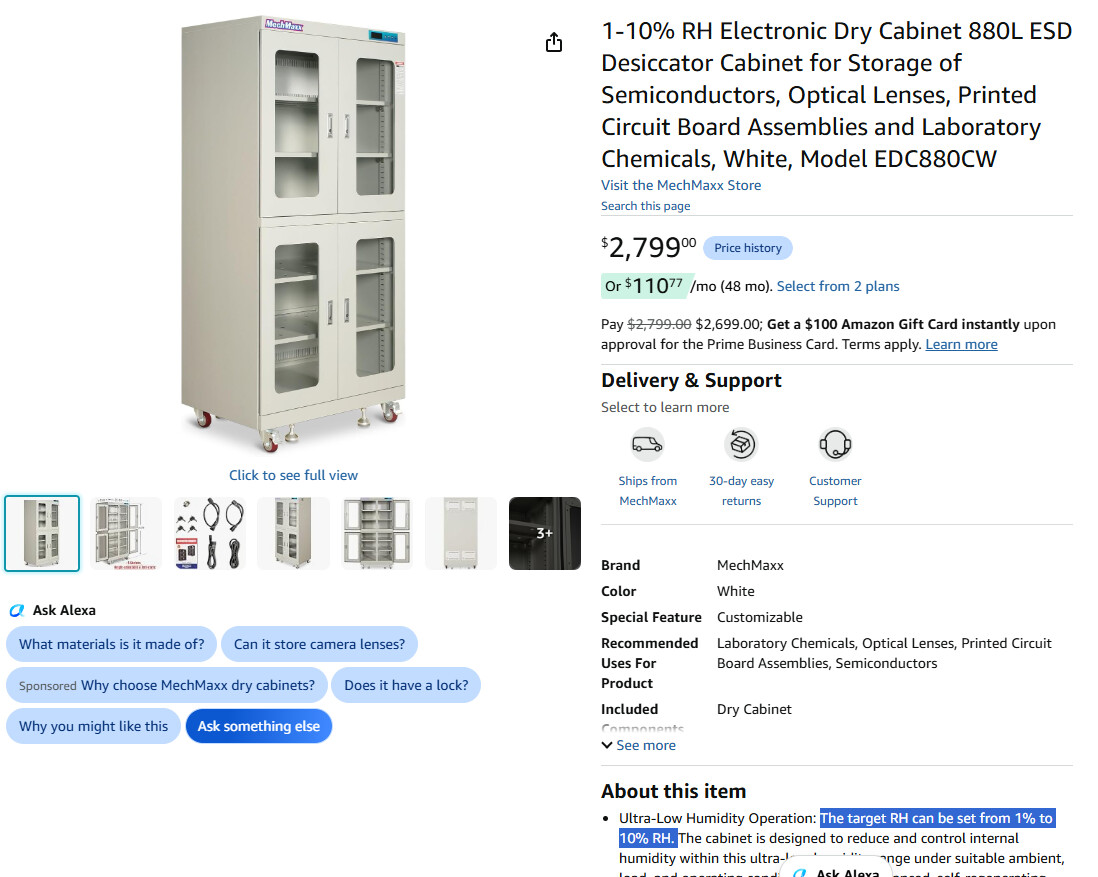
Amazon sells some that really mean business:


This is the pure dream machine, where you can (allegedly) dial the internal RH all the way down to 1% if you want to. And with all that space, if you can’t fit all your filament in, then you have too much filament. Seemingly pure set and forget, with its own automatic regeneration.

You know, compared to a kitchen remodel, it’s cheap!

I haven’t had a chance to verify the claims, but he’s claiming this filament fridge uses molecular sieves and self-regenerates:

at what he claims is a very low overall energy budget.

That’s my question, too. I have skimmed through the threads here (some are very long) and I see the cabinet has a heater, but where does the moisture actually go?

If the cabinet is theoretically sealed, elevating the temperature only increases the capacity of the air in the cabinet to hold water (non-condensing). But the net amount of water inside the cabinet is unchanged.

Finally, as humidity approaches 10% or less the ability for sensors to accurately measure humidity gets worse by a significant amount. We tend to get fixated with numbers and forget their true meaning. The cheap sensors are even more suspect.

For storage (after drying) I started with bags because I was trying to minimize space, but they tend to fail and require too much time and fussing. I’ve since switched to the plastic cereal boxes, some sieve, and a cheap hygrometer. The hygrometer simply tells me that the internal environment is stable and has remained stable for long periods. That may have more to do with the sieve.

The worst thing about sieve is they are spherical and if you drop or a 3D printed container falls out of the hub of a roll of filament to a hard floor, the resulting mess is outstanding.

I find the whole setup strange:

  • No fan to help the air circulate - at least this model is advertised as fanless.
  • The heating element is located at the highest point, rather than at the lowest point - for example, at the bottom of the cabinet.
  • It’s advertised as being nearly airtight, but that can’t be true. The door appears to be sealed, but of course the heating element isn’t. In theory, that’s a possible approach, but not if the air can’t circulate and the heating element is at the highest point.

Personally, I don’t recommend such cabinets because they’re a waste of money on something that can often be solved more easily: simply preventing the air in the room from getting humid in the first place.

I’m not saying they’re a waste of money across the board, but they definitely are in the budget segment. If someone really needs one, they’ll have to go for a true climate-controlled cabinet.


And actually, strictly speaking, they either have to be connected to an exterior wall so that the moist air can escape to the outside, or - in the case of other models - they have a collection tray for the water, which you then have to empty every few days.

Because, physically speaking, the water has to go somewhere - it doesn’t just disappear. I actually think the best solution is a collection tank that gathers the water. Funny side effect: This is perfect for cleaning windows… It’s very similar to distilled water, even though it isn’t.


But to put it in a nutshell: Keeping indoor air dry is always better than overpriced solutions. This allows PLA to be left lying around in the open for months without drying. Of course, this does not apply to specific materials.


Personally, I just find all of this way too complicated and like using a sledgehammer to crack a nut: Keep the room dry = profit. Where is no water, nothing can get wet - in terms of humidity.

I’m in Florida and the humidity inside my office generally runs between 40% to 45% with a room temperature varying from 73°F to 82°F (waiting for new windows in a few weeks). Our AC was installed two years ago and I just got done crawling around in a +100°F attic to install a larger air duct. The above conditions are best I can do.

So, I need dry storage for my materials.