The internet says that Bamboo Lab Studio can change to inche measurements instead of Millileters. It says to start in Settings, then Preferences then Measurement units, But I can’t even find the settings option in the tool. Does anyone know how to do this for my P1P?
I’ve loaded both imperial and metric models into Studio and they both print fine. No settings were changed.
There’s a button in the top left: the down arrow.
Ctrl+P or hit the down arrow


I am from the USA:
Changing from Metric to Imperial does NOT work from the Preference Menu.
I downloaded this software 4 hours ago, and this setting was the 1st thing I was trying to change.Very simple to do, so I thought.
I have tried many ways to change this. The last 2 and a half hours has gotten me no where in my searching.
I have seen that customers have been complaining about this for many months. Bambu says
BAH BAH BAH about this.
Well, I will NOT purchase something I can NOT use.
So, Bambu, take note here. I tried to contact Bambu on their website, but that was impossible.
When a business ignores its customers, it time to move on.
I will not be spending my money on a business that don’t care!!
Studio 2.2.1.58 for Windows:


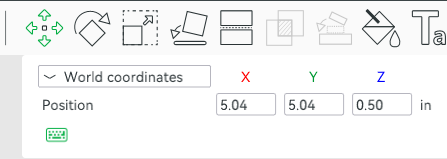
I’m not finding the complaints you speak of, just a few requests to show both imperial and metric.
Metric is pretty much the standard worldwide for 3D printing and specs. It is much easier to use than to fight with the conversions. I use metric where possible, only reluctantly switching to imperial (and converting inconsistent fractions to decimals) when reproducing old parts.
I’m in the US and have been trying to find ways to switch to Metric for nearly 30 years. I have always put both formats on all my CADs and use it when I can, but changing professionally was the biggest roadblock because the industry is so entrenched with imperial/standard. Since I’ve gone freelance, I’ve been able to use Metric almost exclusively and it’s honestly so much better. If you’re not technical at work, just make the switch in your life and you’ll be much better off. I started out by just placing a metric ruler at the base of my keyboard. It has inches and CM, so I could quickly see a relative measurement in inches until I was able to have a more intuitive sense for metric (like I have for standard). I don’t miss having to convert fractions to decimals in my head (my industry uses 1/16 as the smallest figure for everything, so I have those memorized) but not having to worry about rounding to the nearest 1/16th on everything has been nice as well.
The only time it becomes an issue is when designing around US lumber dimensions. For that, I just use CAD software’s ability to convert on the fly in the various expression builders and input boxes. In Fusion (and every other CAD app I use) I can just type “3.5in” in the box instead of converting it first, then I can just keep moving with all my own measurements in metric. You can usually do the reverse if your software is set up for imperial by typing “mm” after the dim.
It can be frustrating making the change, but sticking with inches is really a “you” problem, not a problem for the rest of the world to work around. (That sounds spicier than I meant it, but it’s true.) It takes a lot less effort to just switch. I really hope you give it a chance because it’s a lot simpler and you won’t regret knowing both formats.
If we can also get Americans to use dates correctly.
- Wrong
Month, day & year - Right
Day, month & year
The right way is smallest to largest, why on earth middle precedes the smallest and then the biggest confuses me.
Why not also order time that way? Minutes, hours & seconds!
When dates are stored on a computer they reverse things so they can be easily sorted and arranged. Biggest, middle, smallest.
4th of July 2025
- US+ ^ = 07.04.2025 (Middle-endian)
- Others = 04.07.2025 (Little-endian)
- Data storage = 2025.07.04 (Big-endian)
I always write my dates for my own use as big endian as most of my life has been writing software.
Just thought I would add my useless annoyance.
Don’t get me started on how many countries (think Europe in particular) swap the period and comma over in numbers.
- 1,234.56 (most countriesj
- 1.234,56 (others)
^ Countries using Middle-endian
- American Samoa
- Australia
- Canada
- Cayman Islands
- Eritrea
- Ethiopia
- Federated States of Micronesia
- Finland
- Ghana
- Greenland
- Guam
- Guinea
- Hong Kong
- India
- Indonesia
- Kenya
- Marshall Islands
- Nepal
- Nigeria
- Northern Mariana Islands
- Norway
- Palau
- Panama
- Philippines
- Puerto Rico
- Singapore
- Sri Lanka
- Togo
- United States Minor Outlying Islands
- United States of America
- United States Virgin Islands
- Vietnam
Give me big-endian dates and little-endian bytes and im a happy man
on topic- As someone who grew up with imperial, I find I can naturally work with metric on paper/cad all the way up until the point where I have to “Get a sense of how big this thing actually is in my hand”. I keep calipers on my desk and a couple reference scales to make sure I can reckon with reality when I need to. Try it out!
You need to click the arrow down button next to the file button up in the top left corner of your Bambu Studio screen. It will then pull up a menu options and your going to want to click preferences then look for the box that says measurements and change it to imperial or metric and your done.
I hadn’t realised this had not been marked solved when I made my comments earlier.
It seems everyone assumes the OP uses a Windows machine; probably does.
Mac users have a different answer.
-
Use the application menu and select “Settings…”
-
Locate the Units option and choose your preference, metric or the old-fashioned way
 .
.


I have both a mac and pc. I am able to change the preference from metric to imperial without any issues. When attempting to do the same on the pc it locks Bambu Studio when selecting Preferences and then I have to kill the program. Any help is appreciated.
Where do I find this menu?
If you had scrolled back a few posts, you would see them described.
Windows:
Mac
Thank you! I was looking in Bambu Studio itself thinking - “this does not exist”! I do have a Mac. Boom! Done!
US lumber sizes $%#*8 
Being an OLD Brit, I was taught Imperial dimensions, had to convert to Metric  and moving to the US 30+ years ago had to learn Imperial all over again - but for Lumber a system that dimensions anything before it was put though a planner instead of actual size you can purchase is hard to comprehend.
At the OP - I understand you not liking Metric, but for small dimensions as apply to 3D printers it’s really easy AND you can add and subtract measurements on a calculator without resorting to decimal inches.
Stick with it, you may be pleasantly surprised
Using imperial keeps my brain from getting mushy..
Date storage format used by programming languages is implementation specific, so this is not necessarily true. It’s common for software to display dates in ISO 8601 date format (e.g. 2026-08-11T21:32:22+8:00) but display and storage are totally separate things.
For example C++ standard library provides std:tm defined in ctime, this stores the date and time as (if i remember correctly) 9 separate fields (sec, min, hr, year, mon, etc). Many C programs use UNIX date format which is the number of seconds elapsed since 00:00:00 on 1st Jan 1970 (As this is typically a 32 bit signed field, this will overflow somewhere in 2038, but nothing you have to worry about as people are slowly fixing the code in time, just like Y2K. There will be news stories, and nothing much will break, and people will say it was a hoax, not knowing all the work that went on behind the scenes to fix it)