Charity 3D Printing for Kids at Augsburg Pediatric Oncology – Pieksekisten

Hi Pascal, I found this thread a little while ago, and have been thinking about it ever since. I am so sorry for your loss, but I am incredibly moved by your kindness and the community you are fostering for these children and families.

I am not a seasoned maker, but I have designed a few pokemon keychains. I am not sure if they are good for the Pieksekisten boxes. The keychain hole can be removed if there isn’t a good place in the rooms for attaching it, and the model could instead be used for play. Alternatively, the larger size prints that I call ornaments might be suitable to hang in a window with a suction cup, again if they can be hung.

I decided to upload my models to Makerworld today and enter a few into the contest, but you may look at the rest of my collection as well (I don’t think I can upload the link to the collection here, but my user id is user_1095067435).

I wanted to reach out through this forum personally to thank you and everyone you work with to make this possible. Even if my designs aren’t right for the Pieksekisten, you and everyone in the hospital–staff, families, volunteers–and all the makers contributing to the project have my love and support.

Hi @user_1095067435

Thank you — and especially thank you for thinking not only about the model itself, but also about how it could actually be used in practice. That kind of thoughtfulness is incredibly valuable.

Ideas like that are often even more useful to us than a “perfect” finished upload, because a lot of what works best only really becomes clear once something is used in a real environment.

With very well-known third-party characters, we simply have to be a little more careful on the project side once things move beyond uploading and into real-world printing and distribution. That is less about the design itself, and more about keeping a clean line around what we can responsibly use within the project.

But the way you are approaching it — designing with adaptability and practical use in mind — is exactly what makes contributions like this so valuable to us.

Hi Pascal,

I’m getting close to publishing. I’m preparing print profiles and would like to know what printers you use so that I can create appropriately sized batch plates. Mine is a bit more complicated than a simple figurine and takes more than one plate. I know, not ideal, but also I couldn’t see a way around it because I was going for durability, usability, and imagination over how many can be printed at one time :sweat_smile:

Hi @berri3D and thank you for thinking that far ahead already — that kind of preparation helps a lot.

The current production setup here is built around Bambu Lab P1S systems with AMS, so multi-color and repeatable batch printing are both realistic on our side.

And no worries about a model taking more than one plate.
For this project, durability, usability, and how well something actually works for the children matter far more than squeezing the highest possible quantity onto a single batch.

If a design needs more space because it is sturdier, more practical, or simply more engaging to use, that is usually a perfectly reasonable tradeoff here.

Thank you! That’s good to know. I did my best but sometimes there’s trade-offs! I decided that quality over quantity was more important. I use layer swaps for multicolour so while it takes up more real estate, it makes up for it in faster waste-free printing! Okay, gotta get back to work. I’m very excited to share this one with you :blush:

mmh…

hallo pascal,
wie lange dauern eigentlich die “längeren” drucke die du unternimmst… so circa? per objekt?
denn ich habe keine ahnung was da zeittechnisch normal ist?
ich wollte ersteres unbedingt ein mehrfärbiges objekt entwerfen da du gemeint hast dass es aus deiner sicht nicht schlimm sei… aber ich fand einfach keine wirtschaftlich sinnvolle lösung dafür… nun dachte ich mir ich schau mir mal an was dabei für druckzeiten rauskommen würden und tja…? was soll ich sagen.. so wie ich die druckzeit dafür gesehen habe, habe ich den slicer auch schon wieder geschlossen ohne zu speichern…
es steht einfach nicht zur relation..

wie auch immer..
ich werde das lange wochenende nutzen um meine objekte mal online zu stellen. ich bin noch immer am prototyping weil es sich einfach immer wehrt aber ich bin auch recht zuversichtlich dass es sich noch ausgehen wird…

dann kannst du dir diese ja mal anschauen… bei bedarf können wir ja auch noch ideen ergänzen oder ein paar veränderungen vornehmen…

mmh…
in diesem sinne,

ich wünsche dir ein angenehmes und halbwegs stressfreies wochenende pascal…

gruß

hello you,

your model sounds realy very interesting to me! because of pascals charity contest i also had a hard time, researching for multi color solutions and i believe… im not sure but i think i come across this technic, that you discriped there on your model design idea…i m realy excited and looking forward to see your work!!

but for now we should get things done : )

best greetings
ImU

Farbe an sich ist dabei gar nicht das Problem – die eigentliche Frage ist eher, ob sich ein Modell sinnvoll in eine reale Druckcharge einbauen lässt.

Ich drucke in der Regel keine Einzelmodelle, sondern bündele Chargen immer nach bereits geladenen Farben und kombiniere dann mehrere gleiche oder passende Modelle in einem Lauf. Je nach Größe und Laufzeit liegen solche Chargen meist irgendwo bei 8 bis 20 Stück.

Genau das ist der Punkt, an dem auch längere Drucke wirtschaftlich werden.

Mein längster Lauf zuletzt lag bei etwas über 36 Stunden für rund 27 kleinere Flex-Modelle. Durch die Menge wurde selbst der zusätzliche Purge wieder wirtschaftlich vertretbar.

Ich bin Farben also überhaupt nicht abgeneigt – ich versuche nur, sie so einzusetzen, dass sich Zeit, Material und Purge am Ende auch wirklich lohnen.

Deshalb ist für mich weniger entscheidend, ob ein Modell mehrfarbig ist, sondern eher, ob es sich sinnvoll in eine echte Produktionscharge integrieren lässt.

Wenn ein Modell robust, sinnvoll nutzbar und gut batchfähig ist, sind auch längere Laufzeiten völlig in Ordnung.

Ich habe inzwischen sogar mit einem dritten P1S aufgerüstet, weil einzelne Modelle je nach Aufbau auch allein schon auf 6 Stunden Laufzeit kommen können.

Aktuell läuft die Produktion ohnehin etwas langsamer, weil ich gerade in eines der klassischen Probleme gelaufen bin, das man gern erst merkt, wenn es zu spät ist: Ich habe das Filament zu lange aus den Augen verloren und erst spät bemerkt, dass es langsam Feuchtigkeit gezogen hat.

Das bremst die Produktion gerade spürbar aus, weil ich nun erst einmal wieder sauber trocknen muss, bevor die nächsten Chargen sinnvoll weiterlaufen.

Meine neuen AMS Heater und der S4 Dryer sollten Dienstag kommen, dann lässt sich das wieder sauber stabilisieren.
Ich hatte zwar testweise mit Vakuumbeuteln gearbeitet, aber die Amazon-Lösung war auf Dauer eher mäßig zuverlässig und hat das Vakuum nicht konstant gehalten – den Ärger habe ich jetzt entsprechend im Nachgang.

Am Ende ist also nicht die reine Druckzeit pro Einzelteil entscheidend, sondern ob ein Design in einer realen Druckpipeline sinnvoll und wirtschaftlich funktioniert.

Just checked out the donation page—it’s over 90000 points!

That’s incredible. You could start an entire printer farm with that.

It’s amazing to see how a small request grew into something this wonderful and big.

It really has grown into something much bigger than I ever expected.

And honestly, what matters most is not the number itself, but what it represents.
The points are incredible, of course — but more than anything, they mean people chose to support this, and that kind of trust carries a lot more weight than the number alone.

And realistically, it would never just become “more printers.”
What keeps something like this running long-term is usually far less glamorous: filament, wear parts, maintenance, failed prints, packaging, and all the little things that turn printing into actual reliable output.

Most of the work here is not single showcase prints anyway — it is long production batches, grouped over time, built around stable runs and repeatable output.

That is really what those points help make possible:
not just more machines, but a more stable and sustainable way to keep all of this moving.

Hello everyone,

I know I’m joining this quite late, but I still really wanted to create a small contribution for the Pieksekiste and reach out here!

When I read about the project behind it, it truly stayed with me. The idea of creating small 3D printed objects that can bring even just a tiny moment of comfort to children during such a difficult time feels incredibly meaningful. Since I’m only a little “Katzensprung” away from Augsburg, this project also felt especially close to home for me.

My heart goes out to you, Pascal, and your family. I am deeply sorry for your loss, and I have so much respect for the love, strength, and kindness behind this project.

A little (Shooting) Star Kitten flexi - Sternschnuppen-Kätzchen - is my small contribution.

I wanted to design something that might bring a little smile and could be a tiny pocket friend. A shooting-star kitten felt like a fitting idea to me.

Even though I’m a little late to the contest, I’m really grateful that I could still add my own small piece to this beautiful initiative.

Thank you for creating a project with so much heart! I will definitely contribute more to it in the future​:growing_heart:

hallo und guten morgen pascal,

ich hab deine nachricht mehrmals gelesen, bezüglich der wirtschaftlichkeit und der logistik dahinter… hm… ich kann mir darunter irgendwie trotzdem nichts vorstellen, wie das dann wirklich ausschaut oder abläuft??
ich stelle mir diesen von dir beschriebenen projektablauf recht stressvoll vor, generell im allgemeinen.. dass du dabei strategien ausarbeiten musst kann ich absolut nachvollzilehen…
aber wie schon geschrieben, keine ahnung wie dieser große gesammte ablauf, inklusive “hinter den kulissen” deines projekts wirklich ausschaut..?? ich stell mir das jedenfalls wild vor und ziehe absolut meinen hut vor dir!!

musst du dass eigentlich alles allein machen oder hast du in der familie oder deinen freundeskreis menschen die da mitwirken?

ich hab schon fast ein schlechtes gewissen dass ich dir deiner zeit beraube da du das ja irgendwann lesen wirst… aber ich verlange wirklich nicht dass du mir immer antwortest denn ich weiß ja auch wie wertvoll die zeit eigentlich wirklich ist!

meine hochachtung!
gruß

Hey @ImU

Ganz im Gegenteil — solche Fragen sind hier ausdrücklich willkommen.

Ich freue mich über genau solche Nachfragen sogar, weil sie zeigen, dass das hier nicht einfach nur still im Hintergrund „durchläuft“, sondern dass sich Menschen wirklich dafür interessieren, wie das Ganze funktioniert und was aus ihren Designs am Ende tatsächlich wird.

Und genau das ist wichtig.

Die Zeit für Antworten muss hier bewusst mit eingeplant sein, weil sie ein Teil des Projekts ist — nicht etwas, das davon „Zeit wegnimmt“.

Fragen und Antworten gehören hier ganz bewusst dazu.
Sie machen sichtbar, was im Hintergrund sonst niemand sehen würde, sie erklären Abläufe, schaffen Verständnis und helfen dabei, das Ganze transparent zu halten.

Und genau das ist mir wichtig.

Was sich hier gerade bildet, ist nicht nur ein Projekt mit Druckern, sondern auch eine Community rund um dieses Projekt.
Und so etwas funktioniert nur, wenn man offen bleibt, Dinge erklärt und Fragen nicht als Störung sieht.

Gerade hier soll jeder fragen dürfen, was er wissen möchte.
Nicht alles wird immer sofort beantwortet, aber es wird beantwortet.

Denn am Ende ist genau das ein Teil dessen, was dieses Projekt tragen soll:
Transparenz, Nachvollziehbarkeit und ein offener Umgang damit, was hier entsteht, wie wir arbeiten und was am Ende aus den Designs tatsächlich wird.

Ihr gebt nicht einfach nur Modelle ab — ihr gebt einen Teil eurer Arbeit in dieses Projekt.
Und ich finde, man sollte auch sehen können, was damit passiert.

Von außen wirkt das Ganze oft deutlich kleiner, als es im Alltag tatsächlich ist — und genau das ist wahrscheinlich der Punkt, den man von außen am schwersten greifen kann.


Was man im Forum meist sieht, ist am Ende nur der sichtbare Teil.
Die Drucker sind dabei nur ein Baustein innerhalb eines deutlich größeren Ablaufs.

Die Modelle, die später in die Pieksekisten wandern, kommen nicht einfach „aus dem Drucker“.
Am Anfang steht erst einmal die Auswahl: über Forum, Website und die dafür angelegten Collections sehen wir, welche Designs überhaupt freigegeben sind und sinnvoll in Frage kommen.

Danach beginnt die eigentliche Produktionsplanung.


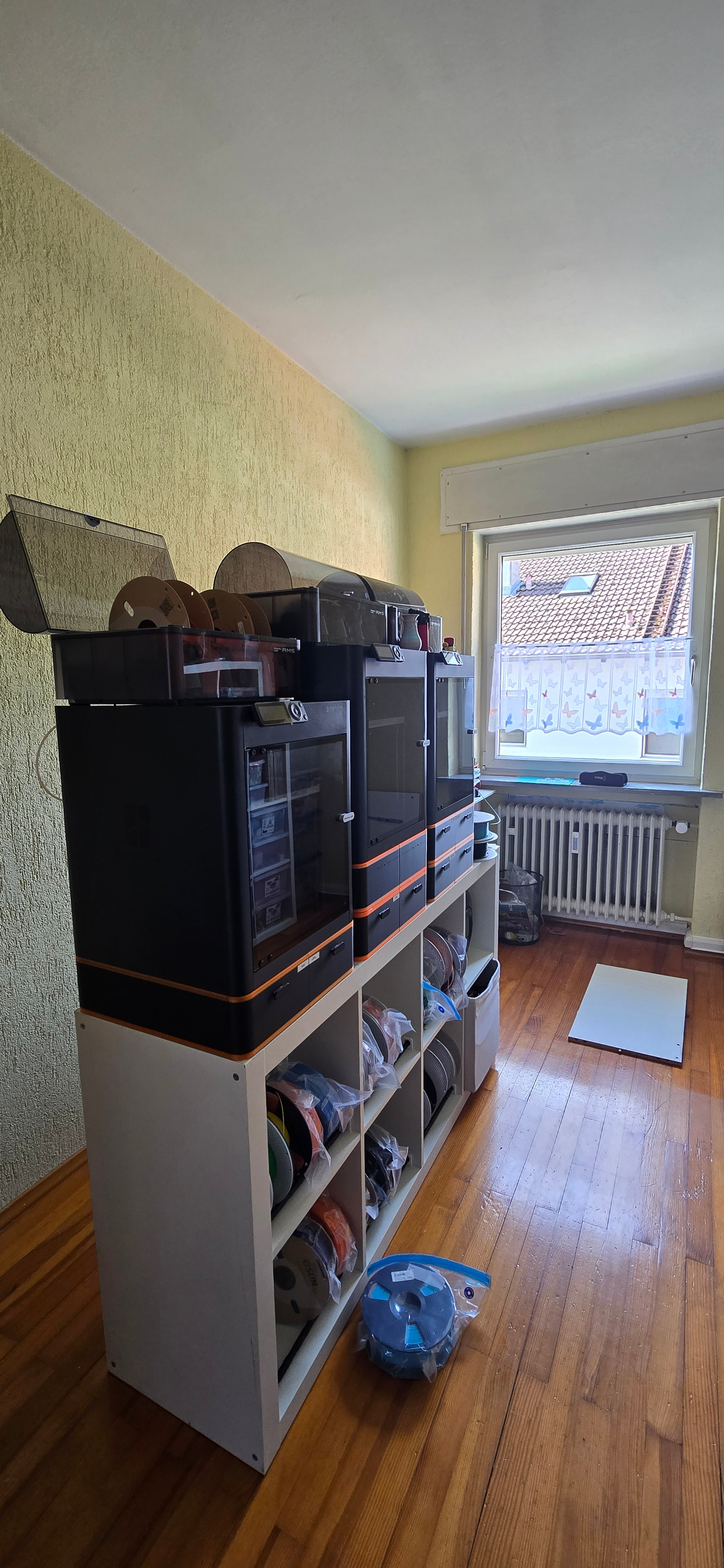
Im Einsatz sind aktuell drei P1S Combo Systeme. Jeder Drucker läuft dabei nicht als Einzelgerät für spontane Einzelteile, sondern als fester Produktionsslot mit eigener Farb- und Materiallogik.

Wir reißen nicht ständig neue Filamente auf, sondern arbeiten möglichst mit dem, was bereits sauber geladen ist.
Das heißt: wir schauen zuerst, welche Farben aktuell in den AMS-Systemen liegen, und planen dann passende Modelle gezielt um diese vorhandenen Farbsets herum.

Gedruckt wird also in der Regel nicht „ein Modell“, sondern immer eine Charge.
Je nach Größe, Farbe und Laufzeit werden mehrere gleiche oder passende Modelle gebündelt, vorbereitet und einem bestimmten Drucker zugewiesen.


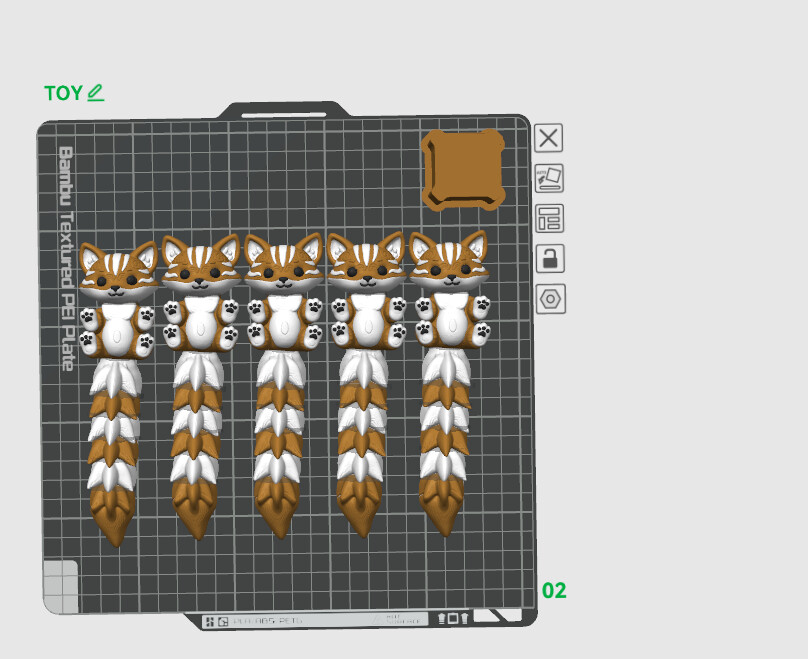
Das hier ist ein gutes Beispiel: ein Modell aus dem Contest, das in dieser Variante fünfmal auf eine Platte passt.
Da in diesem Setup bereits Weiß, Braun und Schwarz geladen sind, wird nicht nur dieses Modell vorbereitet, sondern parallel geschaut, welche weiteren Designs sinnvoll in genau diese Farbgruppe passen. So entstehen daraus gleich mehrere vorbereitete Druckaufträge, die nacheinander abgearbeitet werden können.

Ein solcher Lauf dauert dann nicht „mal eben kurz“, sondern in diesem Fall rund 20 Stunden und 52 Minuten.
Der Drucker ist damit also praktisch einen kompletten Tag gebunden.

Diese Laufzeiten werden bewusst nicht nur technisch, sondern alltagstauglich geplant.
Die Drucke werden so getaktet, dass sie möglichst entweder morgens gegen 5:30 Uhr oder abends zwischen etwa 17 und 20 Uhr fertig werden — das sind die Zeitfenster, in denen wir sicher da sind, um Platten zu leeren, Drucke zu entnehmen und direkt weiterzuarbeiten.

Und genau da endet der eigentliche Druck nicht — dort beginnt erst der Teil, den man von außen fast nie sieht.

Denn „fertig gedruckt“ heißt noch lange nicht „fertig für die Kiste“.

Nach dem Druck folgen:

  • Entnahme von der Platte
  • Sichtprüfung
  • grobe Qualitätskontrolle
  • Support- und Stringing-Reste entfernen
  • Beweglichkeit prüfen
  • fehlerhafte Teile aussortieren
  • gegebenenfalls Nacharbeit

Erst danach wandert ein Modell überhaupt in die Sammelcharge.

Zusätzlich folgt dann noch der Teil, der im Alltag fast genauso viel Zeit frisst wie der Druck selbst:

  • Modelle aufbereiten
  • Chargen fotografieren
  • Bilder sichten
  • Bildbearbeitung (Lightroom / Photoshop)
  • Druckprofile bewerten
  • Bilder unter den jeweiligen Druckprofilen veröffentlichen
  • Website-Gallery pflegen
  • Instagram-Beiträge vorbereiten
  • Designer korrekt zuordnen und verlinken

Das ist auch der Grund, warum im Forum nicht jeder einzelne Druck sofort als „hier ist die nächste Charge“ auftaucht.

Was man hier im Forum sieht, ist fast nie ein einzelner Live-Drucklauf.
Die sichtbaren Updates sind in der Regel bereits gebündelte Sammelstände aus mehreren fertigen Chargen.

Intern laufen oft bereits drei bis sechs abgeschlossene Chargen, bevor davon überhaupt etwas öffentlich sichtbar wird.
Produktion, Nachbearbeitung, Dokumentation und Veröffentlichung laufen bewusst in getrennten Schritten — einfach, weil sich das im Alltag anders kaum sinnvoll organisieren lässt.

Das Forum zeigt also nicht den laufenden Takt in Echtzeit.
Es zeigt meist den bereits aufgearbeiteten Zwischenstand.

Und dazu kommt noch ein Punkt, den man von außen ebenfalls schnell übersieht:
Die 3D-Drucke sind nur ein Teil der Pieksekisten.

Die Kisten bestehen nicht nur aus den gedruckten Modellen.
Die Drucke sind ein Baustein davon — sichtbar und greifbar, aber nicht der gesamte Inhalt.

Ein weiterer Teil kommt ergänzend über die Wunschlisten dazu.
Wenn man sich auf der Website unter Donate die Wunschlisten ansieht, bekommt man meist erst ein richtiges Gefühl dafür, was neben den 3D-Drucken zusätzlich noch in den Kisten steckt.

Die Drucke sind also nicht „die Kiste“.
Sie sind ein Teil der Kiste.

Am Ende läuft hier deshalb nicht nur „ein paar Drucker und ein paar Figuren“, sondern ein recht vollständiger Kreislauf aus Auswahl, Produktionsplanung, Druck, Nachbearbeitung, Qualitätskontrolle, Dokumentation, Lagerung, Verteilung und späterer Bestückung der Pieksekisten.

Und nein — komplett allein würde das auf Dauer auch gar nicht funktionieren.

Der technische und produktionsnahe Teil läuft hauptsächlich bei mir: also MakerWorld, Modellprüfung, Druckplanung, Website, Fotografie, Bildaufbereitung und alles rund um die eigentliche Druckpipeline.

Silke übernimmt dafür den kompletten Social- und Kommunikationsbereich rund um das Projekt, also vor allem Instagram, Außenwirkung und den Teil, der später nach außen sichtbar wird.

Dadurch ist das Ganze bei uns recht sauber aufgeteilt und funktioniert überhaupt erst alltagstauglich.

Allein würde man so einen laufenden Ablauf auf Dauer weder sinnvoll noch konstant in der Form halten können.

Hello @pawnyca

and honestly — this is exactly the kind of contribution that matters here.

It does not matter at all that you joined late.
What matters is that you understood what this project is actually about — and that means far more than simply uploading a model near the end of a contest.

Your little shooting star kitten is not “just a small contribution.”
It is exactly the kind of piece this project is built on: something thoughtful, kind, and made with the simple intention of bringing a small moment of comfort to a child who may really need it.

That is never a small thing.

And that is also what makes messages like yours so meaningful — not just because of the model itself, but because they show that people are not only seeing the project, they are understanding it.

That matters more than any contest ranking ever could.

So thank you — for the kind words, for the thought behind it, and for adding your own little piece to this.

And you are very welcome here. :heart:

Hi Pascal, it’s finally posted. This took a lot of time to get right :sweat_smile:

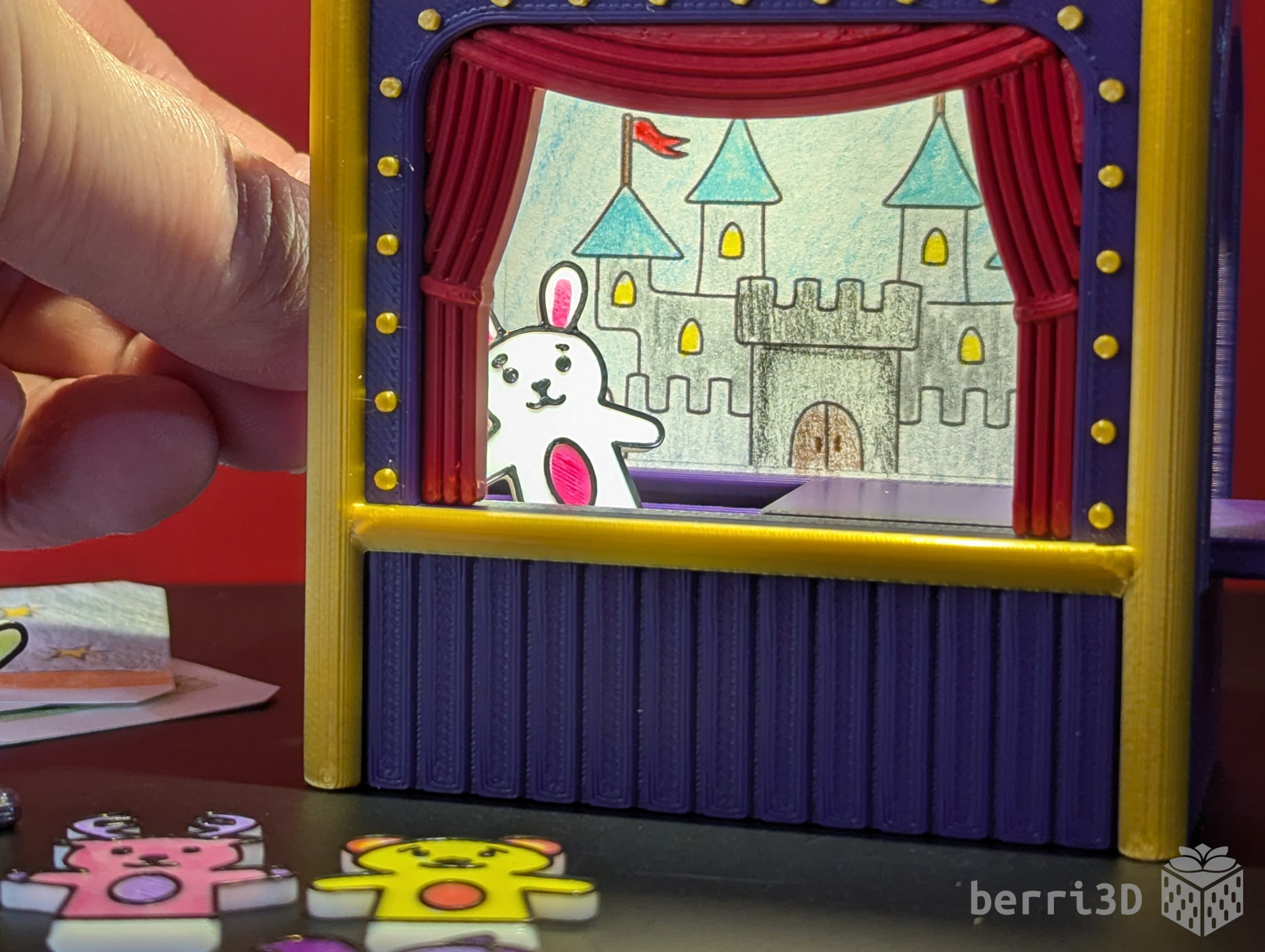
It started as a kit card and now it’s a fully-realized ready-to-go pocket puppet theatre.

The backdrops can be made out of business cards which I chose as a source of sturdy, easy-to-find paper. I based the slot size on European cards which are slightly bigger than ours here in North America (it will actually accept any of the various global sizes out there!).

I added in an additional colouring component with the puppets. Permanent markers work best or pencil crayons can work. They also don’t need to be coloured as they look quite striking on their own in a sort of illustration-comes-to-life look. After the playing is done, there is onboard storage for the puppets and backdrops.

Even though it’s small, it’s packed with a lot of design touches and is sturdy enough to withstand a toss in a backback or a purse. Lastly, no AMS purge waste! All two-colour parts print with filament swaps. One complete theatre with puppets can be printed in about 3.5 hours.

Anyways, I wanted to share and to also let you know that I will be creating a batch-print profile for the P1S as soon as I’ve had some rest :sweat_smile:

Hi @berri3D

this is exceptionally well thought through.

And honestly, that is exactly what stands out here the most — not just that you made something creative, but that you clearly designed it with actual real-world use in mind.

You did not just build “another contest model.”
You built something practical.

The moment you start thinking about durability, storage, transport, easy replacement materials, low waste, child interaction, and realistic print times, it becomes very obvious that this was designed as something meant to be used, not just displayed.

That makes a huge difference.

The fact that you already thought about sturdy everyday materials, onboard storage, real handling, and even avoided unnecessary AMS purge waste shows a level of practical thinking that is incredibly valuable for something like this.

That is exactly the kind of design work that translates well into actual use later — not just because it looks good, but because it was built with purpose.

And the P1S batch-print profile part is honestly just the cherry on top — because that is exactly the kind of practical optimization that becomes incredibly valuable in day-to-day production.

This is genuinely very, very well thought through.

Pascal,

Danke für den detailreichen Einblick und die Erklärung, wie das alles abläuft um überhaupt funktionieren zu können…
Jetzt kann ich mir das Große Ganze irgendwie vorstellen und versteh auch was du gemeint hast, wie du beim 3D drucken vorgehst um das alles Wirtschaftlich abwickeln zu können…

Es ist eine Logistische Meisterleistung… Das alles am laufen zu halten… Zeiteinteilung… Alles rund herum und dann muss man auch manchmal noch etwas trinken, essen und/oder auch schlafen…

Wahnsinn… Meinen Respekt hast du jedenfalls!!

vielen Dank,
Gruß

Thank you! I’m not sure that it’s all that! For what it’s worth, I started designing even before there was a contest. This wasn’t done for anything other than trying to bring a bit of joy to someone somewhere in the world :sweat_smile:

I’ve since uploaded special batch print 3mfs. They can be found under the “Download STL/CAD Files” button. I had chatGPT help me translate the text. I don’t speak any German, so I apologize in advance if anything is unclear. There are two ways to print depending on how many you’d like to do at a time (that is if you choose to print them). I’ve grouped the puppets into 4 packs as 8 might be a bit too much to keep a track of. They’re attached with a 1-layer high “mini” sprue to keep them together when removing from the plate. That way you don’t have to worry about sorting. The lines pull off very easily because they’re so thin.

Thank you so much for all the work that you do. It matters that there is people like yourself and your family giving back in such a kind and thoughtful way. I wish you and yours much joy and peace.

-Naomi :smiling_face:

Hey @ImU
Danke dir — und genau deshalb versuche ich das hier auch so offen wie möglich zu zeigen.

Von außen sieht man meistens nur den Moment, in dem irgendwo ein fertiger Druck auftaucht.
Was man nicht sieht, ist der ganze Ablauf davor und danach, der am Ende eigentlich den deutlich größeren Teil ausmacht.

Wenn man das einmal komplett aufdröselt, wirkt es oft schnell größer, als es von außen zunächst aussieht — aber genau deshalb ist Transparenz hier auch so wichtig.

Nicht nur, damit nachvollziehbar ist, warum manches dauert oder gebündelt läuft, sondern auch damit jeder, der hier Designs, Zeit oder Unterstützung rein gibt, sehen kann, was daraus am Ende tatsächlich wird.

Und ja — am Ende ist es genau das: viel Planung, viel Taktung und irgendwo dazwischen muss man tatsächlich auch noch daran denken, selbst mal zu essen und zu schlafen. :sweat_smile:

Aber genau deshalb funktioniert es auch nur, weil es nicht einfach „nebenbei läuft“, sondern bewusst strukturiert wird.

Hey @berri3D
That honestly makes it even better.

And you can tell.

That is exactly why it feels the way it does — because it was clearly designed around the idea of giving a child a small moment of joy first, and everything else second.

That kind of intention usually shows very clearly in the final result.

And the fact that you went back afterward and even built proper batch-print variants around real handling and sorting makes it even more valuable on our side, because that is exactly the kind of practical thinking that helps once something moves from “nice idea” into actual day-to-day use.

That kind of iteration is incredibly valuable, because it means the idea was not only thoughtful in concept, but also adapted for real use afterward.

And no worries at all about the translation — it came across just fine.

Also, the puppet box is already on the print list. I’m just waiting on the right filament set for it, since I do not have all colors loaded for that one at the moment. Once that is in, it is absolutely getting printed.

And thank you, truly, for the thought, the care, and the time you put into it. It shows.