
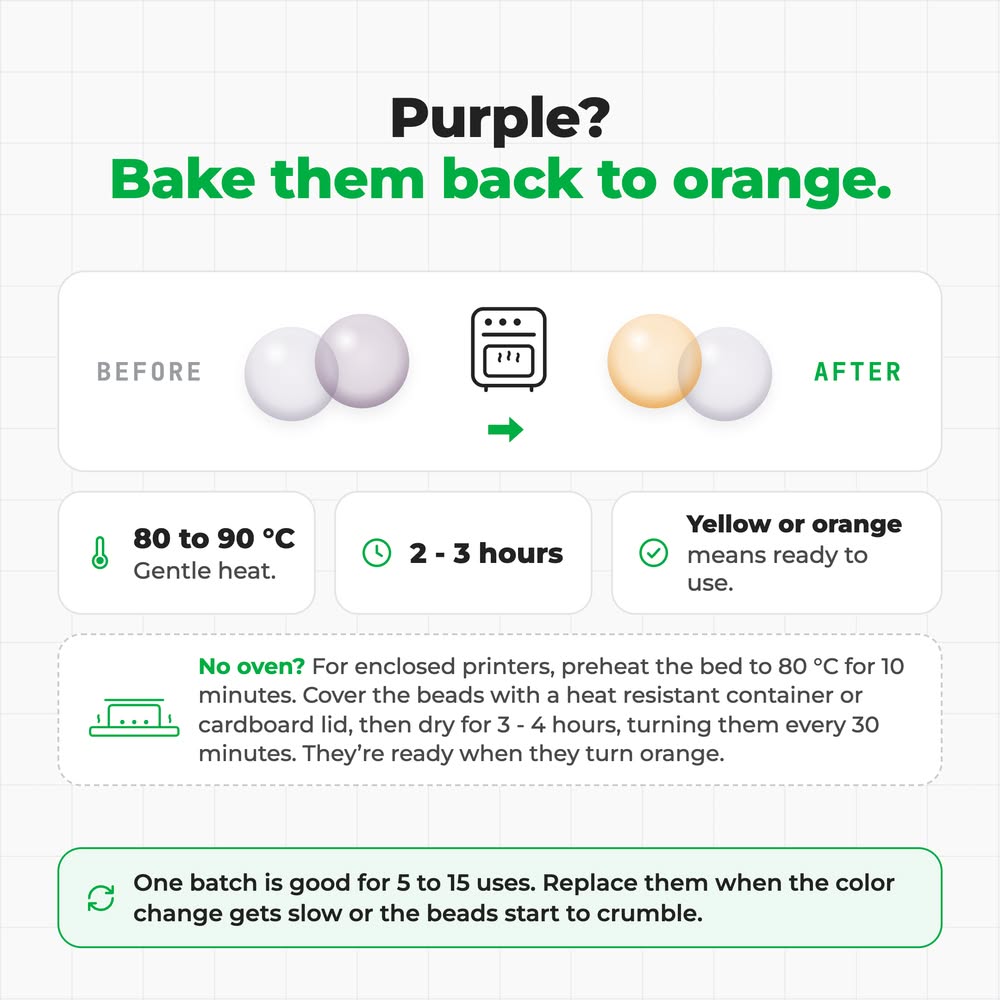
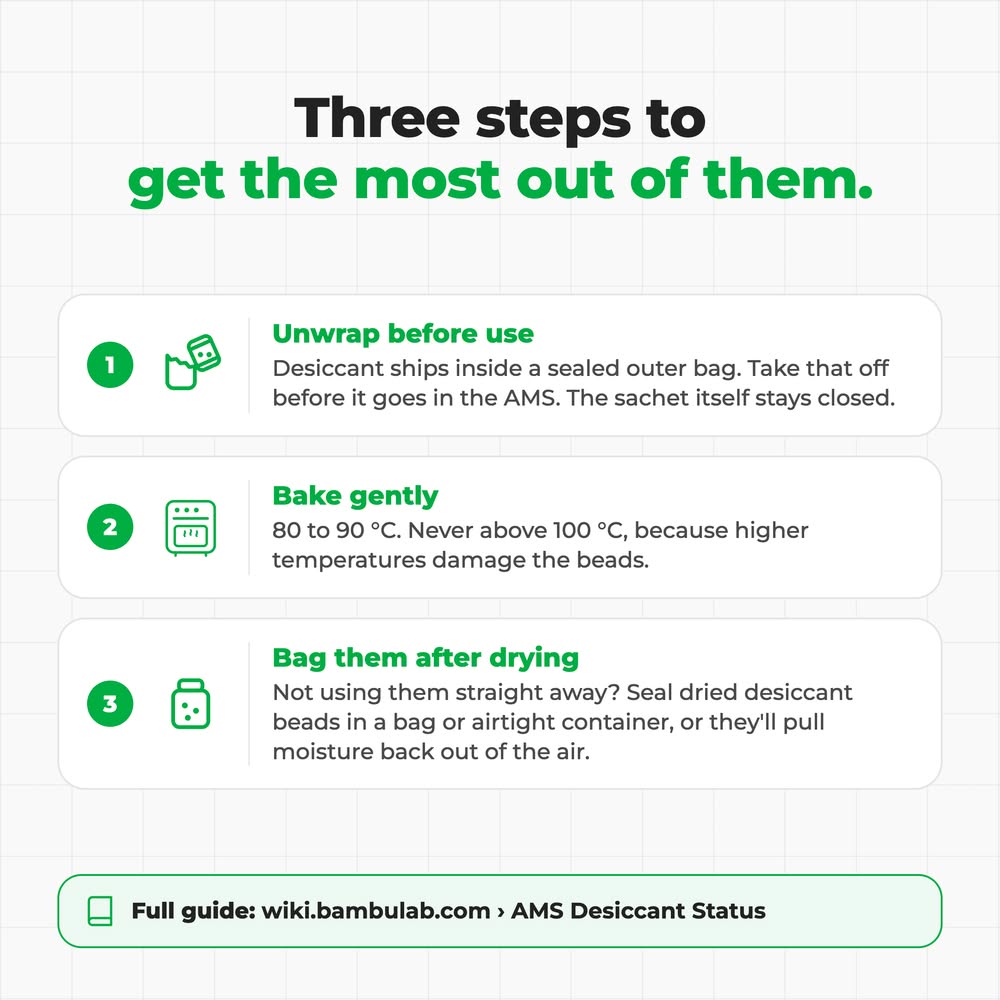
If you want to learn more, check out this Wiki article where we go in-depth about desiccant:
Using the color indicator is very reliable but is hard to really judge what water content the beads are actually at at low water contents and when they should be regenerated. The hygrometers in the AMS units are a better guide on desiccant water content.
I don’t know what indicator you are using but if it’s like the orange/green, waiting until the color really changes puts the humidity at levels too high for some filaments. Hygrometers tell you right where you are.
Waiting until the silica gel is “full” is way too late in my opinion. Silica gel can be a water sink or source. If the silica gel water content puts it at a humidity higher than the filament water content puts it, the silica doesn’t help dry the filament - it hydrates it.
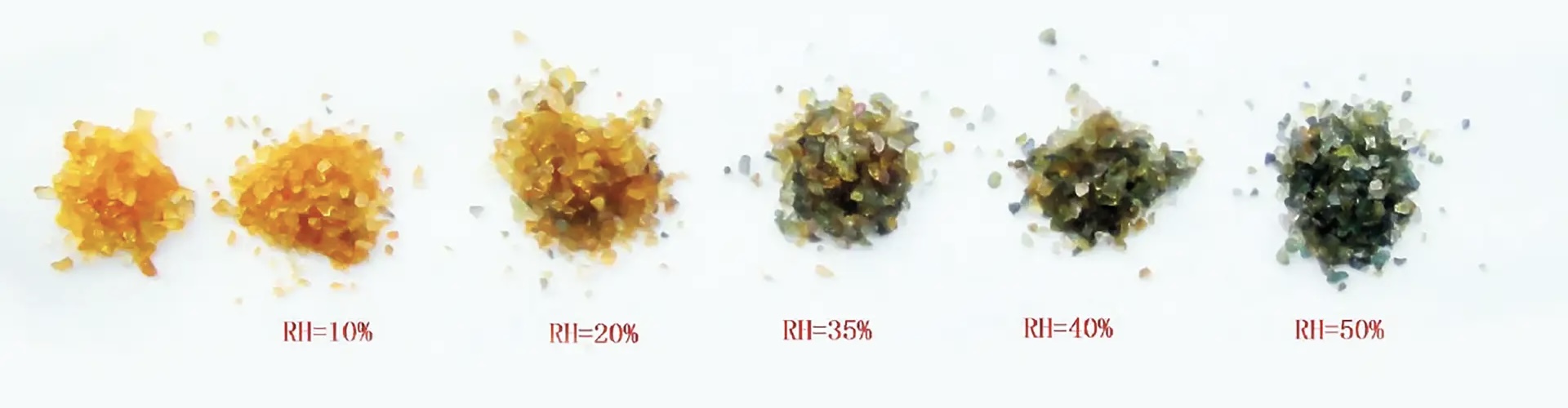
At least with the orange/green beads, waiting until they turn fully puts them at something around 50% humidity. If those are in an active dryer they will add water load to the active dryer besides helping the filament pick up more water.
I would (and do) regenerate my beads used in storage at between 10 and 20% RH - well before they turn green. I’ve found keeping my filament well below 20% RH gives the best prints without water issues.
I completely agree with MZip. Regeneration needs to be done much earlier than a deep color change.
I follow my Desiccant manufacturer’s recommended method. And frequency for my location, with average RH running in the mid 30% range I have been regenerating on a weekly basis. Regardless of my desiccants color change. It does not hurt to dry your desiccants early. But if you value your collection of filaments, in my opinion, protecting it from absorbing moisture in the first place is paramount.
So I am regenerating (drying) my various containers on a weekly basis. If you live in a more humid region your frequency may need even more attention.
My AMS’s (2) have 3D printed desiccant boxes in them, and the dryer power supplies. In one of the boxes is a spot for a commonly available round hygrometer. Living in my AMS’s in their controlled environments they indicate 10-20% RH. But the Bambu Labs hygrometers are indicating 13% and12% . So I put far more faith in my AMS reads then the inexpensive round hygrometers for the final reads.
While convenient, the inexpensive meters do not run as true, IMHO, as Bambu Labs system. But they can be something for say, daily checks.
And dry desiccant is a good thing. Waiting for saturation is not. It is easy enough to keep it dry. I’d rather err on the dry side with my spools of filaments. Your milage may vary.
It depends on the indicator though. I’m not familiar with the orange/purple indicator but if it fully transitions by 10-20% RH then letting it go to full color change is correct.
What matters is maintaining desiccant at least below 25% (IMO) but if people are drying filament to 10%, maybe changing/regenerating desiccant at a lower value might be of value.
That’s why I posted the color change/humidity chart. It would take a similar graphic to know if letting the orange/purple indicator go full purple is good advice or not.
Unfortunately, industry probably wants indicators that change across the whole water content range so there’s a good chance full purple is too far. But maybe it is changing across a range better suited to filaments?
Microwaves’ superpower is that they make water molecules spin and dance about. It is the motion of the water that creates the heat. The purpose of recharging desiccant is to remove the water that has been absorbed. Why not use a device that targets water? Full power in a 1200 watt microwave will cause damage to the desiccant if left running long enough. However the defrost settings work just fine. Desiccant saturated at 20% will recharge in 15-18 minutes or so on the defrost setting of a microwave oven. I use desiccant packets and when I recharge them in a dish, water forms on the bottom of the dish. Half way through, I open the door to let the generated humidity out and to wipe the water from the bottom of the dish.
In my experiments, on the defrost setting, the desiccant was warmed to only about 140°F (60° C) as the water evaporated out. If one lived in Roswell, New Mexico one could recharge their filament by sitting it out on the sidewalk. But then, in Roswell the desiccant would never absorb enough moisture to need recharging.
Using an oven to recharge desiccant will use upwards of 2000 watts while a microwave will only use about 160 watts.
Please be aware that cheaper microwaves will break if run empty, or near empty. “a few small bags of dessciant” would quality as near empty.
There will be some statement similar to this in the manual for your microwave oven
The waves produced by a microwave are supposed to be absorbed by the food. If not, the energy will go back into the microwave, and the thing does not like it when the energy flows in tthe wrong direction.
The bigger problem with microwaves is how easy it is to overheat/burn desiccant. Once they are burnt, they do not work. Plus, if you are not careful, they will pop and split.
You have to make sure it is on the perfect setting, and that is difficult since all microwaves are slightly different.
An oven or AMS HT has always been better for drying in my opinion. It is slower but it is more consistent.
Sure probably true depending on the appliance, but even say you are using 2000W, that is only a quarter in electricity.
Food desiccator. Slow but won’t overheat the silica gel.
I do have a 1-gallon jug of the orange stuff, but I don’t use it because it is too granular for me and some of it “leaks” out of my printer made desiccant holders. The only real reason I don’t use it. It’s actually for drying flowers.
Instead, I prefer to use Dry&Dry desiccant beads, (<Amazon link) and I regenerate them per the manufacture’s recommendations. So far, so good.
But my first line of defense is my AMS’s humidity indication. My second is to check the little round Hygrometers in my desiccant boxes in my AMS’s. And visual is actually my third indication, and after drying my desiccant.
I prefer to dry mine prematurely. If I see one of my AMS’s is rising on my inexpensive Hygrometers, say at 20% RH, I’ll pull the 5 containers and put them in a glass bowl and defrost them for 10 minutes. Per the manufacturers recommendation for microwave drying of their beads. I’ve added cleaning the microwave to my routine after drying my beads.
But so far that has worked great for me. And apparently, I’m not dead yet.  (But shucks, at 76, I’m probably close to it. I’ve been told I smell like it.)
Humm, I think I will stick a thermometer in my beads to see what temperature they are after 10 minutes on defrost. But really, getting too fussy does take the fun out of it. Mystery is the ground red peppers on my pizza. Oh, that’sa spicey meata ball!
I think you’d be better off with a dedicated microwave if you’ve got the blue silica. doesn’t need to be special or powerful, just different. Cheapest one at the pawn shop kinda thing. I think it’s overly fussy to use a separate microwave for orange beads, but, blue ones have cobalt (iirc) and maybe heavy metals arent so great to human life. As a thought experiment, if you did the drying on a stovetop on an induction burner set to 80c, would you think twice about using that pan for your eggs tomorrow?
There are food grade desiccants. I got some. I wouldn’t put them in food containers to dry them though.
I think the point of this post was to let people know they can regenerate the desiccant that comes with the AMS, and not have to throw it away. I didn’t know they had color change beads until I actually looked at them one day, though I only used the original ones when I first got the machine over a year ago, and have been using the printed containers and Blue/Orange beads. I still have all the unopened packages sealed up in a vacuum bag, which is how I noticed they have the color beads.
As far as drying desiccant, I found the perfect sequence with a small 900 Watt Hamilton Beach MW. 5 minutes @ 50% power. put the desiccant in a glass baking dish, remove it after 5 minutes, and not so much toss it around, but pour it back and forth in plastic dishwasher safe containers. You can see the moisture leaving the beads as it fouls up the sides of the container, then when they are cooled down to where you can put your fingers in without burning, another 5 minutes @ 50%. and repeat. Takes 3-4 cycles to fully recharge both the Orange and blue desiccant. What I found works really well for tossing, or airing out the beads are Ramen cookers. Just don’t cook the beads in them or they will melt the bottom and stick.
When I change out or swap a roll, I have desiccant containers in the roll center hole that I swap out, so I check and if I see green or pink, I switch it with fresh and regen it, this way I pretty much always have fresh desiccant and my AMS are normally single digit %. If I don’t swap rolls, or have had an AMS idle for any length of time and the % creeps into the teens, then I do a full bead change. I usually spend about an hour swapping out 7 units of beads, but in my shop where the % is usually in the upper 60’s or more, all my AMS and HT are single digit if not 0%, so worth the effort.
One other thing I have done is recycled all the bags of beads that come with filament spools. The clear ones I mix in with my blue ones, no sense throwing them away when they can be regenerated.