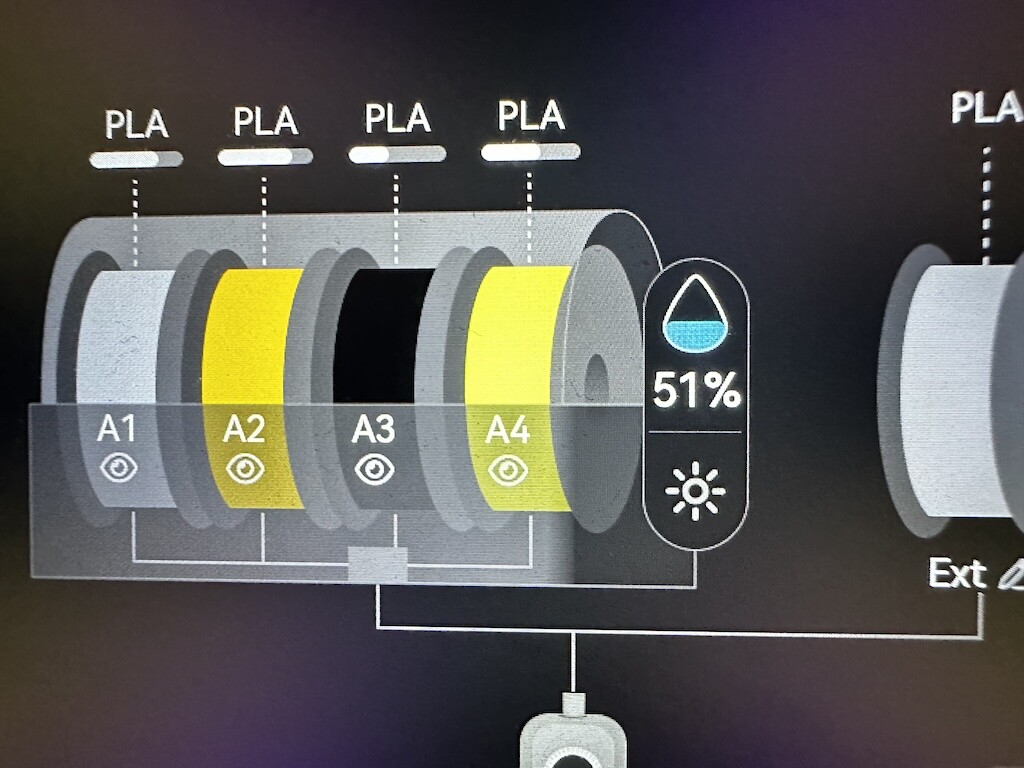
I dry it (pla) once when I open a new roll but beyond that just bag it with desiccant. If nothing else, keeping it in a bag or box of some type, rather than out in the open on a rack, keeps it clean and dust-free.
ps… if you vacuum-bag filament, put the desiccant container out in the circumference of the reel, not the center. The center gets sealed off from the rest of the volume in the bag when you vacuum it down.
Unfortunately, most of these discussions skip over the crucial variable - the actual manufacturer of the filament. Not all PLA or PETG is the same. And those ingredient additives make a world of difference in how one should handle the filament for printing.
Personally, I defer to the individuals that actually make the filament that I utilize. They’d know best. As one example - the plant manager for one of my filament suppliers is very clear - neither need to be dried. So I leave my PLA out in the open. I keep that manufacturers PETG in vacuum bags as a precaution and convenience as they’re stored with all of the other PETG (don’t want to make a mistake). The manufacturer suggests that I do not dry their PETG. I merely adjust the flow and temperature when the PETG begins to produces strings. It solves it each and every time. Fantastic filament.
Another example - the Bambu Lab filament - I dry the PETG. That is the recommended action. If I experience stringing, I fine tune the flow and temperature. It solves it each and every time. Does that infer that I didn’t need to dry it? I honestly don’t know. But the supplier is clear - dry it. So I do.
I leave ALL of my PLA (minus SILK and TRANSLUCENT) out and have never dried any of it, regardless of manufacturer. I’ve never experienced anything remotely off with any print. The SILK and TRANSLUCENT do require special handling, which I follow. Even with that, I have lost an entire spool of TRANSLUCENT Bambu Lab due to brittleness. It was stored in a vacuum bag. It was dried. It didn’t help. That stuff is not great filament.
The lesson here - There’s a very clear line of demarkation between those that “have to dry” PLA and PETG vs those that live in the “doesn’t require it” camp. And that strip of land in between can get seriously pockmarked with concussive statements.
I’d suggest you do whatever it is you want to do and treat it like your bathroom habits - not up for discussion. Otherwise you’re likely to get some seriously mixed signals from others. And those signals would be expected as we most likely utilize different filament manufacturers for our chosen supplies. Do your research on your chosen filament and follow those guidelines. Best to you on this.
For the most part, yes. A few outliers. I use a combination of the “typical” choices and some US manufactured filament. There are definite differences in the additives. And as such, they are not handled the same when dealing with drying, temps, and other nonsensical things. SUNLU will soon be manufactured in the US. That will be another interesting variable. Looking forward to where that path may lead.
How do you come to that conclusion? I’m very convinced that Sunlu, eSun and Polymaker are independent manufacturers. Especially Polymaker has many unique PLA filaments. I also see subtle differences in the surface texture of equivalent PLA types. Especially on matte PLA, I explicitly ordered 2 spools from a bunch of manufacturers. The only two that were indistinguishable were white bambu PLA matte and Polymaker Polyterra PLA. All others had slight differences when printing and in the final objects.
I have read many many times about there are only 3 real filament manufactures in China and that all spools come from those three factories. Never a proof, a document…
But it gets repeated so many times finally it gets as a “fact”.
What I think from experience is that you only need to dry your filament if you’re having issues with it. With harder-to-print materials like TPU you should definitely dry it. Dry it overnight if you have no long prints you are trying to do, then leave the filament in the AMS Pro 2 and then print! Try not to take the filament out if you need it dry for a week or smth. I dont have an H2 series printer but this is what i’ve learned from the P2S!
eSun:
exists since 2002 and is a manufacturer of various organic materials and chemicals. they only started dipping their toes into 3d printing in 2007. so filament for 3d printing is more of a side business for them, although it has grown very fast.
they are a listed company on the chinese stock market with anual sales of ~47b $
Sunlu:
is much younger (2013), a private company with estimated sales around 100b $
Polymaker:
Exist since 2013 too but is financed by venture capital. estimated sales are 14b $.
30-45% humidity in my house, store all my filaments openly, and have never dried a single one. ABS, ASA, PETG, PC, all print just fine at those humidity levels, for me anyway.
Oh sorry, I mixed up the letters. Please replace “b” by “m”
“Billion” has different meanings in German and English, so I concentrated hard on not mixing them up whole completely missing, that the “million” relevant here is actually exactly the same
Since humidity is measured in relative terms, high humidity isn’t always the same. The Pacific Northwest has high humidity, much of it being in a rain forest. Yet it never feels muggy like it does in the Southeast. In the Northwest the highest RH tends to be during the colder part of the year when the air holds less water. Whereas in the Southeast, the air is warmer and holds more water year round.
Which is why dry boxes work so well, the desiccant removes moisture from the air. Whereas heating in a warm humid environment can be a bit counterproductive as it allows the air to hold more moisture,
I have desiccant in my AMS units inside printed desiccant buckets.
If I remove any filament I store it in a sealed bag where I can pump out the air so it’s air tight.
Otherwise I do nothing else. I primarily only print PLA, using PETG as a support interface at times. I have never dried any filament to his day, after several years of printing. Humidity in the room is generally around 45-50%. No issues.
I would only dry more specialist filaments - like nylon, which I don’t use anyways. PLA and PETG are fine as long a they are stored properly and not left out in the ambient air for months at a time!