There actually are. Just a quick look and the cobalt indicator looks like cobalt chloride. Negligible vapor pressure at room temperature but it rapidly climbs as it’s heated.
Anyone using cobalt indicators should look up the specifics and use due care in handling.
Best info I can find is that cobalt chloride does not produce vapor below 500°C, and then only in the presence of HCL gas. Otherwise, the melting temperature is 735°, and none of the vapor pressure charts I can find start before 1035°C.
Recommended drying temperature for desiccant with cobalt is typically only 110-120°C.
I doubt any cobalt is escaping the desiccant in a conventional kitchen oven at recommended temperatures.
Are you looking at the hexahydrate? That seems to be the form used in humidity indicators and shows a 40mm Hg pressure at 770C - very hot. It will be much lower at dehydration/regeneration temperatures though and agrees largely with your findings.
The problem comes in permissible exposure limits (PELs). It looks like 0.02mg/m3 is the time weighted limit set by an industrial hygiene body. That limit is 20 micrograms per cubic meter. Pretty low.
The calculations would get more involved to find vapor pressure data at regeneration temperatures but those calculations or similar data would be needed to say if heating cobalt chloride in a kitchen stove would be safe.
Another problem with kitchen stoves is the evolution of cobalt with revolatilization when cooking food adding another exposure pathway besides breathing.
Cobalt exposures can have nasty consequences. Nerve damage, heart problems, lung scarring, and cognitive decline.
I can’t tell anyone what to do but with very low exposure limits, very low vapor pressures can still be an issue. Older people can get by with lots of stuff and escape long term consequences (by dying), but younger people have their whole lives to possibly regret exposures.
But do as you wish. There are non-toxic indicators out there and meters that don’t care if there is any indicator. It doesn’t make sense to me to risk it especially where families are concerned especially if small ones are in a household.
At 120°C, cobalt hexahydrate is decomposing and does not exist as a stable, pure compound. The substance loses its final water molecule between 120-140°C to form solid anhydrous cobalt(II) chloride. (CoCL₂).
Cobalt(II) chloride hexahydrate melts at approximately 87°C and begins to lose its water of hydration, effectively decomposing. It loses all water at 120-140°C to become the blue anhydrous form((CoCL₂).
Anhydrous cobalt(II) chloride (CoCL₂) melts at 740°C and vaporizes at 1049°C.
Due to the decomposition of the hexahydrate and the very low vapor pressure of the solid anhydrous form at 600°C, a precise, usable vapor pressure for the user’s specified compound at that high temperature is not a meaningful value in a practical sense, as the substance would be the solid anhydrous salt (CoCL₂).
Most domestic ovens top out around 290°C
Some specialized ovens (pizza) might reach 400°C.
Self-cleaning ovens might get close to 550°C in the cleaning cycle.
Even if you try, you cannot vaporize cobalt chloride with typical ovens.
Don’t eat your desiccant, don’t inhale the dust, wear gloves and wash after handling.
I know this is already marked as solved, however to answer your original question: the instructions that I have read from Bambu Lab mentions that you can dry your filament on the bed, so I’d imagine the same would apply to the beads. Just food for thought.
To the original question, I’d love to know how to use the heatbed to do this, specifically how to keep it on for a set number of hours. I’d previously done this using gcode hacks on a Creality Ender 3, but I’ve not tried it on a Bambu and I’m not seeing resources/walkthroughs on it.
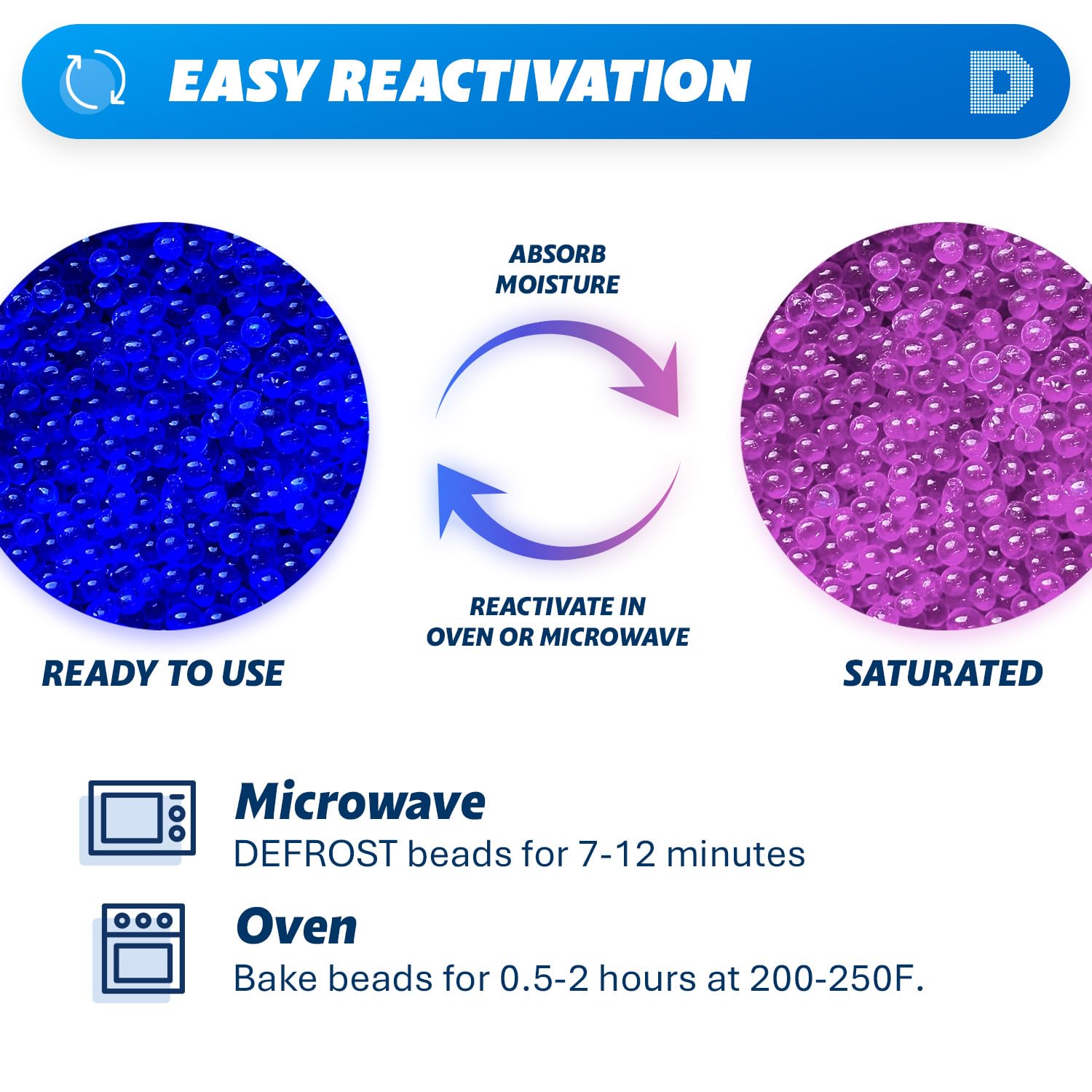
I emptied my beads into Pyrex, glass baking pan, then put them in microwave on defrost for 12 minutes (one of the silica manufacturers suggested this). I ran them through the defrost for 12 minutes 3x and the beads have returned the color.
I don’t want to use an oven or microwave where I prepare food for drying my desiccant beads.
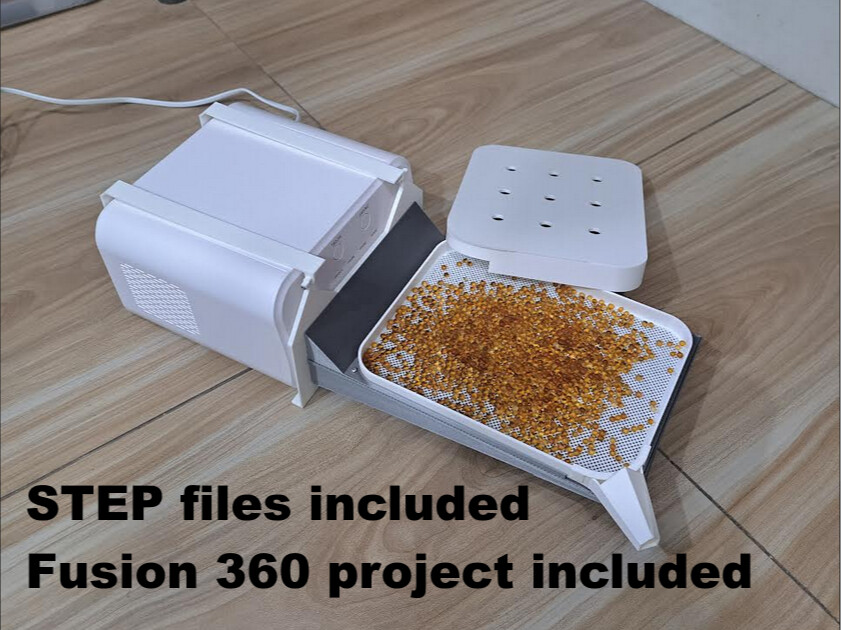
Using the print plate is out of question as well, so I looked for a cheap solution.
Got tired of drying desiccant in filament dryer, made these PD USB Rechargeable Desiccant AMS / Spool Dry Pods - print 4 for the spools and 3 for the AMS. Remove and plug in to recharge.
I set my microwave to 40% (1200W max) for 7 minutes to dry around 2 cups of beads. At the end the indicator beads are bright orange. I put the beads in a small shallow ceramic oven tray which is then put inside an open cardboard filament box. Even at 40% the beads and the tray are extremely hot, but the cardboard box remains warm and can be handled. I store the beads in a glass bowl with a lid for an hour or so while they cool, then I put them back into a silica gel container. Ive been doing this for more than a year with no obvious deterioration to the beads
Yesterday I made a tactical error: Beads, microwave, full power, stepped into another room for a conversation. Returned to smoke in the microwave, and well-cooked brown beads, and very stinky (and probably toxic) smoke.
I was more sneaky. We had a gas range that I’d been wanting to swap out for a while so I proposed a nice inductive cooktop range with precision temperature control in the oven. Supposedly it holds to within a degree and has low temperature cooking modes perfect for regenerating silica gel beads.
I’ve only done one batch of beads with it so far but no issues, no odors, just nice dry orange beads. The precision temperature control in the oven was a key feature when I was checking out ranges. Luckily my wife just wanted a better stove and was fine with the one I decided on.
And to anyone who doesn’t know already - never regenerate the blue silica gel beads in an oven used for food. It’s probably not the best to regenerate silica gel in food ovens anyway, but blue beads use a cobalt compound for the indicator. You don’t want cobalt in your oven.
In legitimate industry/lab use, nobody would use food ovens or microwaves for dehydrating desiccants. In labs and industry there should be stickers/notices on stoves/microwaves/fridges that forbid them for food use and should be SOP.
Cobalt (II) Chloride is a carcinogen with various health effects from exposure. At least from what I found the take is it’s not a really bad health threat but if you’re the one that gets cancer, it’s small consolation.
And when you read a few anecdotes, it’s not uncommon that people overheat their beads while drying them. That liberates extra cobalt and is extra exposure. Each dinner cooked in the oven or microwave after that happens may get a little dose of cobalt too.
Thing is, the green/orange indicator is an organic dye that is considered non-toxic. It does have health issues and even has a possibility as a carcinogen itself at very high concentrations. But that’s at really high concentrations.
Anyway, Dry & Dry might want to clarify those directions. In legitimate laboratories and industry, there would/could be discipline involved for putting what is considered “chemicals” into food use microwaves and stoves and those used would be properly vented.
Thing is there are lots of processes that companies make available to consumers that carry health risks. The public largely ignores the warnings at our own risks.
There really is no reason to use the cobalt indicator beads - which also are supposed to disposed of as chemical waste when all used up. Especially when non(less)-toxic beads are available that are just as good.
In the electrical industry we used industrial ovens to keep our desiccants viable. In Wyoming, they were set at 140°F, and had large trays the blue desiccant was spread in to dry. So not food ovens. Laboratory grade ore drying ovens repurposed to dry the desiccant.
In the utility, we would remove the damped desiccant, clean the breather, put the dry desiccant in and the spent desiccant was sent downtown to be reconditioned for reuse. These were breathers for big transformers.
At this point, (76 yo) after all the crap I’ve worked with, and chemicals exposed to if I was dead tomorrow it would be because I was too old to keep livin. Not desiccants.
I can appreciate your concern, but I’m just too experienced to take the advice or to give a damn. Here in California EVERYTHING is carcinogenic. So it depends on who’s talking.
MZIP was talking more generally. If you understand and accept the risks for yourself, fair enough. Life is full of trade-offs.
Many people that come here will not have any inkling what-so-ever of the issues with dehydrating dessicant beads in the same microwave/ovens that get used for food. This is especially concerning in situations where they may be preparing food for vulnerable populations like young children.