I love the Handy integration and design of the new air purifier and would love to buy it but…
The price on the filters?! I would not mind the price as much but they also recommend replacing the enhanced $70 filter every 15 days if you print often?! Thats $1680 a year in filters! I really hope they lower the price or do a bulk pack sale on them. If that does not happen I look forward to AliExpress decent quality knock offs.
Replaceable Disposable filters are such a scam. Partially because it’s tricky to quantify usage/efficiency effects over time. In many cases a good vacuum will extend the life. Washable is where it’s at though.
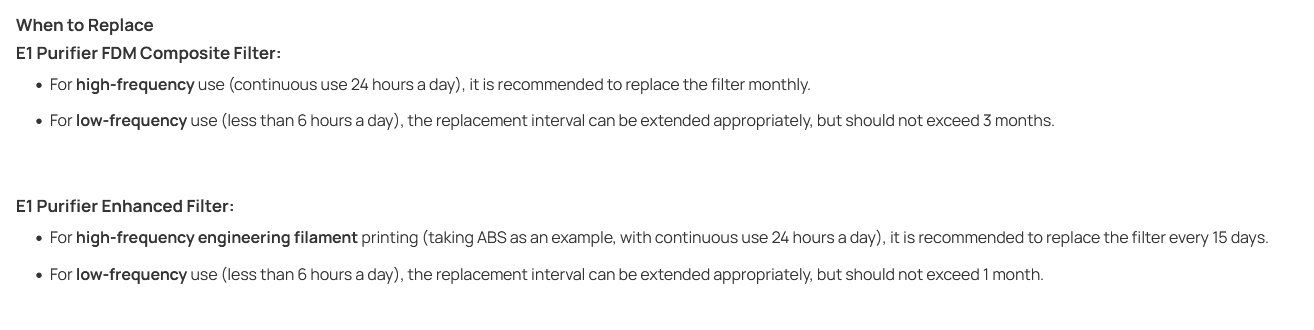
E1 Purifier Enhanced Filter:
For high-frequencyengineering filament printing (taking ABS as an example, with continuous use 24 hours a day), it is recommended to replace the filter every 15 days.
For low-frequency use (less than 6 hours a day), the replacement interval can be extended appropriately, but should not exceed 1 month.
Uh, so if used 24 h/day then it’s good for 360 hours, but if used less frequently then only for 180 hours? Does some volatile ingredient expire after a month? (I doubt it!)
Never mind that it’s the actual trapped particle count that matters, not “usage time.”
If it was so smart it could measure input PPM as well as output, and flow speed to judge efficiency (cloggage).
IMO, Bambu is famous for not saying what they are trying to say. I is my understanding that these filters have active carbon in them - and that becomes less effective over time as it absorbs particulates from the environment. Hence, you must change the filters periodically to remain useful, even when you have not printed very much.
Still, the price is outrageous. Even if you drop back to the monthly replacement frequency to avoid breathing in those ASA fumes, you are still talking $840 USD per year! Indeed, the price needs to come down or they need to offer them in bulk, or something. That price is too expensive for the E1 product to survive.
Well, for the price of a filter one can buy quite a bit of activated carbon/charcoal granules in bulk. I don’t know how much the filter holds of course. The paper parts can be vac’d/washed (in theory).
Granules can last for months or a year, or longer depending on filter design, but it does depend on amount and usage and environment. If the unit sits in a smoky/dirty and humid environment, then yea the effectiveness could slowly decay passively, but that’s unusual. The only way to really measure effectiveness is particles in vs. particles out (and that has caveats as well). This can all be researched online of course, don’t take my word for it.
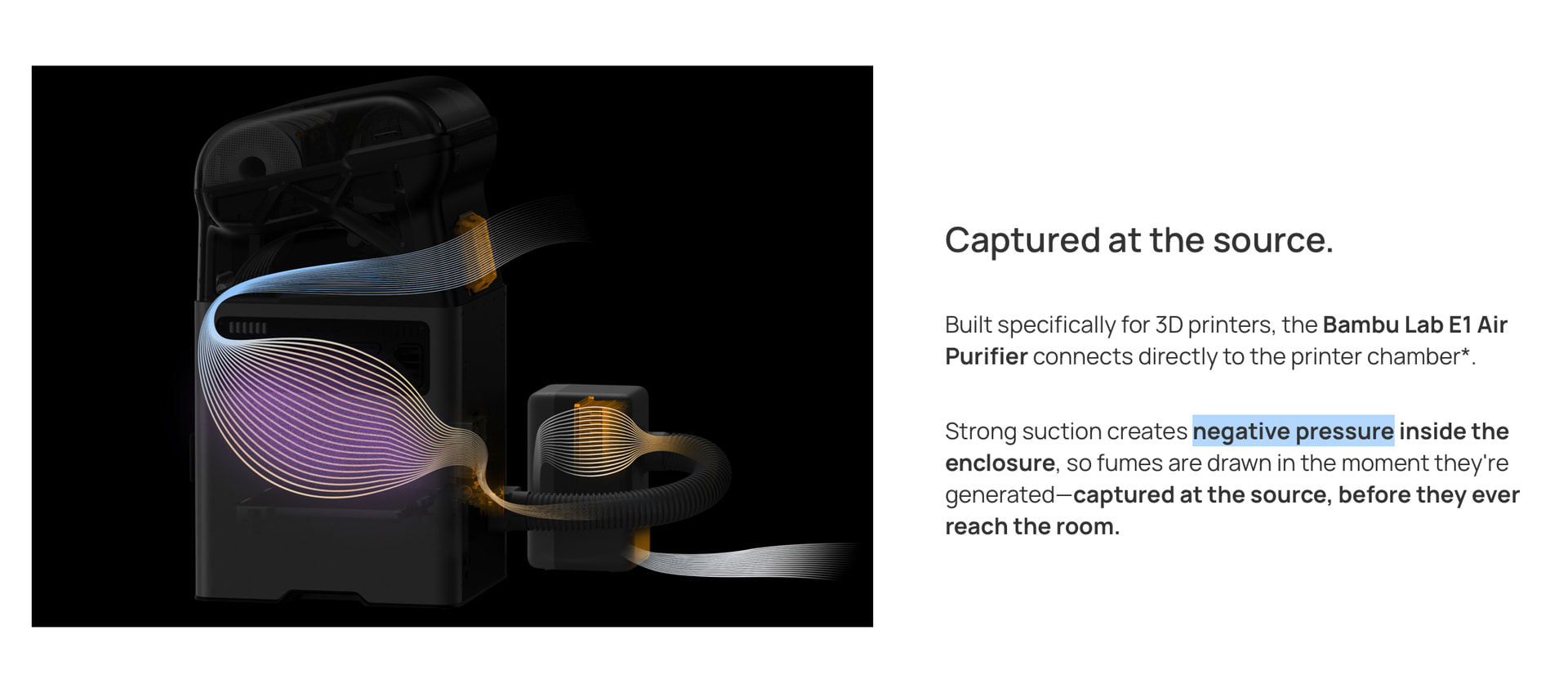
If you haven’t done piping laser or printer exhaust before, you usually don’t want to pressurize a hose and pipe it, you want a negative pressure at the egress (like the window).
Nah, I have already done 5x ducts 2-way 3-way splitters whole bunch of inline fans one-directional valves in the shop, works great. “Negative pressure” as in inside the printer chamber to draw air through the enclosure gaps. Not sure why the misunderstanding it’s the term I’ve seen a few times used for printer fumes including Bambu on their E1.
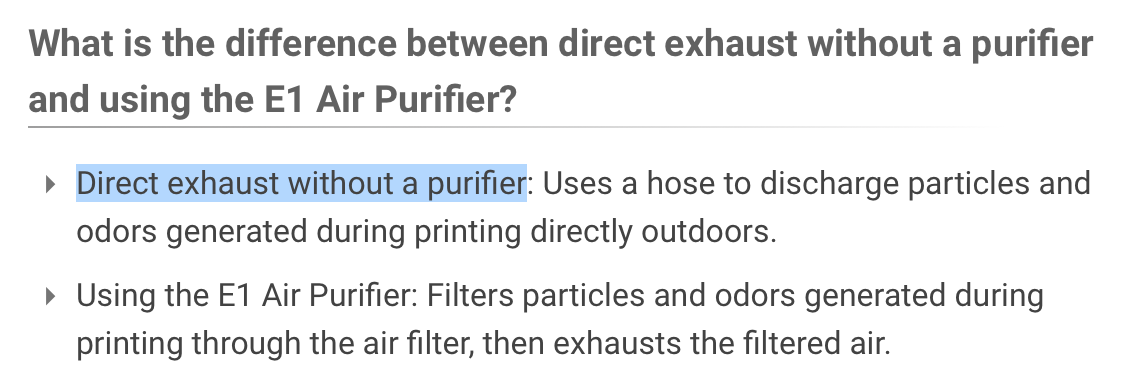
Again, I was literally just saying using the E1 without its filter, venting everything straight outside, thus, implied, without having to spend extra on the filter. Because bambu literally wrote a line maybe unintentionally in the wrong way in the wiki made me wonder if they meant this being a feature for the E1
Also, this is probably a dumb question but I currently own a P2S with the exhaust kit and vent it outside. Could I essentially just install this on the back of my H3C, use the hose on the back to a check valve, then to a T off the P2S which will also have a check valve going to the T? I think I worded that correctly lol.
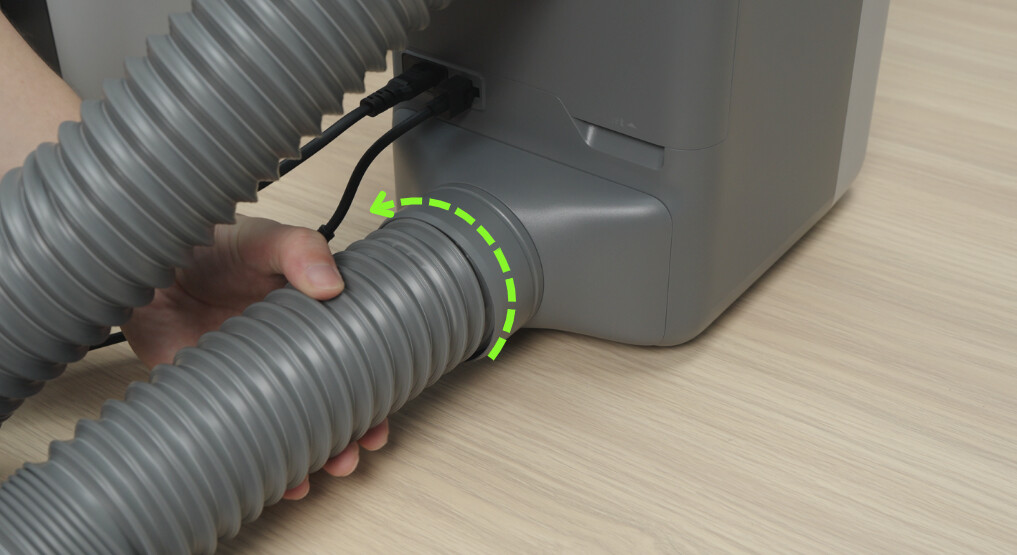
If I take the adapter off the hose, the OD of the hose is 70mm and the ID is 60mm (When collapsed). The OD of the fitting where it presses into the machine and the adapter you have to print is 71mm ( Where you see the o-ring).
Also I bought one for my H3C and H2D. Both that came are absolutely identical, same part number. So if the H3C is out of stock you can get the H2 series. The only difference is they threw in a bag of BT3x8 Screws. Not even in the box for the purifier, they threw it in the shipping box. The screws are just to hold the 3D adapter that you have to print to the H2 series printer. On the H3C you re-use the factory screws on the back of the machine.
I made a TPU seal for the adapter where it connects to the 3d printer. Its the only spot that doesn’t have 0-rings or a gasket on the inlet side of the purifier. Figured every little bit helps.
FYI on the H2D i have to either un-plug my TPU feed assist module or get some sort of splitter. The AMS’s have two 6 pin ports but the H2d and feed assist module only have one port. The back of the H3C has 2 ports. So basically my TPU feed assist is the end of the line. You can turn the fan on manually with the button on the top of the E1, so it will work without the 6 pin, it just wont be automatic.
I assume the filters aren’t chipped, but what happens if you turn it on (and prints) without a filter inside? Does it throw errors? Might sound dumb but I’m thinking if the thing still runs and can just vent dirty air outside
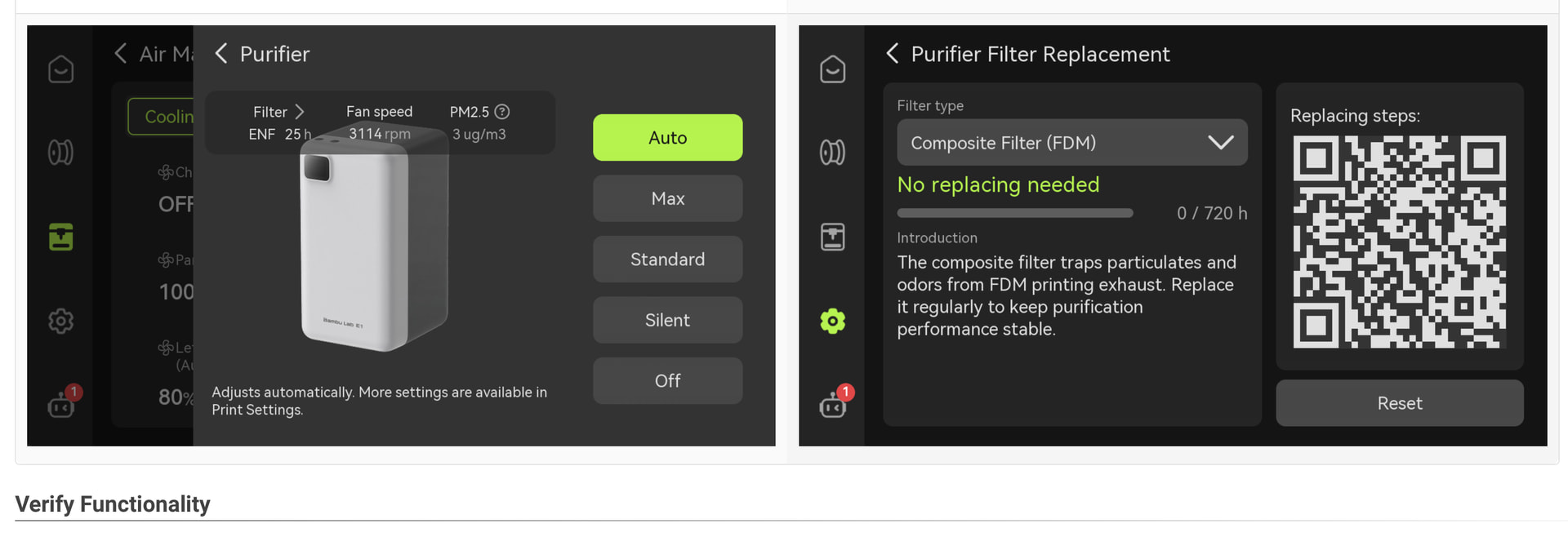
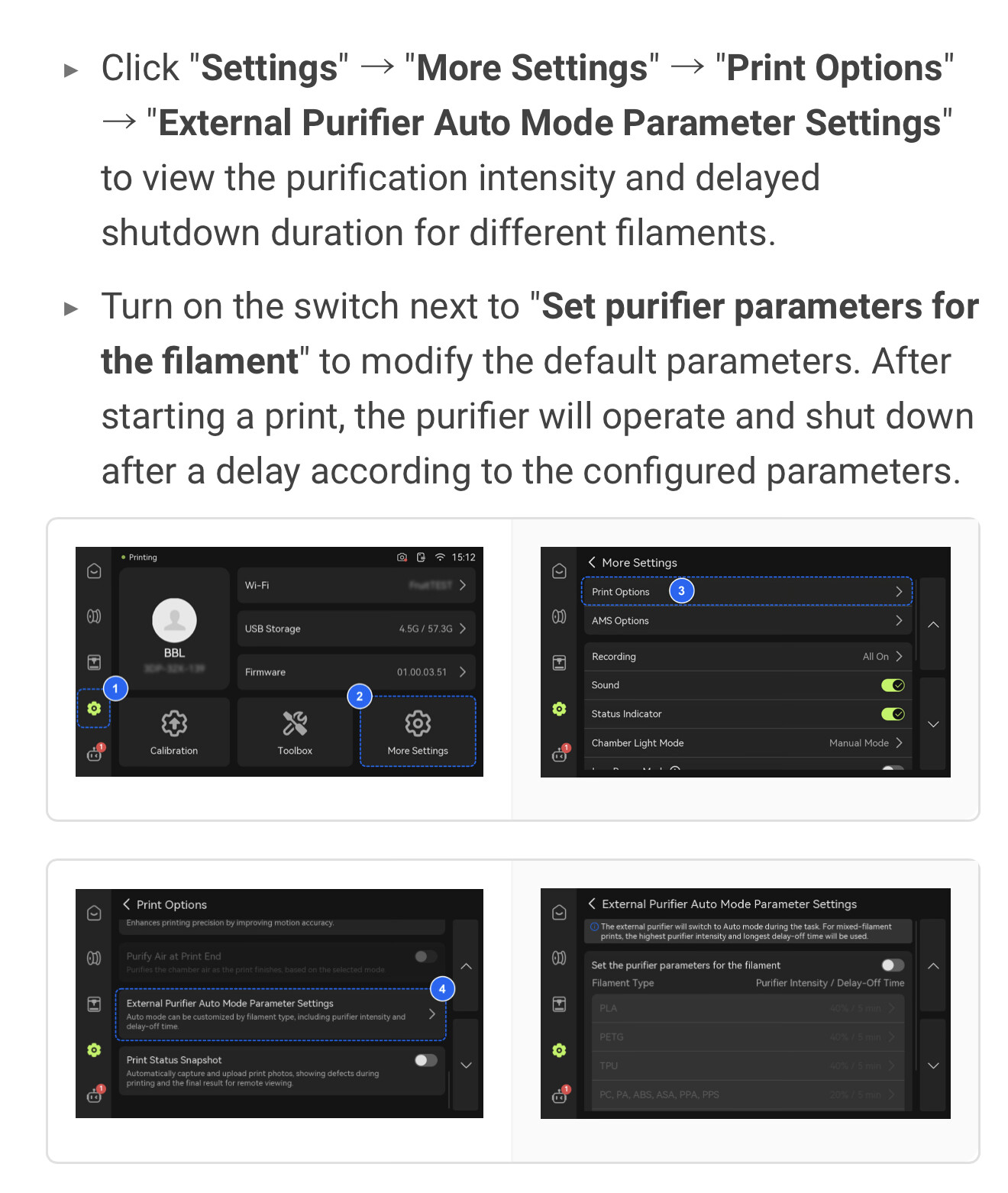
The lowest they go down to is 20% (Settings are 20, 40, 60, 80, 100%) and then there is a "Delay OFF time) ( Settings: No-delay, 5min, 10min, 15min, 30min).
I pulled the filter and it still runs. The filter element is massive for what it is. Its 110mm Deep, 130mm wide and 170mm Tall. The filter is a sealed unit. I can’t tell if you can take it apart and I’m not about to start pulling on the foam seal.
If you want to vent outside you will need to buy another hose. it comes with ONE hose and an adapter for the exhaust hose. If you buy the right hose you can thread the adapter on it.
When running HT-PLA-GF I usually have a nasty smell from it and with the purifier I have no smell in my office.
If I pull the filter out it will still operate as normal. Also while its running you can press the FAN button on top and turn the fan off, Low Med, High, or AUTO.