Yes that is why the inverter ones are so desirable. It might pay for itself for you to buy a high SEER mini-split and just put both sides inside and pump the condensate out.
Thats surprisingly expensive. I guess those things are not meant to be run 24/7.
I use a cheap 95 Oz dehumidifier for my office and it will pull about 200 watts when really being pushed, but most of the time it only pulls 50 when on.
Im guessing it is around 5 to 8 USD on my bill at 13.5 cents per kwh. I think it really depends on the rest of your home, since my air conditioner does the heavy lifting.
Yep they by default will cycle on/off to a humidity setpoint, and I measured mine at about 60watts when its just fanning and not compressing. So the duty cycle puts your bill between 10-125. … But they do have a real tempting “Turbo/Continuous” button that tells it to haul ■■■ as hard as itll do, forever.
It works, you’ll drag 20 gallons outta your air every day
But it’s spensive in electricity  The one I have is “Pelonis” and is ~1hp compressor based, drains itself, blahblahblah. If you were in california or on rural electric you might spend more on electricity in the first month than the cost of the unit!
Your experience that you relate just does not fit with mine. I don’t know why but with all the intermixing of non-Bambu printers and filaments, and reluctance to just answer direct questions, I’m not going to spend any more time with this. I know what I’ve tested and how, and I know what my results have been. If you ever determine why your results are different, you ought to tell others.
Up to you, of course. I don’t think you realize that the difference in speed between the P1S and The Elegoo Centauri Carbon is virtually nonexistent. There are small variations as the firmware on them is updated, causing one or the other to pull slightly ahead.
I don’t know why my results are different than others. I just report my experience.
Bye.
It’s easier to identify color and plastic when in a labeled box. Apart from that, the cardboard (possibly) brings moisture and it definitely takes more space
I been storing the bambu filament in a IP-56 Class container. At arrival i throw the cardboard boxes, unopend in there, as a result, the silica turns bad quite fast. Hygrometer still stays at 10% but the orange silica has turned light green. I swap for fresh silica, and it stays orange.
I’m suspecting the cardboard is quite moist after transport. (god only knows how its been transported.) A a result, i’m wasting the power of silica on drying cardboard boxes. :-/
I’m planing on ordering a batch of ten spools of gray PETG, taking them out of the cardboard boxes, placing them in the storage box, just to se if there will be a difference.
It really could just be your location.
We had someone from Montana bragging about his 20% humidity the other day.
This time of year (May to July) we get a lot of rain, causing us to get 80% and up humidity outside.
We usually run our air conditioner though, and the basement, as I mentioned, runs between 45 and 55% year round.
Finally back. I had dried the desiccants in an airfryer using its drying mode. Evidently this did not work as well as expected. So I reverted to using our standard oven (a combination convection/steam unit that we hardly use anymore) to dry the desicants. I can also use this oven to dry multiple spools of filament as its holds the temperature +/- 2 degC.
Anyway, I also realised that adding 10 drops of water to the test setup was far too much and would result in the desiccant taking a week or more to absorb the water. I have tested using 3 drops and that took 4 days to get to down to 10% humidity. What I did find is that the new grey bags performed much better than the blue food type vacuum bags.
So this basically was all that I was looking for. I have now dried all of my filaments, put them in the grey bags along with a dried desiccant. I have only partially vacuumed the bags so that there is no tendency for the vacuum to try to pull in more air/moisture. They all show 10% humidty (it seems we use a similar digital indicator where 10% is the minimum reading).
Now I will watch them over months I guess, and see how things go. I have also bought a Sunlu AMS1 heater which is working well.
Oh, I opened a new Bambu filaments today and to my surprise noticed that its a reusable bag. Sadly I haven’t bought very much Bambu filament product. But this looks like a nice solution, I wonder how many folks use this bag for storage? A metalised plastic material.
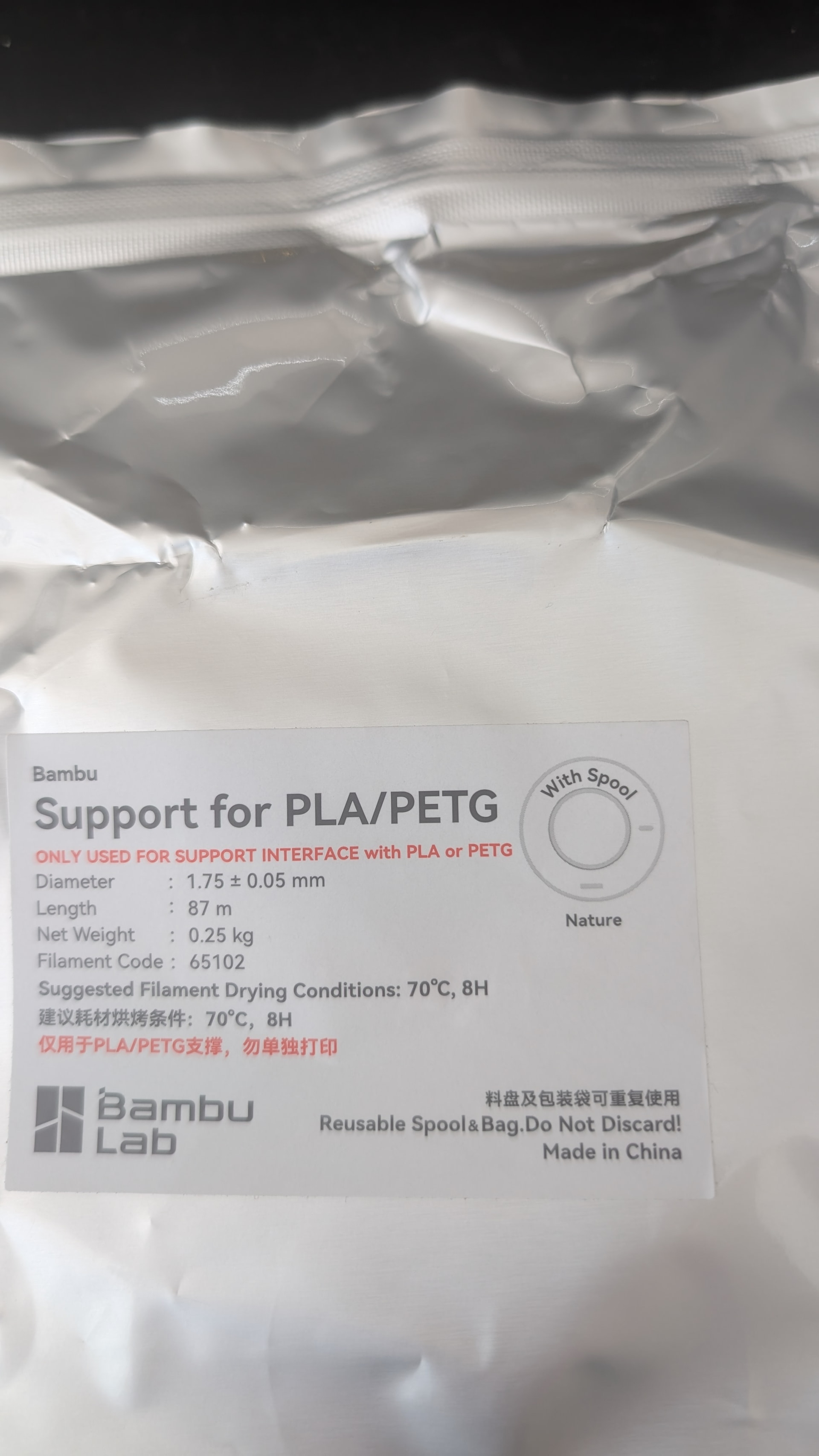
The metallised bags are the gold standard and allow almost zero water to diffuse through. BambuLab only ships some selected Filaments in those bags that are especially hygroscopic. So you probably didn’t miss much buying elsewhere.
And they are more expensive. It’s a big deal in the food industry. Lots of products come in metallized bags. Leave some contents out and exposed to air or put in a ziplock bag and depending on what it was you could have soggy/stale/soft crackers, chips, or whatever.
Its a nice bag, metallised and a press type seal. I tried to find a source on Amazon and also a wider search but couldn’t find any similar 30x35cm bags. The largest that I could find are 25x30cm. I was just curious, no real intention to purchase any atm.
I’m simply using a Seal-A-Meal vacuum storage, with 16” of 11” wide bag material.
I do stop the vacuuming when it begins to crush the spools.
Holds vacuum extremely well. The length allows it to be reused at least once. Much cheaper than a cereal box.
The flipside to this coin is to use it fast and not have it around to worry about. 
I’m sure you could get them cheaper in bulk from other suppliers.
One of my IRL friends has a ‘printer closet’, a relatively small space with a weatherstripped door and a dehumidifier. Any filament he’s opened is in racks with special bags or containers.
While those bags hold vacuum really well, they still allow water vapor to diffuse through the foil at a surprising rate. Almost all plastics let water vapor through, some faster, some slower. So for long term storage you really want walls in the range of mm to slow down diffusion to an acceptable level. Do you measure humidity inside your bags? If not you would be surprised.
Recently bought a Sunlu E2 (from the Sunlu site) to help with the drying issue.
Couple of uses so far. Seems fine.
Very good prices and free shipping to many areas, where they have established warehouses.
I think that this is the way to go. So far I cannot find this size bag on amazon.nl or .de the 1.5 gallon bags dont seem to be available. I notice on amazon.com 20x cost $43.89 but the same can be bought from Walmart for $23.35, not that it helps me. But how do you use them, as I think vacuuming isnt a possibility?
I use a desiccant holder in the center of the spool and just push as much air out as I can while closing the seal.
Yes, actually I do. I put a shorty desiccant holder and a printed adaptor to hold a Hygrometer in the spool. I had my reservations about exposing the little round Hygrometer (the battery particularly) to the vacuum in the bag, but for me it worked fine.
I’m such small potatoes; I don’t have things stored for long. That was why being able to reuse the bag material was good. Not sure what you mean by foil, no foil in the material I use. Are you meaning the Mylar bags? Not for me. Trying to use what I have on hand. Dual purpose is a point for me. Anyway, it’s been working for me.
Then I used the wrong word apparently  I meant the plastic sheet, those vacuum bags are made of.
Great that it works for you! If you use up your filament quickly, they certainly are a great option. 
I’m still on vacuum zip bags, but maintaining low humidity in 15 bags for longer time has become a logistical challenge and I want to switch to something more efficient.