Many people have different opinions on vacuum bags,
I bought some because they are cheap and curiosity got the better of me when I wanted to compare it to Sainsbury’s freezer bags that would tear if you looked at them wrong.
Myths/debates I set out to solve:
- Putting silica gel in the centre of the spool seals it off and makes it useless
- Vacuum bags don’t hold a seal and tear easily
- water permeates through the bag
So I went off to test these starting with the first one
I first put a new bag of silica gel (I used the one that comes with elegoo filament because my loose silica gel has degraded so it can’t get under 30%RH) into the centre of an empty kingroon spool, since these are the only plastic spools I have empty ones lying around.
I had a hygrometer in the centre of the spool and on the edge of the spool.
At first the hygrometer in the centre read 64% and the one on the edge read 67%
minute 10: centre; 36% edge; 66%
minute 20: centre; 20% edge; 59%
minute 30: centre; 20% edge; 59%
minute 60: centre; 10% edge; 58%
24 hours: centre; 10% edge; 52%
48 hours: centre; 10% edge; 49%
next when I put the silica on the edge:
at the start the centre read 74% and the edge read 65% however the high reading may have been due to holding the hygrometer In my hand however the readings after 5 mins should be accurate but I can be treated as 65% for the start
minute 10: centre; 60% edge; 57%
minute 20: centre; 59% edge; 56%
minute 30: centre; 57% edge; 52%
minute 60: centre; 54% edge; 45%
24 hours: centre; 43% edge; 32%
48 hours: centre; 40% edge; 29%
from this we can see that despite diffusion meaning it should even out if there is even the tiniest hole it is still always much drier where the silica gel is located and I would consider this myth true since moisture on the wetter side of the spool likely went through the hole in the centre o the spool where filament is secured in at the start of the spool during manufacturing but when the spool is full this hole would be plugged and have many layers of filament in the way.
Myth 2.
I have used the vacuum bags for 1 week and none have torn and the bags are slightly thicker than ziplock bags maybe 1.2x as thick and these are much better than my supermarket own brand bags that would develop holes because it would crinkle due to its thickness of about ~1.4x as thick as cling film and the crinkle would make a tiny pinhole hard to notice just around the crinkle.
now comparing to the vacuum bags:
I tested it like a real world condition by putting the bags onto a surface ,with the bigger face facing up and down (micropore down and smooth up) , and sliding it 30cm to the side and leaving for a day.
I would do this every day and see if it lasts 7 days or if it doesn’t what day it fails at and if on the first slide then I will mark as failed.
The smooth wood is the wood in furniture that is treated and covered in a glossy coating so it is as smooth as plastic but not as thick as resin coatings.
The rough wood is similar to a fresh dry 2x4 on the side where it is not like a tree but rough enough to give a noticeable texture in between a textured pei bed that has spikes in the pale of the smooth bumps and a matt finish.
The new tarmac is just a fresh brand new tarmac driveway.
The ‘absolutely ancient Bri’ish road’ is like a poorly maintained old ridged concrete road like some found on semi private land between enclosed houses like in a cul-de-sac.
The first row is the sainsbury’s freezer bags and the second row is the filament vacuum bags.
| smooth wood | rough wood | new tarmac | absoloutely ancient Bri’ish roads |
|---|---|---|---|
| Pass | 4 days | 2 days | failed |
| pass | pass | pass | 5 days |
In conclusion this gruelling torture test shows that the vacuum bags are very robust and that this myth is busted and it tearing is due to scrunching it up making stress points or due to leaving exposed filament ends which can tear when vacuumed, however the scrunching of the bag being vacuumed has not caused me any problem after many vacuum cycles so it is only if you scrunch it up into a ball that it could tear.
and also for my bags that I use under normal conditions without testing it or anything they are holding a seal very well and I have not had any problems however people who have had problems may be having seal issues such as using a finger to seal the bag rather than my meticulous method of sealing twice from one end to the other one each direction get the the edges whilst squeezing hard.
Myth 3.
I have been confused why my supermarket freezer bags had been only getting down to 30% even with desiccant that would reach 10% in a dry box and I had assumed that water had permeated through the bag due to the bag not being strong enough to resist the forces of diffusion when the inside was under 30%.
I had heard similar things about these vacuum bags so I had to test it out in some way or another.
Test method:
I started by putting some desiccant into the bag and sealing it shut whilst measuring the humidity halfway to the other side of the bag.
I used a container of the fresh loose desiccant I had left in a sealed bag with some filament for a long time so this was not degraded by regeneration cycles with the rest of the desiccant but I dried it once after I found it in the bag.
Note: using a different desiccant does not make this an unfair test because I am using the same desiccant throughout this entire test and it is only different to the other tests which we are not comparing to.

an image from the start

10 mins

20 mins

30 mins

1H

24H
It seems that water does indeed permeate through the bags.
Now when we have a problem we don’t just moan…
we moan for 10 mins then find a big brain solution.
Now I wanted to see if double bagging is as effective as a dry box.
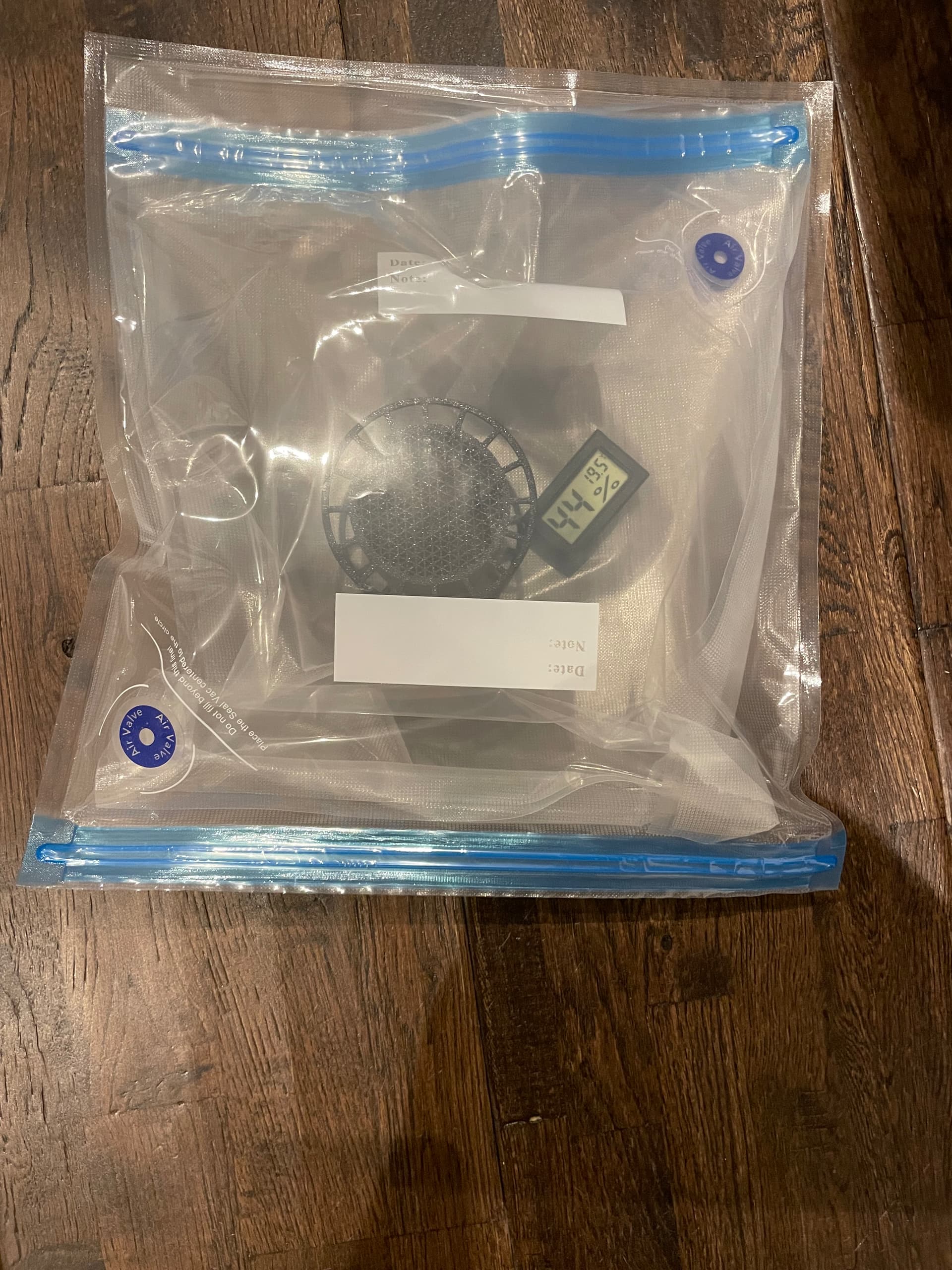
double bag after 5 mins (this was the first photo because it took 5 mins to put the bags in each other)

double bag after 10 mins

20 mins
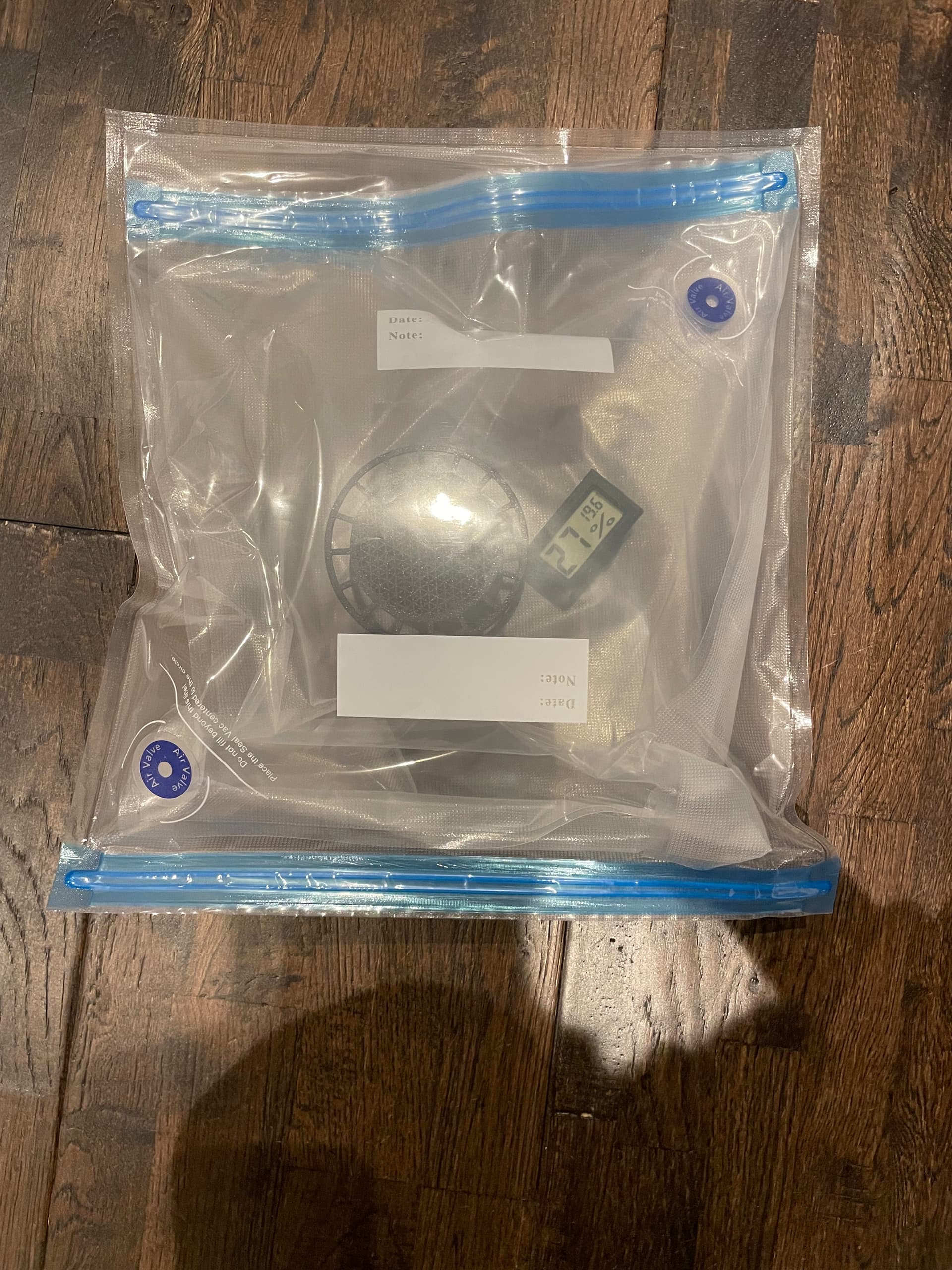
30 mins

1H

2H

24H
from this we can see that a similar thing happens with the vacuum bags and water is definitely permeating through because a dry box gets down to 10%RH with this desiccant in this container within 30 mins so water must leak in somehow.
In conclusion this myth is confirmed and double bagging is an effective way to store filament and will not take too long to fit one bag into the other if the bag on the inside is vacuumed unlike in my tests.
real life use on filament vacuum bags:
I have not needed to flatten the seal after vacuuming but I have sealed and vacuumed a bag with and without doing this however it may make a difference as the ring around the hole in the centre of the the seal becomes white after vacuuming indicating that the two sides aren’t pressed together and it turns dark blue after pressing with my fingers.
Despite not having issues with the seal the blue stickers are sometimes slightly misaligned so I would understand if others are having seal issues however if it is for every bag then it is likely due to user error.
The silica gel included with my bags turned out to be bentonite/montmorillonite clay and the bags looked similar to the bags that come in Kingroon filament which also was this type of scammy clay formed into balls to feel like silica gel just the packets were smaller in the bags.
The humidity indicator is not really worth it so I didn’t get mine with it as there isn’t really anywhere to put the humidity indicator card so it is pressed against the wall so there is no air touching it and also if it is sealed then it will always be low enough if it is double bagged with desiccant and shows no sign of leakage like ballooning outwards.
In summary we can see that to put this into practical use we know that you should,
use the desiccant on the outside of the spool
not have to worry about tearing as much but problems are more likely caused by incorrect sealing
double bag the spools with the one on the inside vacuumed but your choice on the outside
use your own silica gel if the bags are the white paper ones with bold black text.


 Used up a box of those so far with 50% failure rate, bought ~ a month ago (they seem to change their designs often). I’ve used another brand with ~10% failure rate, though the bags are a little smaller and not as easy to deal with (“Domivio” brand large size,