Meant for the guy ranting on Bambu policies.
Most of the issues with fully printed is the lack of a real barrel and firing pin. With a few dollars at your local hardware store, this is not much of an issue.
“Ghost guns” are most commonly the “hybrid” guns that you are talking about.
Since you are recreating the part that carries the serial number, that is what makes it the “ghost”. Although this is not exclusive because scratching off a serial number is not a hard thing to do.
I’m fully aware of everything you said. It ain’t my first rodeo on the hybrids, or putting some through their paces.
Pandora’s Box.
Interesting bit of theological history:
Little bit of back story here-
- William Tyndale started translating the Bible into English in England in 1526.
- Now the Bible in English was banded in England up until 1539 under Henry VIII (more than 10 years after Tyndale started his translation work and 3 years after his execution).
- King James I version would not be published until 1611.
Now the Key Points-
- Since Tyndale’s Bible couldn’t be published in England, a guy named Humphrey Monmouth had it printed in Europe and smuggled it over in shipments of Denim starting some time around the late 1520’s (at this time England was still Catholic).
The Question-
- What is to prevent outside government from producing the uppers, smuggling them into the US in shipments unassembled. Have local print farms produce the lower. Ship everything to dispersed assembly points, and then sold on the black market. Would these guns, since they are not registered with the ATF be defined as ghost guns (There is no doubt in my mind that this is something that the CIA would have done in a dozen different countries)?
Pandora’s Box
If it’s not illegal to print the lower parts, would local print farms even know that they where aiding and abiding a crime?
If the part files where broken down to one farm does triggers, one farm does handle grips, ect. would they even know that they where creating parts for a real firearm?
It is illegal to distribute the lower parts without the proper licensing and the engravement of a serial number
It is pretty obvious.
TBH I don’t have any experience in this are and was hoping to hear from @DMBell on this based on his experience as a gunsmith.
Again, i have no experience in this area.
@DMBell probably has more experience with gunsmithing, but at the end of the day it is not insanely complicated.
It is not illegal to manufacture the lower parts for personal use. It is illegal when you are missing the correct licensing to do so and pay your taxes. You need to hold an 07 FFL to legally manufacture for commercial sale.
Now if you get caught illegally manufacturing, thats one charge. Aiding an abetting is a hard charge to hold because you need to prove intent, so it can not be generalized as easily.
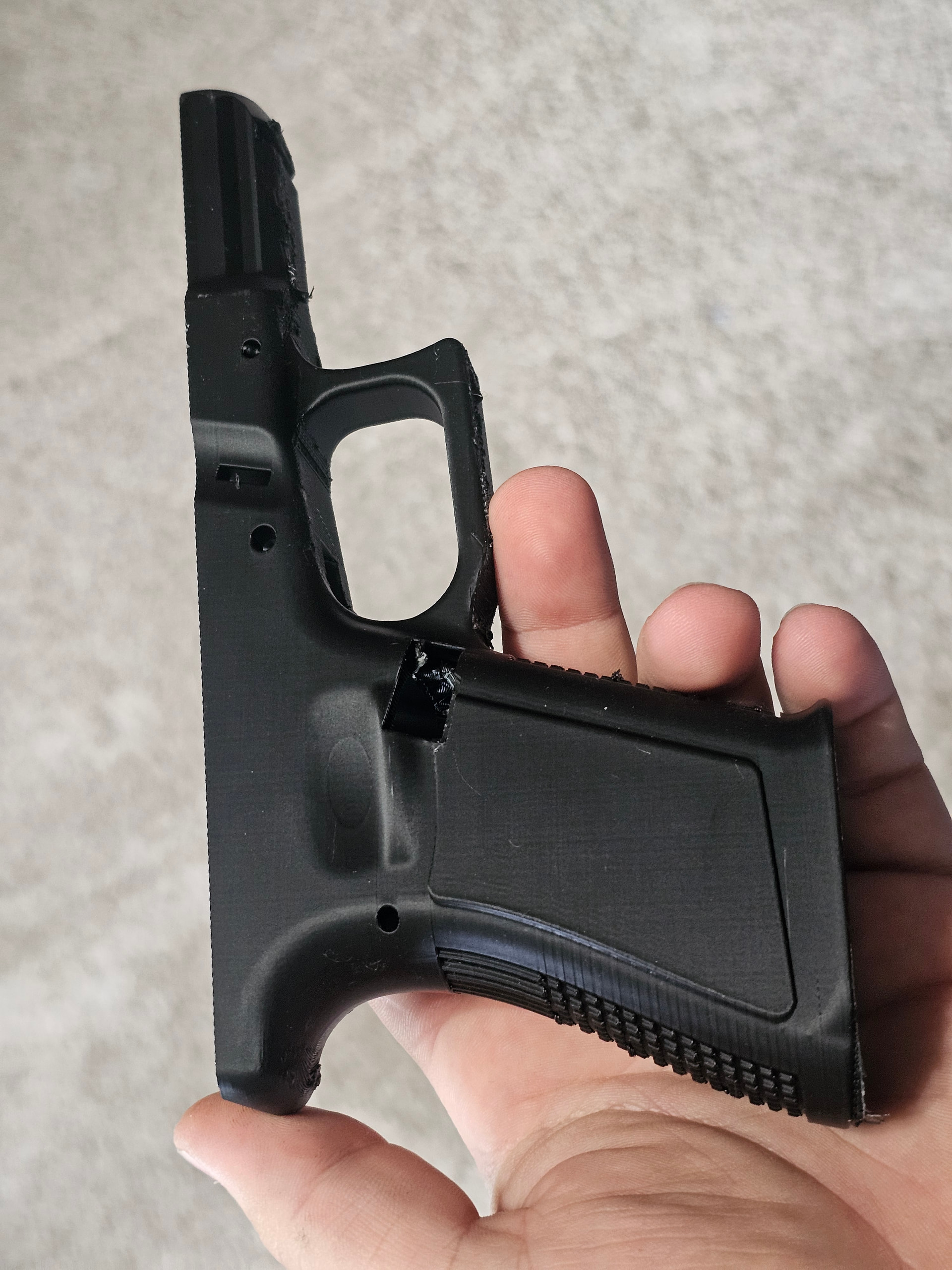
Lets use this as an example. It is a frame for a glock 17 gen 5.
Most would be able to look at that and recognize that is a part for a firearm.
In the case of triggers, grips, etc. Those are not something that someone would need to manufacture. They can be bought at most sporting stores or online without any checks. The way the law is written, there is no limitations on “wear parts”.
OK, Thank you.
So, even if smuggled in, assembly need not go though print farms.
This reduces the claim of preventing the FDM community from being a direct vector.
Edit: need a common between “in assembly” to make better sence.
FDM is just a tool, same as CNC or any other manufacturing method. People are using it for enough other things for firearm manufacturing to just be a footnote.
What makes America so free is that the country is very large and there are not enough law enforcement officers to enforce all the laws. It is why marihuana cultivation and use has thrived throughout the United States in spite of rather draconian prohibition laws. There is also an argument to be made that most law enforcement personal aren’t all that bright. That most solved crimes have more to do with dumb luck rather than as a result of the investigative skills of law enforcement. That acquittals are often the result of incompetent and dishonest law enforcement.
Growing up, I was given a .22 single-shot, bolt-action rifle. It was made by one of my dad’s friends who worked as a machinist. It was totally illegal. No markings, no registration, or anything. Although it may have been legal when it was made. I took it to gun ranges and used it in competitions and no one ever questioned it.
I’m not sure of the exact number but somewhere around a quarter of the prisoners in United States prisons are there due to weapons charges. In America, seemingly everyone has guns. Yet law enforcement mostly does nothing about it until an incident occurs. When an incident happens one of the first things they ask is where did the gun come from. With threats of legal peril those in the know tend to give up information in an effort to save themselves.
Say, John gets mad and shoots his lover. When they ask John’s close friend, Tom, where John got the gun, Tom tells the police John got it from Joe. When they ask Joe, he tells them that he bought it from Sam, who makes guns in his basement. The police then go to Sam’s house and discover his operation. Sam may have been doing it for years, even displaying his wares at trade shows and what not. He may have even come to think that what he was doing was perfectly legal, or at least that he could get away with it. Suddenly Sam is facing ten years in Federal custody. In the same neighborhood, there could be another dozen houses with lathes and mills capable of creating ghost guns, and maybe even committing crimes, but it is only the one associated the incident that gets investigated.
When I read the literature from the EU on the subject, it seems they are more concerned that plastic is not alerted by metal detectors. That nefarious actors would smuggle 3d printed guns into the country, or into an event, undetected. That is the primary purpose of plastic guns, to be undetectable.
Yah, well, many here have already state that pure FDM weapons are nearly useless and pose as much risk to the user as they do to the target.
The idea that they can be created has a high probability of being political cool aid.
I had an earlier post that got blocked by the community about the likelihood that it’s big money being unhappy about the rise of cottage industry into the manufacturing sector (curious why three people in community would block that…).
Anyway. Closing down Bambu’s Digital Ecosystem is the primary topic here rather than ghost guns, though doing so does tie into the broader topic of print production liberties.
I think we are observing the differentiation of “Business Builder” vs “Passionate inventor who creates a business”.
Bamboo owners are Business Builders more than innovators. Their model is like so many other businesses created by those with a plan to capture market share, then begin to squeeze. Usually this involves squeezing both sides of the coin - suppliers and customers.
I often suspect this begins not with owners but the advisors and consultants who drive such methodologies, dangling the fruit of giant profits as they steer previously well intentioned Businesses down a path of profiteering, Building their books for sale over actually being a loyal business based on genuine maximised quality.
Look to Netflix and Uber and others who were the “Robin Hood” of their industries until they had sufficient market share to bend everyone over and humble them dry until every ounce of possible revenue was squeezed from any transaction. This includes shifting existing features behind paywalls as “premium” and downgrading quality to pressure people into higher price products.
”Optimisation” is what you see now - the strategic gaming of new innovation to maximise return not maximise product potential.
Is the balance right? No it is not however as long as the owners are able to do this they will. Only financial backlash seems to land - looking again at streaming services where so many have begun to operate them that a person needs 5 services to see one shows 6 seasons licensed across different platforms. It’s a ■■■■ show that customers are no longer tolerating.
Bambu will keep walking this path because it’s what their company is - and what they can be in the current market. When another “bambu” comes along and undercuts them with visionary equipment you will see them squeal and become the clients friend all of a sudden. Of course that is hard since Bambu entered 3d printing precisely because it was a transition market ripe for the type of appliance level products and reliability they had delivered in the drone space - along with the “ease” of customer adoption.
Vertical integration is easier here too - like inkjet printer market except the ■■■■■■■■ they pull (Yes HP - bricking printers not using your ink you F#$(*%wads) wouldn’t fly here.
None of this makes them a “bad company” for a customer intrinsically. Do keep that in mind. What it is, is risk the customer caries that Bambu is not customer focussed and will toss you under the bus for profit, or convenience. Eg: California legislates that printers must have cloud “filtering” of products and Bambu dumps the fw globally because it’s easier than operating multiple channels.
There is zero requirement for cloud engagement in any feature in my view. If capability is missing locally in apps it can be added as external modules. This is a deliberate feature to take control from owners. The ONLY reason people accept it is that so many companies are trying to impose controls, microtransactions, subscriptions to create ongoing revenue streams. It’s why products are deliberately constructed to fail and not be repaired. Anyone who denies that - I have dozens of engineering examples, not just legislative.
This is also the stage where locking down and shutting out innovation from outside source, and setting the pace of innovation begins to create monopolies.
Yes - look at some of the patents being filed and you see how the printer industry is being artificially constrained.
If we want innovation and true quality - we need to enable that sharing of ideas…. so that’s a tough balance with protecting genuine IP rights. The patent system is too easily gamed using some well known jurisdictions in the US just as one example.
Ironically, China is the place where the least respect for IP exists. I’ve seen too many individuals with patented one off designs having to compete with their own manufacturer who starts making it, or other factories running copies. Nations where such rules matter become disadvantaged.
It is not that simple. For example, before Bambu Lab came along in 2022, all these “open-source” 3D printer companies did was to make poorly-made ones that need lots of work to get it to print. They had more than a decade before BL to make the printers better and did nothing.
For all the criticism, BL is the one that brought about a new level of innovation and quality that forces these open-souce companies to care for quality. Even now, they can’t compete with BL in terms of built quality, easy of use, and reliability.
Even though they have to up the game now, innovation will not come from them. Their business models based on open source are not made for competition on innovation and quality.
I would say more innovations can only come from true competitioin against BL. It will be another startup that is close-sourced and is willing to put in the money and time to compete on innovation and quality.
It is exactly as I have stated, and I did not overlook anything that you stated if you read over my remarks again. Some motives we will never know, however we do know much about those behinf the company and their previous business actions. We know how other businesses proceed on the path of business maturity and how clients are focussed as the product in today’s market.
Perhaps go and read what I wrote again (or in full) and you will find some more depth that you missed.
The Question-
- What is to prevent outside government from producing the uppers, smuggling them into the US in shipments unassembled. Have local print farms produce the lower. Ship everything to dispersed assembly points, and then sold on the black market. Would these guns, since they are not registered with the ATF be defined as ghost guns (There is no doubt in my mind that this is something that the CIA would have done in a dozen different countries)?
Pandora’s Box
Nothing, except laws currently on the books in the US, and the consequences of being caught . The files to print most parts are out there, or in some rare cases probably will be soon. The cost of the parts that need to be more substantial than the various filaments that can be used on the “home 3d printer” can handle cleanly, are relatively small though, and easily acquired at this point. To print the lower for a Glock 19 cost in power, filament, and time (and by time I only factor hands on time of the print, such as setting up, starting with a .stl that is already done, if you are going to “create your own”, add time, and I charge $75/hour smithing) is about $10.00 US using Bambu Lab PLA Tough +. Cost goes up with the change in filament of course.
It is illegal to distribute the lower parts without the proper licensing and the engravement of a serial number
With the exception of SIGs (and possibly others that I haven’t worked on), the only part that needs a serial number is the lower itself. In a SIG the Trigger Control Group is what has the serial number, so the lower can be made without the serial number (and is done by many people already) without issue, and can be sold that way as well, without license (except sales license if needed in your area/country, etc…).
Ok, so I just realized there is a gap here.
In all of this we continue to talk about these items having serial numbers.
If a foreign power is attempting to destabilize a rival government, serial number are not going to be on their todo list. In fact, that is what a ghost gun is, a completely untraceable firearm. No serial numbers anywhere. Now, would getting local print farms involve in their production be reasonable? Nope. To many holes in the intelligence network. Would you buy mass produced parts from a gun store….. You are already shipping things in from China, just ship in a container full of lower parts. That could go though customs without setting off any red flags.
So again, we come back to there being no really indication of a need for locking down production liberties outside of market control.
We’ll leave the reality of ghost guns for a separate thread.