It doesn’t. The printer knows what the last material that has been used with that nozzle, so when in your next job you assign a different material, it will simply purge the nozzle as it normally would.
Regarding your other post about the number of nozzles and the number spools in the AMS, it is not that those 2 extra slots are useless, because they could function as a spare for spools that are close to empty.
On the other hand you still have the possibility to do prints with up to 24 materials in one print and still have a lot of reduced poop when filament swaps are optimized.
Additionally if your next job needs different filaments, you can already preload those, just swap the build plate and press print for the next job.
Agreed on the benefits off more than 3 AMS slots connected to one Vortek
Where LR is the really fast Left to Right Nozzle Swaps, and V is Vortek and A is slow and wasteful AMS - I think the splits for the different types of tool changes with well placed colours within AMS’s, for models that don’t use every colour in every layer, could be along the lines of:
So for example even with a 16 colour model probably only 20% or less of the changes will end up in practice needing to be slow and wasteful full purging AMS changes.
Within a job I am sure there will be no purging when you switch back to the same colour in the same nozzle, however I am not sure that they will definitely do this when they eventually start doing multiple nozzle sizes on the same filament, plus whether they remember the filament and avoid purging out everything at the start of each print job is an open question too - especially for when non BL filaments are used in the AMS.
Nice analysis! Still the amount of waste is really depending upon how much filament changes there are in a layer.
And if there is a certain range of layers that stay below 8 filaments.
The Vortek might require a purge of a nozzle now and then, but when planning is optimized purging can be minimized.
We all have to wait and see when it is released and also the Bambu Studio version that comes with it.
Wait, so my understanding here is that there will still be a purge shoot to purge out the filament at the end, but it greatly reduces the amount of filament waste? 7 colors without purge and 25 colors with purge right?
we need to see what is released. In theroy you could have 4 ams for each of the 7 nozzles. 16 x 7=112 probably the limitation is for the slicer. That is wild speculation.
I assume the same smart filament nozzle can be applied as the H2D.
My first reaction is I would never… But I can imagine how that would change the options. Thinking conductive filament.
I theory yes no limits on numbers of AMS, I would personally like to see the limits lifted on AMS Pros beyond 4, plus also allow AMS pros to be shared across the two H2D nozzles, and even better across multiple H2Ds - but the BL wiki has stated they will still be limiting the total number of AMS slots to 24 across all nozzles. - See Q7 Vortek system FAQ | Bambu Lab Wiki. Plus I suspect AMS’s will need to be connected to either the left up/down extruder, or the right 6 way Vortex extruder gear path - rather than both.
I “was” excited, very excited. At first… Now… I think I’m staying right where I am.
I’ve put in a few tickets, regarding lack of features in the H2 and AMS pro iterations. Still lacking features, basic features, like being able to start and stop drying from handy and/or studio. Not to mention that headache of a software called “the suite”… The cutter thing is a waste of 70.00 to me, because of the software…
I just am kind of tired honestly. I doesn’t make any sense “to me” at least. You’re rolling out a million new products, but basic things, and maybe they don’t consider them basic, but for those of us that work a ton of hours(and there are more than not, considering the whole consumer map), remote functionality is basic. I haven’t used my printers on a couple weeks simply because of the need to “babysit” the AMS Pro’s and HT’s!
I didn’t but them to babysit the printers or the AMS units. That is a step backwards for me. And I never would have sold my P1 units has I known this was the way it was going to be in the long-run…
I’m just not impressed TBH with this round of how they’re handling the software side. I know we live in a consumer based society, but time is limited, and I just don’t have the presence at home to do that. And my “assistant” my wife won’t touch these e expensive machines, to mess with the filament.
Anyhow, just not thrilled or excited anymore… And I’m shifting(well, I already h have done so) to other hobbies… I will still do parts to say, carry tools l. But not much else… TBH, it sort of feels like diversionary tactics(aka Creality and AnyCubic) to avoid dealing with the basic things. They’ve sold, and will sell tons of machines on any level. I just won’t be one of the people…
the AMS is a many to one. Many slots to one nozzle. It would be complicated to go one to many. Two major problems with that, 1 added time, and 2 user interface.
I totally get it would be nice. But at what cost? AMS has the money cost (buying AMS), time cost, and poop cost.
Anything can be done but what are the ramification.
Yes - its a shame they didn’t go with at least many to 2 - as I am finding it a bit annoying having to swap spools around being AMSs almost every big multi colour H2D print job.
What I envisage though is a separate small device that can take a few AMS inputs into it - and then have a few outputs - either for the 2 H2D extruders, perhaps with 2 outputs per extruder, or even better enough outputs for several printers.
The device would need something mechanical in to actually reroute the filaments between the AMS inputs and outputs.
I know there have been a few attempts at manuals switchers in the past - I even tried creating an automated one myself a few years ago - might relaunch the idea at some point - although I don’t think it would help with the H2D problem - as all of the AMS’s on the H2D go into one electrical port - so there is no point in switching AMS electrical connections within the same printer.
If they added a 6 port hub, with input side filament sensors, we could hook up 4 ams and 2 ams ht, or 6 ams ht. Each ams loads to the filament sensor thats located in the hub. Mount the hub near the entrance to the right side nozzle ptfe port on the back of the printer. Cut out most of the filament transit time by "parking each filament at the hub instead of completely pulled back to the ams sensor. 6 seconds transit time is 100 minutes per 1000 swaps.
The 6 nozzles connect only to one ptfe tube, which means that only a max of 24 colors can be put for those 6 swappable nozzles. therefore, there can only be a max of 24 colors with the ams.
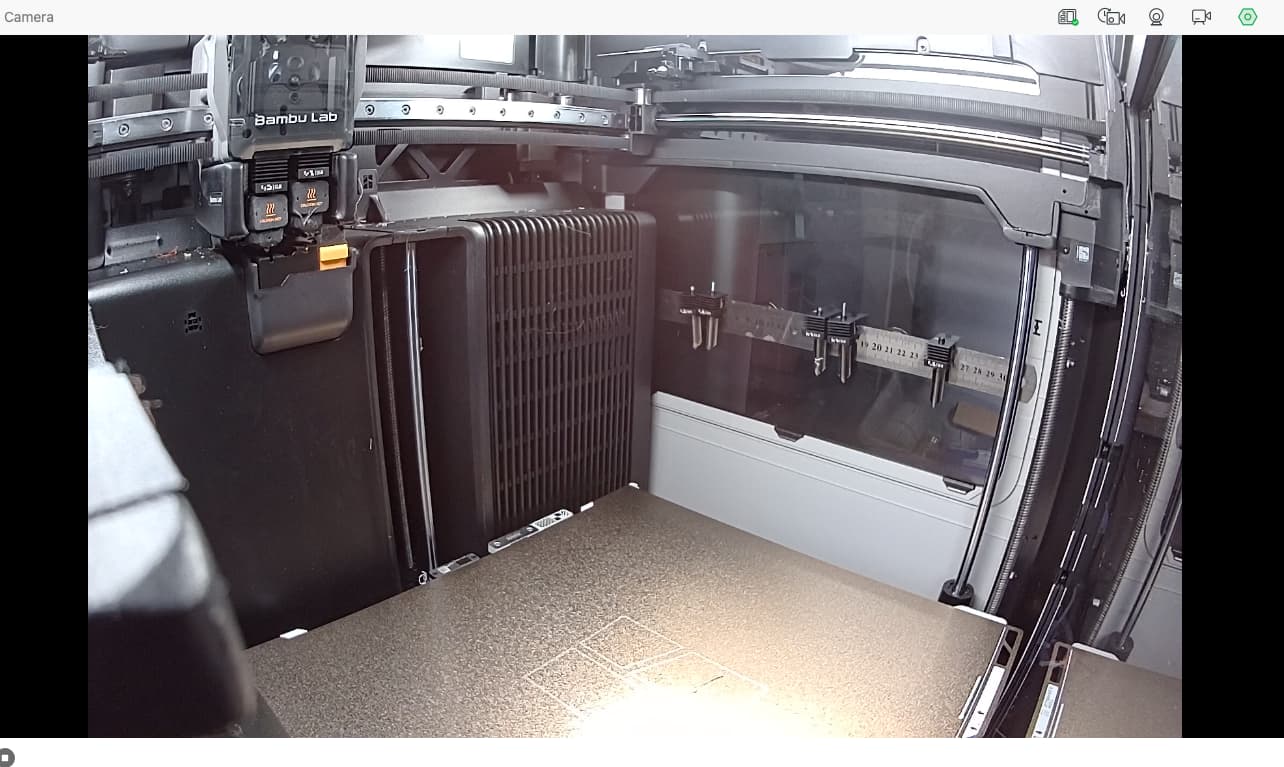
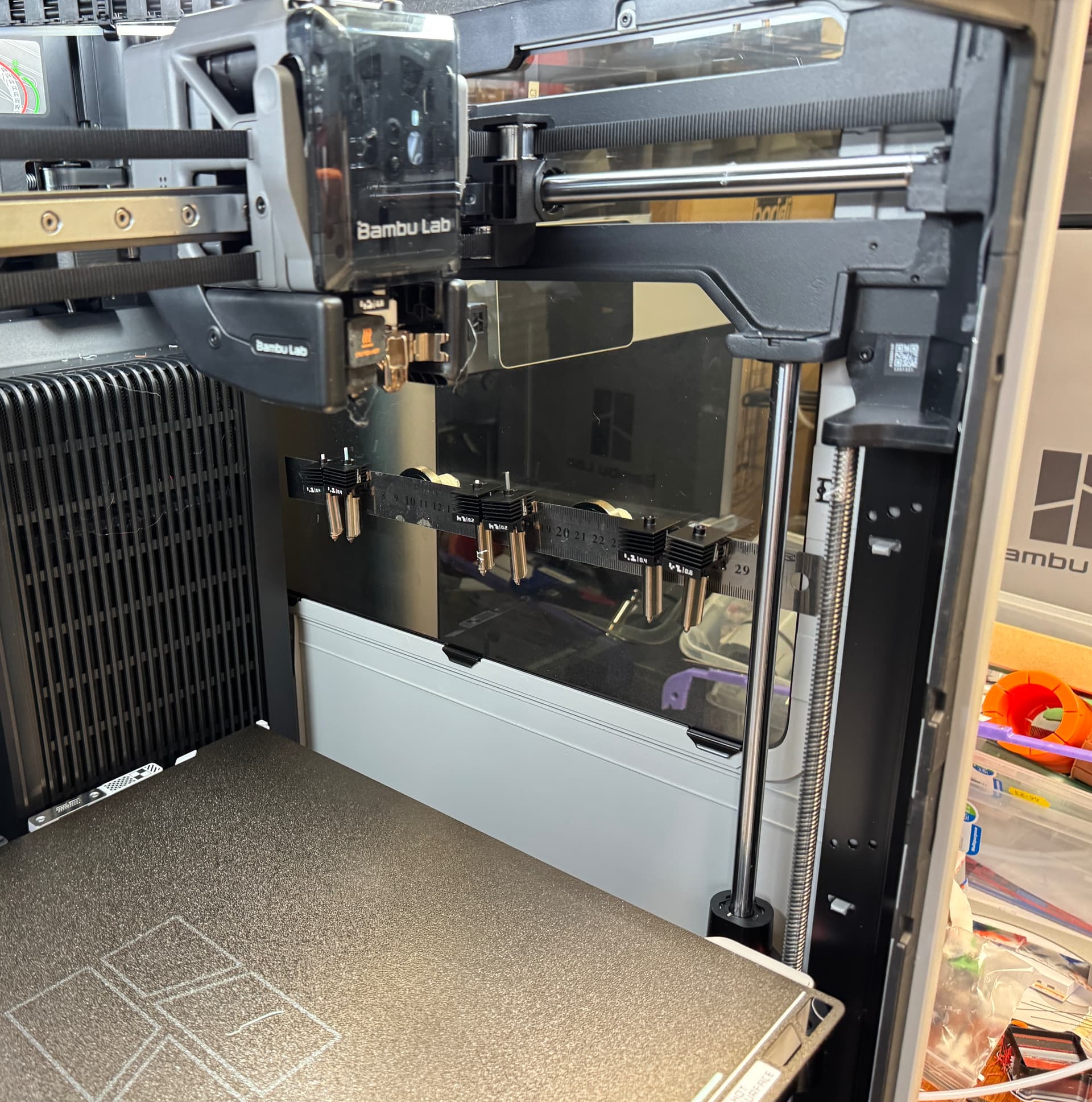
My mock up was mostly in jest, although I may well leave it in place until the Vortek upgrade kit comes out - however it does lead me to a few thoughts:
There is room for a least 5 or 6 more tools on the “Manual” or “Poortek” as someone suggested on Facebook holder.
Plus also this solution doesn’t involve a loss of 15-20mm worth of build plate - like the proper Vortek likely will.
It does make me think that sort of slightly more complicated Vortek type setup - that protrudes out of the right hand side of the printer - and can move the tools in from the left as well as up and down - would allow more tools, and also avoid the loss of build plate width.
Could potentially also allow either of the two extruders to be changed.
Maybe something like this will come along with Vortek V2.
Why are you saying 24 max? 6x4=24. With the x1c you can have 4 ams for one nozzle. If you use the same logic, 16 rolls dedicated to each Nozzle. 16x6=96. I wonder what the limitations are. why only 4ams? How many would buy 24 ams for one printer. (back to pooping every change. I see most will not use more than 6 in one part. Then the remaining that would buy so many AMS would not pay the development of it.
Will probably have an option for a 6 roll dryer. But not be able to assign any slot to any nozzle.
I recognize the one to many is an option. But the problematic operation and complexity that would add to the likely failure.
combine that with the complexities of many to many makes it unbelievably complex. filament 1 to any of 6 nozzles. and filament 2 to any of 6… what happens when filament 1 is needed on nozzle 1 and 2 (different size nozzle). or different printers. (All consumer grade printer only print with one filament at a time.)
There is only one input filament hole for the 6 nozzles. It shares on input hole. This means that there are a total of two input holes: one for the 6 swappable nozzles and one for the fixed nozzle. The fixed nozzle can have up to 24 colors by itself connected by an ams hub and four ams. The shared input hole for the swappable nozzle can be connected to four ams too, but they cant both be connected because of a lack of ports for the ams hubs and the ams. So the max amount of filament is 24 plus one external spool connected to the fixed nozzle. If bambu added more ports to the ams and ams hub, there could be more colors, but who needs more than 25 colors
You can just daisy chain the 4 in 1 PTFE splitters (no hub in H2C design, nor is the external hub compatible), so thats not a problem. The limit is due to the max number of AMS units that can be connected to the printer.
I don’t see how it would work they way you are describing. I have no insite for the H2C.
I would guess the 6 nozzles each have their own feed tube. That tube could be connected to a single filament, a AMS, or a hub from multi AMS. connecting AMS would need purge. Taking time and poop. The big advantage of a multi tool system.