In my opinion yes. I see no reason not to use them 100% of the time. I even print .4mm Obxidian nozzle and Fiberon CF filament - 1000 hours on that, and the nozzle is still alive. Clogged twice.
Don’t forget that nozzles are consumables, you will have to replace them eventually, and from my experience you are likely going to lose nozzle from some stupid event way sooner than from the nozzle wearing down on its own or with CF filament
I lost one nozzle when P1S decided to crash into the bed before the print right after the probing.
Ok i understand better my conclusion is ill use what the h2c+ultimate package gave me but once the dust has settled on the release and parts are available i might upgrade a few nozzles and keep the others as spares. I never considered doing this on the p1s simply because it was work and now both left and right are easy todo and as you point out a consumable. tnx.
1 Like
I’ll dissagree on this. It has more surface area for the abrasives to rub on and hf nozzles can fail catastrophicly internally.
I was about to write a message about basic physics and Coulomb law… But anyway, for the sake of simplicity - no, physics doesn’t work the way you wrote down. It doesn’t damage the nozzle because of the more surface area.
The only reason why fiber filled filaments are more dangerous to HF nozzles are due to the potential of manufacturing defects of fiber being bigger than the nozzle HF channel opening that can cause jam and nozzle damage. Not because of it having more surface to rub against.
1 Like
I would love to see how you relate Coulomb’s law. If Electrostatic force has anything to do with this I am all ears. Seems like an interesting breakdown since Coulomb’s law is not relevant to mechanical wear.
I would instead reference to Archard’s Law as it actually explains asperity contact.

A high flow nozzle has a longer and more complex flow path. The abrasive particles are in contract with the walls for a longer duration and distance. As L (length) is higher, Q (wear volume) is going to be greater. Simple arithmetic.
You are correct that there is a higher risk of clogging using high flow nozzles. However, your argument that the high flow design will not have a higher wear is inherently false.
I suspect that your tactic is only to use big terms to confuse others because you assume that you are the highest educated person here.
3 Likes
Okay, you are more educated on this then i am.
I have had bambu hf nozzles fail. I had pieces of metal come out during cold pulls. I know they have a Y shaped internal design. In my opinion those walls are prone to wear and breakage that abrasive filament can aggravate. I do not believe the simpler design of the basic nozzles will have this issue. YMMV.
Are we talking about wear or are we talking nozzle jamming. Because I’m not disagreeing with HF being more prone to the jamming with fibers. Last time I checked you said
Maybe I misunderstood what you meant, but I implied you meant the abrasive damage from the fiber filament, not the nozzle jamming. Because those two issues are different problems
I had a nozzle fail internally where the poker felt like it was rubbing against rocks and pieces of the nozzle itself came out during cold pulls. Not a fun day, i spent hours figuring that out.
I think the inherent design of the nozzle is more susceptible to issues when running abrasive materials.
Edit: the nozzle failed when printing silver abs. It had flow issues for a week after and i pnly discovered what happened when trying to unclog it.
Quote your laws correctly.
Coulomb’s law and Coulomb’s law of friction are two distict equations. Engineering values being precise. You are mentioning laws to sound smart, not to show how they apply to this scenario.
The Coulomb law of friction is not applicable to this application anyways. It is not specific enough to accurately calculate the friction coefficient in this geometry. As well as not showing the whole picture.
Mechanical Engineering > Systems Engineering
1 Like
Well yeah… It’s due to the way how HF nozzles are made, since all of them have that “Y-spliiter” be a heat insert, so there is always a risk to literally yank that thing out.
(picture stolen from the same forum):
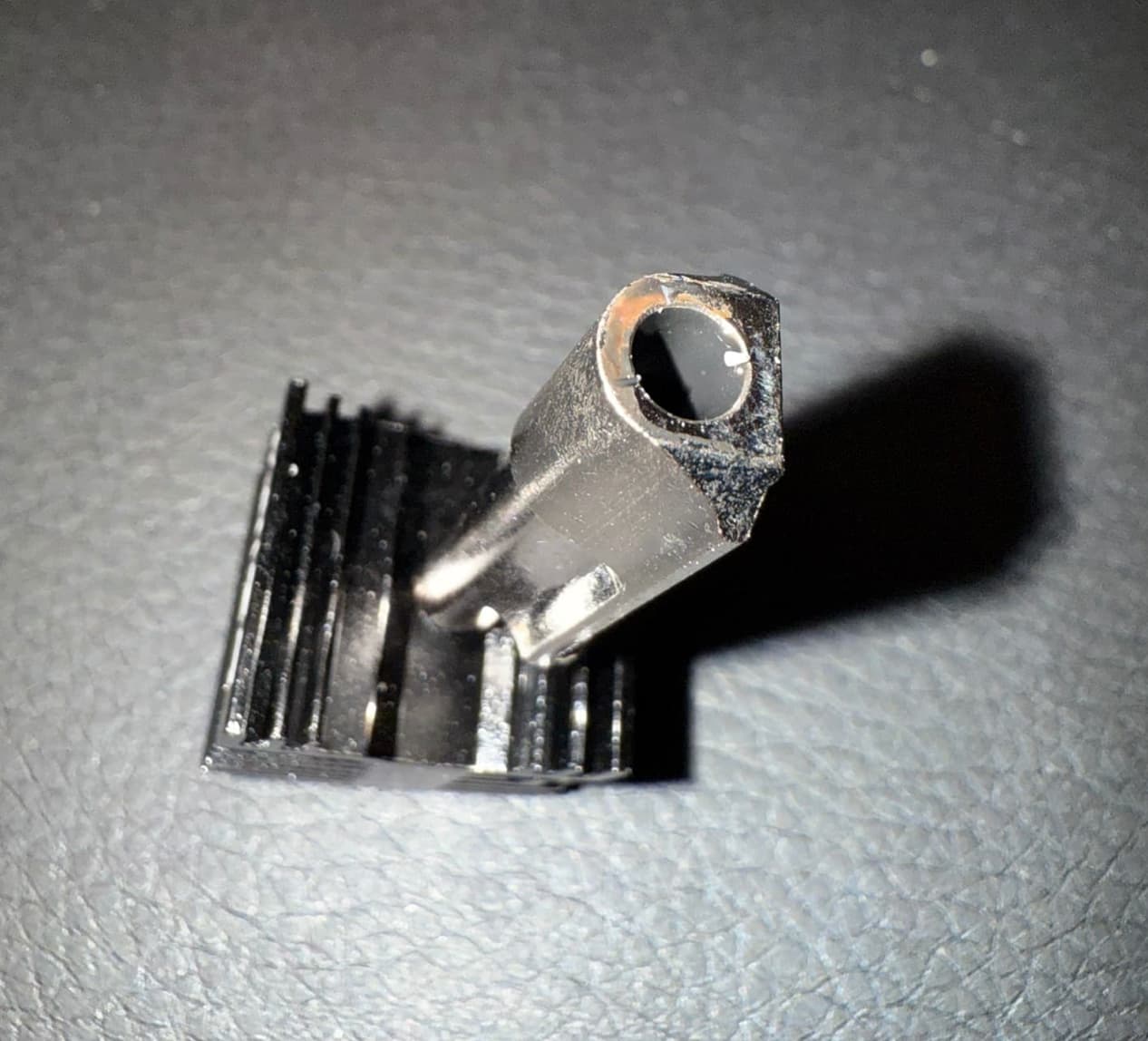
Not what happened to me. The thing failed internally from heavy use. Externally it looked perfect and the issue was not caused by cold pulling.
The nozzles are consumables at the end of the day. If you can justify the cost i see no issue running abrasives. For my hobby projects I prefer running non hf nozzles when using cf or gf.
1 Like
This topic was automatically opened after 8 hours.
Ok to recap. my question about Highflow has been answered and i think for people who upgraded from say a p1s it sounds like with the ease of changing hotends now its something i and others like me can try without too much risk where we didn’t before. If it works out on our type of prints we gain some speed and thats always good. Also my question on ‘can we swap between them to gain speed’ is answered that if you use HF ones there is no real need to switch either use them or not switching only takes time during the print.
New question on Purge/Prime tower. I understand why its there but i just wonder if it can be done smarter and if that has been tried in the past. It seems to be that not all layers need it or not all colors/material need it each layer. The tower has to build anyway since it has to be at the same height as the print… that makes sense. But are their systems/hacks/solutions maybe tried in the past where there is a special ‘tower’ area that moved up/down at different rate as the main plate so it doesn’t have to build the tower each layer but only uses it when needed… i hope this makes sense to someone what i am trying to say.
Daniel
If you aren’t using incompatible materials i.e. support materials; use the purge into infill function.
1 Like
Doesn’t really answer my question but ill put it on my list never tried that before. Again not trying to solve a ‘problem’ just trying to learn more about a machine that clearly has more tricks. Thanks for the reply.
I believe there was a trick for that in Prusa Slicer.
It only used the prime tower when there was a filament change.
This resulted in a much lower prime tower than the part, but also requires quite some space around the tower to prevent collisions between tool head and part.
It also generates a lot of Z-motions, that causes additional wear on the Z-spindles and rods.
It is currently not possible in Bambu Studio though.
1 Like
No sparse layers? If thats what youre talking about, its in orca too. Pretty cool. Saves a good amount if filament sometimes
Oké! Good to know it’s in Orca too.
I have seen it a long time ago and thought it was Prusa slicer.
I am in doubt now.