H3C Air Filter with and without the E1 Purifier

The listed H3C specs state:

Air Purification
HEPA Filter Grade H11
Activated Carbon Filter Type Granulated Coconut Shell
VOC Filtration Excellent
Particulate Matter Filtration Supported

But when going to the Air Filter replacement page (US | EU), the only thing listed there is:

The Air Filter is installed on the inner side of the printer’s left inner lining, close to the chamber, and is used to filter the air inside the printer chamber and effectively remove VOCs.

On its wiki page, it again repeats just the info about VOCs:

It filters the chamber air and effectively removes volatile organic compounds (VOCs).

Did they forget to list the particle filtration or am I missing something here?


As for the actual filtration and filter replacements… The same wiki page says:

Replace the air filter regularly according to the product’s maintenance recommendations.

This also doesn’t really say much about how often you would really need to replace it.


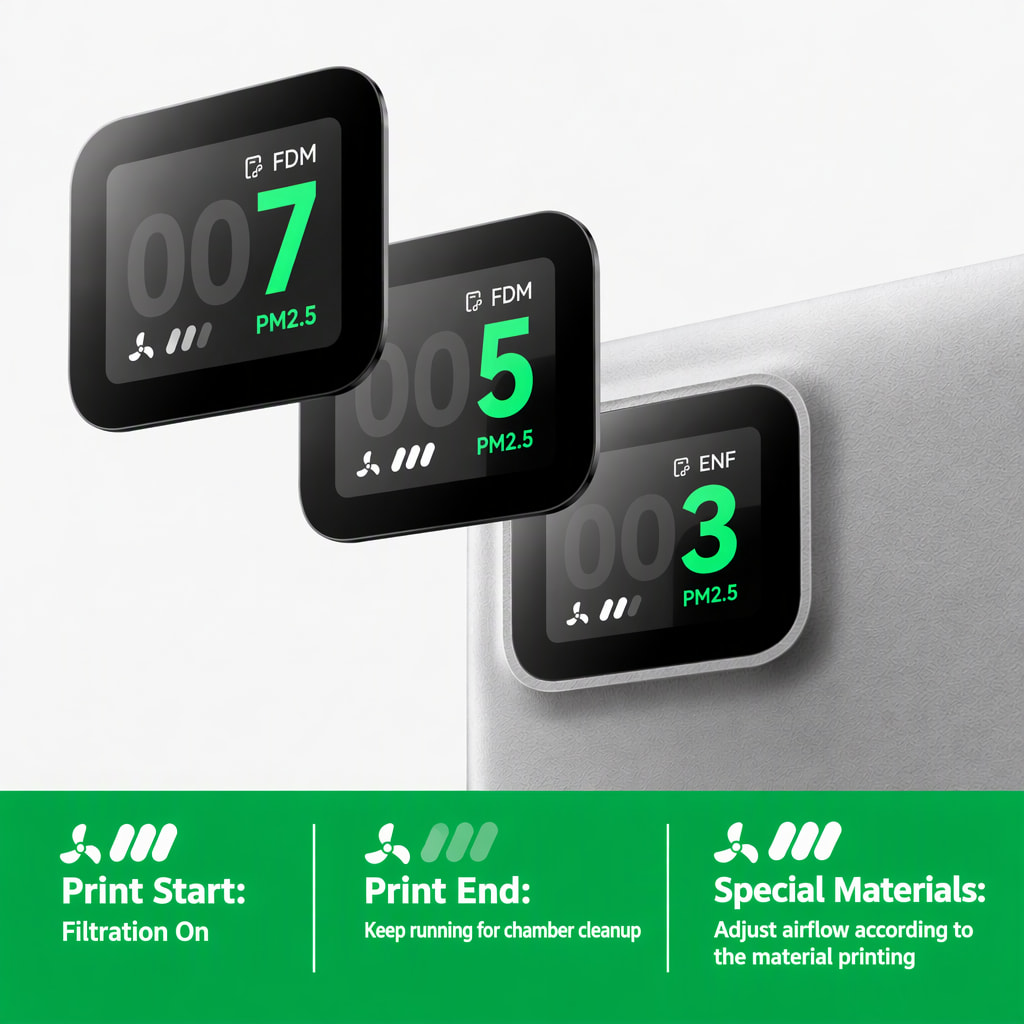
Then we have the new E1 Air Purifier (US | EU) that was made to work with the printer.
Look at the specs:

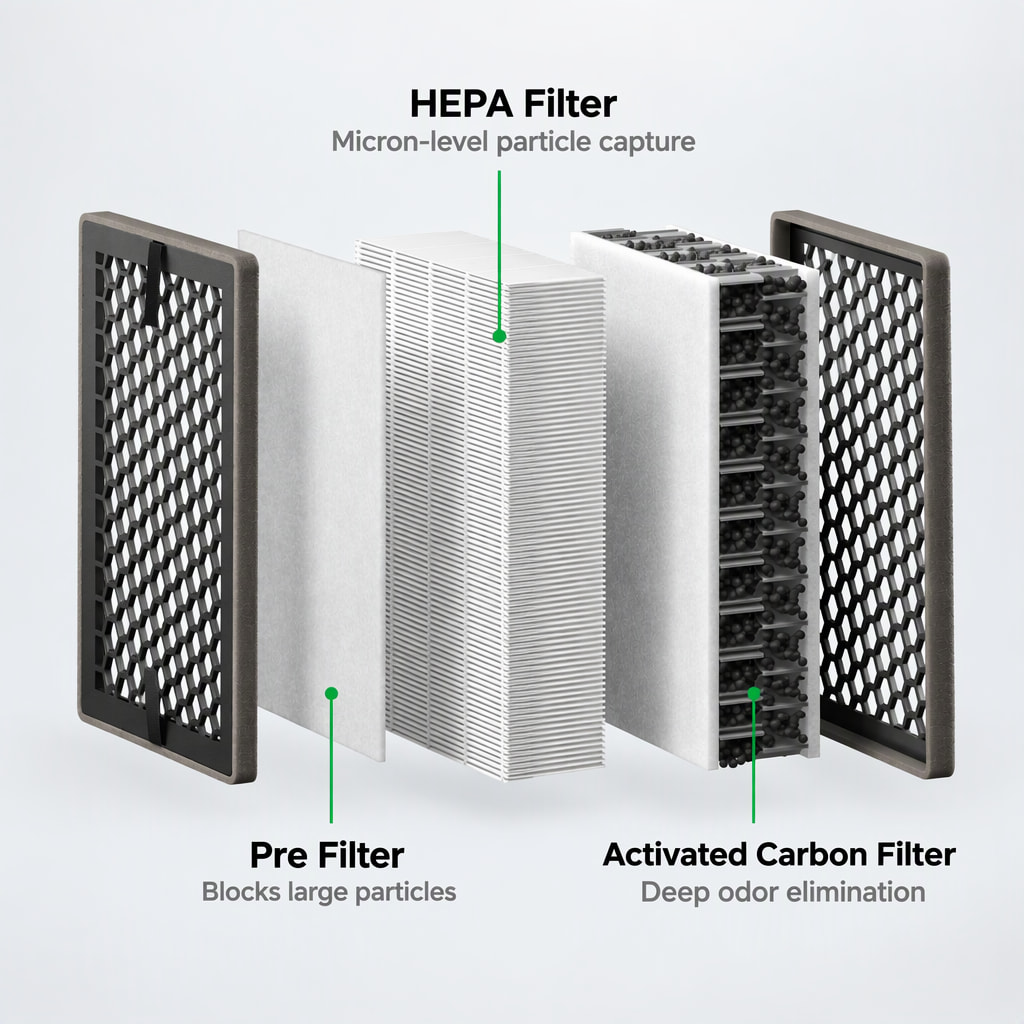
Three-layer composite filter:

Pre-filter: low-resistance coarse filter cotton
HEPA layer: filtration efficiency ≥99.97%
40 mm activated carbon layer: 0.45 kg high-iodine coconut shell carbon

I get it that they want to sell the E1 instead of users just deciding that H3C’s filtration would be enough for their needs provided proper room ventilation, etc… But there is almost 0 information available about the actual integrated filter so you can have a proper comparison between the two usage cases (with and without the E1).

There is even an enhanced filter for ABS, ASA, PC and PA for this air purifier:

Optional Enhanced Filter, For advanced applications

The official enhanced filter for advanced materials and advanced work.

Added catalytic oxidation significantly raises odour absorption efficiency — professional-grade printing, with the same peace of mind.
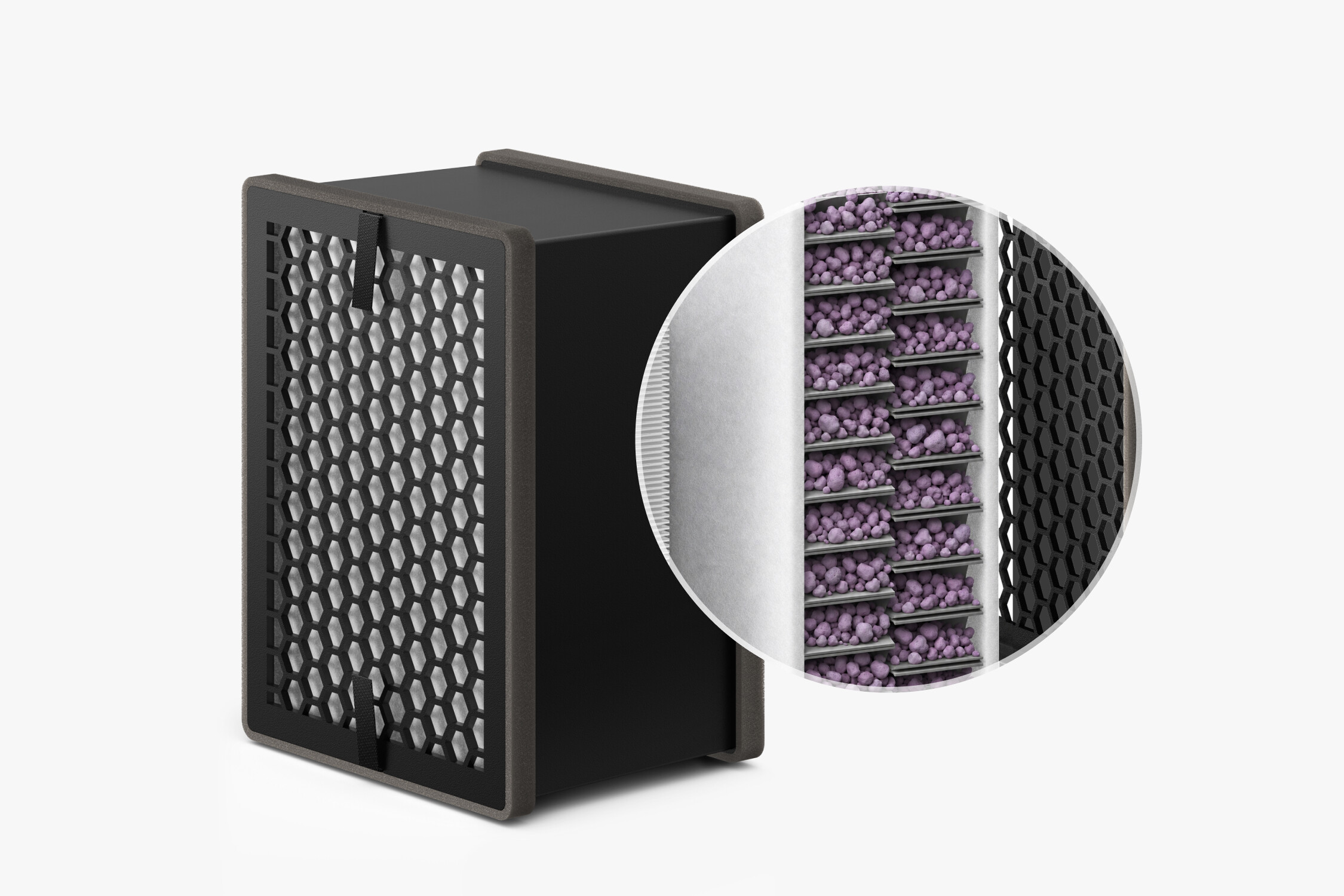

Replacement (US | EU) also doesn’t sound like fun, considering the price:

The E1 Purifier Air Filter is the replaceable filter used in the E1 Purifier. It filters and purifies the air during printing, reducing odors and particles generated in the process — providing you with a cleaner and safer environment.

When to Replace

E1 Purifier FDM Composite Filter (€49.99 / $49.99):

  • For high-frequency use (continuous use 24 hours a day), it is recommended to replace the filter monthly.
  • For low-frequency use (less than 6 hours a day), the replacement interval can be extended appropriately, but should not exceed 3 months.

E1 Purifier Enhanced Filter (€59.99 / $69.99):

  • For high-frequency engineering filament printing (taking ABS as an example, with continuous use 24 hours a day), it is recommended to replace the filter every 15 days.
  • For low-frequency use (less than 6 hours a day), the replacement interval can be extended appropriately, but should not exceed 1 month.

So if we compare using the H3C with just the default air filter vs using it together with the E1 for the following filaments (so no ABS/nylon/CF):

  • PLA Basic, Matte, Translucent, Silk+
  • PLA Wood, Metal, Marble and Sparkle
  • PETG Basic and Translucent
  • sometimes TPU 85A, 90A and 75A

What would you personally recommend for:

  1. Printing less than 6h a day.
  2. Printing 6-12h a day.
  3. Printing most of the day (if not full 24h).

PLA, PETG and TPU have lower emissions than ABS/PA, I think the E1 would be overkill unless it is in the same room you spend a lot of time in during printing. If you want a more affordable solution a popular way to go is an IKEA purifier that has a built in HEPA filter, converted to add an activated carbon filter stage.

Wow that’s incredible! I guess I’m still not used to the wonders of being able to print whatever you need at home instead of having to buy it :grin:

I was actually considering Philips AC2221/13 if I manage to find it at a good price during Black Friday, but the price difference between it and the one you suggest is just insane.

Unfortunately, I have a very small flat with basically just one room :frowning_face_with_open_mouth:
And while there is a tiny hallway, it would be hard to ventilate it properly even if I place it there, so I will most likely have to spend most of my day in the same room as my printer. A bit terrified if I actually end up having to sleep while it’s printing… So I was looking into various air filtrations to make it more suitable for the day-to-day living.

With regular attachable filtration systems my main worry was that it would filtrate during use but not so much afterwards, not to mention some particles could actually escape the printer enclosure even during printing (please correct me if I’m wrong here).

And while I will ofc fully ventilate the room after printing, if I end up having to run longer prints I can’t just sit with fully open windows for all these hours, especially considering how cold it already is outside and that the winter is almost here.

For that case I was considering a regular room purifier (like the Philips one) that would manage to change the air in the room about 8.7 times per hour at maximum speed when needed. The E1 does continue running even after the print is finished, though, so it makes me more inclined towards specialized filtration for printing :thinking:

How did you survive resin? Outsourcing test prints?

Something to keep in mind … most of the commercially available purifiers were designed for home use and have a tiny amount of activated carbon, some just use carbon foam. With the IKEA conversion you can fit a good amount of carbon in that filter. Activated carbon is what filters VOCs which are the main pollutants from PLA/PETG.

E1 looks like a great product, but those filter prices are crazy high. If they come down I will probably purchase one, just for the Handy app integration.

It being too hazardous to work with is one of the things that made me stop printing at home, to be honest. I did have the integrated filter though and ventilated the room almost non-stop. But the whole setup of equipment you have to wear, having to constantly interact with it after each print, resin leaking from the bottles, tiny drops you never even realized were there evaporating into the air, all this isopropyl alcohol… even the finished prints not being safe enough after curing, especially if some liquid was left inside the model that didn’t get removed :grimacing:

I did spend the first few years printing at home, and I do still have the equipment, but… just too much of a health hazard, not worth it. Especially noticing that even leak-proof containers managed to let some liquid escape. Not fun ><

The print quality is better, but I would rather have less hazardous prints and less mess to deal with.

When you hire someone to do pre-supports for your models they will usually test print them to make sure those supports properly work, with the rare exceptions. So I only needed to do my own prints if I wanted to have pretty photos of the said prints :joy:

It’s the main drawback for considering a room purifier that I was worried about. So your suggested setup should definitely be much better in this regard.

I honestly didn’t even consider making my own purifier (so printing, for example, the model you remixed) and filling it myself, but it will probably take time for this mindset switch from the “oh no I need something, therefore I have to buy it” to “hmm… I need something, so let’s print it, and if it doesn’t exist yet, let’s design it and then upload to MakerWorld for others to use as well” :grin:

The best thing to do would be to use a hose and vent out of a window - it removes most of the questions about how safe the filters might be - but I know those are cumbersome setups. Do you really want a hose going up the wall and across the ceiling?

I wouldn’t be able to install it in this place, only after I move out. But by that time I will hopefully figure out a proper window filtration system.

But for now I still need to come up with something for printing in the same room with me. It’s still hard to estimate the exact amount of hours per day I would be printing, but considering that I have a very tight deadline to start releasing FDM models, I expect there will be a LOT of printing involved so I can learn as fast as possible and practice as much as possible :frowning_face_with_open_mouth:

I was going as far as considering having both a room purifier and an E1, which is most definitely an overkill :sweat_smile: