I don’t have and H2C but I just got my H3C build plate in the mail. I have no idea if this is helpful for someone but here is a comparison. This is the H3C PEI plate sitting on top of the H2 Vision Encoder. All dimensions are identical but the front lip is 4mm shorter when measured with a caliper.
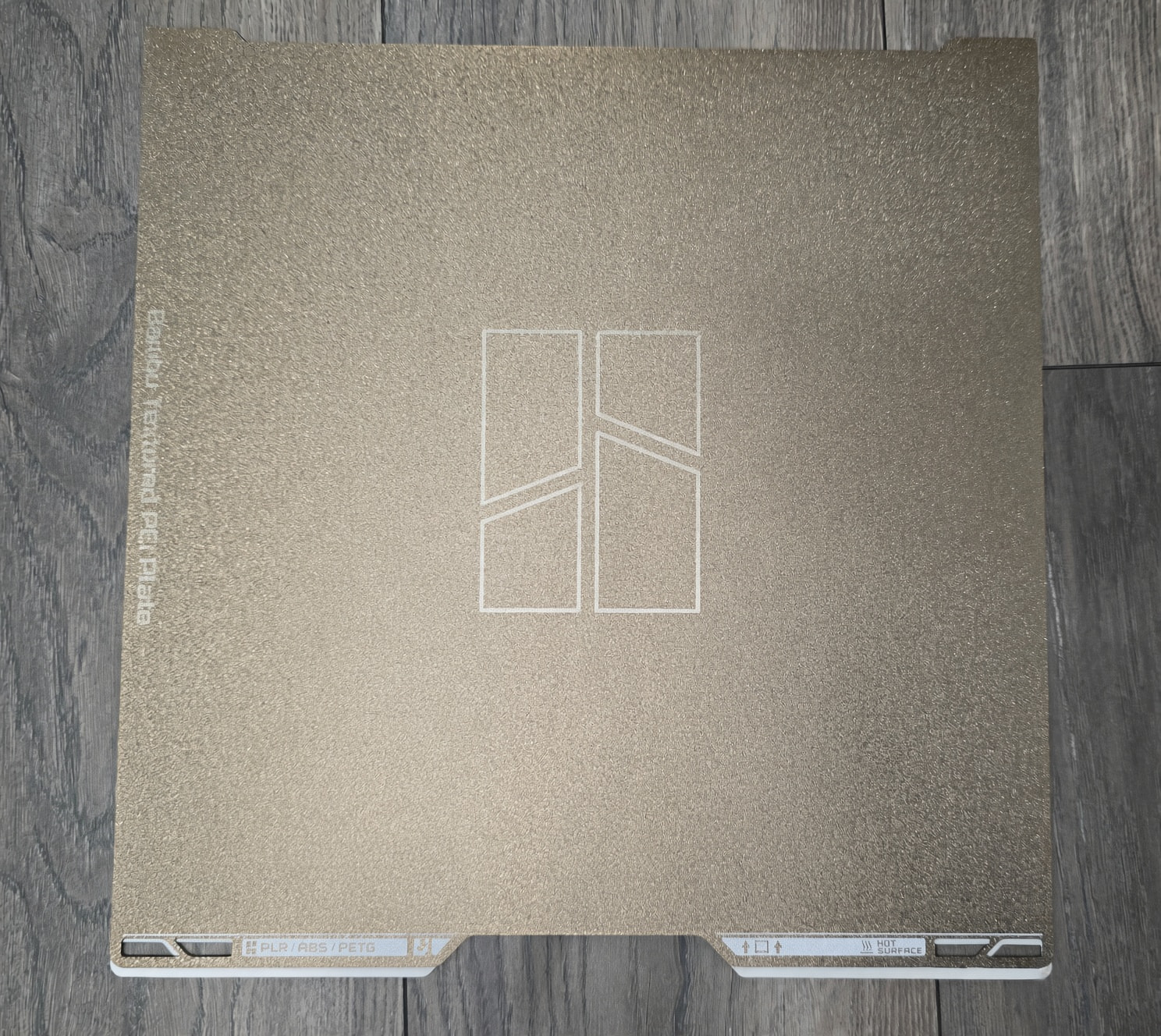
Greally grinds my gears that they just HAD to make the printer use a different plate size.
4mm is nothing. They definitely could have done something to make it work. Especially since the reviews I’ve seen online say a lot of the stuff is completely different. The frame is an all new metal frame. Something else could have moved by 4mm. I’m just glad I don’t need a different vision encoder. I really feel like they should of had it use the same plate as the H2D/H2S
The good news is it can print the full 330x320mm with all nozzles. Thats 5mm wider than single nozzle and 30mm wider than multi nozzle printing on H2D/C.
They tried to explain this difference in the FAQ on their wiki by saying:
If an H2C/A2L build plate is reused on the H3C, the gap between its leading edge and the SwapTek Rack is only about 2 mm after installation. Due to dimensional chain tolerances and user placement deviations, there is a risk of collision or scraping between the PrintTool and the build plate. For this reason, new official build plates and corresponding build plate type identifiers have been specifically designed for the H3C.
So it’s nice they didn’t try to pretend that you need a new vision encoder since it shouldn’t interfere with the print tools anyway.
But it also kinda sounds that you can use the H2C build plates as long as you are being as precise as possible when placing them. The gap is still there, just not enough for the average user’s comfortable swapping.
It feels like they aimed for the same build plate and assumed that the 2mm clearance would be sufficient.
I don’t think building tolerances would consume the 2mm, but a misaligned build plate is something that happens quite often.
Possibly that was discovered fairly late during the design/prototype/testing phase, that the cheapest change was probably to shorten the plates, instead of changing multiple components in the printer to resolve this.
For people who don’t cares about automatic plate detection, it’s quite easy to modify H2C plates to H3C size, just trimming those extra 4mm. from the bottom lips.
I’ve done this before with plates from different printers. For instance, adapting Prusa XL plates ( 36x36cm bed ) to a Voron V2.4-350 ( 35x35cm bed ).
Just curious to what tools you have in mind to use.
Best method would probably be an industrial laser or waterjet cutter. Definitely if you want to change the width of an H2D/S plate also. Unfortunately I don’t have access to those.
There are numerous other options available. But a blade cutter wouldn’t be on my list as it might deform the plate in such a way that the magnetic bed won’t pull it flat at the edges.
The code on the plate is easy to replace if that would be required.
I think a rotary tool like a dremel is your best bet.
First time I used an orbital grinder but the cut was too rough, although the plate didn’t warp at all and was perfectly usable. The kind of steel used for those plates is very resilient to deformation,
Next I tried a jigsaw with a thin carbide blade for tough metals. It went better. Of course, the trimmed sides show that it has been cut at home, so to speak. It doesn’t compares to a regular plate but if you don’t care much about looks, functionality is as good as an unmodified unit.
Anyway, I don’t advise to do this rough mod unless you want a special plate which isn’t available for your printer. In my case, I wanted a plate dedicated to nylon filaments and only Prusa makes them ( that I know of ).
I already have a vision encoder for my H2D, can I use it to calibrate the H3C or am I going to be forced to buy another product I’ll rarely need to use.
You’re good to go. That’s the only plate that is officially ok to use and has not changed.
We have the waterjet cutters, but I’m thinking it’s easier to start with a bigger plate and cut the whole thing then try to align an existing plate and trim it.
Is the CAD for a complete plate online anyplace?
Made this just for you H3C STL, SVG, DXF and F3D.
Extracted STL from BS, then converted with GPT Sol.
I fully agree with that on the waterjet. You need a rigid mount (or a full sheet) to prevent it from flying through your machine.
For a laser cutter the only forces in place are caused by the air flow. So the fixture can be a lot simpler.
I was mentioning the 2 as they are the best for making a clean cut without the tendency to deform the plate.
A large industrial sheet cutter would do the job also.
But besides a laser cutter, I don’t think hobbyists would have the other ones hanging around in their workshop 
Still a Dremel can do a great job too.