Sure, how to dry your filament is well known, but for the sake of your energy bill I hope you are not storing your filament at those elevated temperatures  .
.
you can 3d print dry boxes and 3d print stuff to enclose the AMS lite
In Makerworld
Just how airtight is it? I could well be wrong, but the rumor I heard is that 3d printed means rather leaky (though I was never clear as to why, except maybe that each individual wall is fairly thin). So, I’d be very happy to hear otherwise. Anyone have data suggesting air tight?
I had to deal with sealing against air with the air dryer. Someone mentioned raising extrusion temperature can help along with extrusion volume, but I didn’t think of that and found a honeycomb infill would help reduce air movement (gyroid is one of the worst for that) and increasing the walls.
I was sealing against pressure (very low pressure) but I found I could blow right through my first models. Kind of surprising how porous they were. Look close at edges and corners and where the extruder turns around there’s lines of tiny holes.
I was using matte PLA and that took painting with cyanoacrylate well and gave a nice semigloss finish that also sealed up all the pinholes. May or may not be of use, but models can be very porous and increasing temperature and volume on the extruder may help (but I haven’t tried it).
I’m guessing POR 15 might work as well, if only because it appears to close pinholes well enough to seal out fuel, according to a number of forum members on this other thread: Fuel resistant filament - #3 by RMB
Also, @JonRaymond has experience dipping ABS prints in acetone to get a smooth candy shell on his prints. Maybe he can comment as to their subsequent air-tightness, as perhaps that (or similar techniques) would work as well.
It sure would be a great help to print air-tight containers rather than to endlessly hunt for injection molded containers of the right dimensions.
I live in MA and humidity is low in winter but can be really high (at least for the NE) in summer. I’ve used a set Sterilite containers (available at Wal-Mart) that have a fitted locking lid that helps to keep moisture out (have used these for years). I installed cheap Hygrometers (not the best quality but at least give me a rough idea of current humidity level) into the boxes and stock with desiccant. This at least attempts to keep moisture in check for my sitting filament. In addition I generally dry all my filament using a Dry Box (currently using a Sovol SH02) prior to use. This setup has worked really well for me.
That’s how I used to do it also, but the weakness of that approach is that, unless you’re hyper vigilant, by the time the hygrometer shows a much higher humidity, your filament has already been compromised. So, for that reason, I’m migrating toward double encapsulation (drybox(s) within a larger drybox), on the theory that the dryboxes within are adequately decoupled from the larger drybox that contains them. That way, by the time I notice a rise in the outer drybox humidity, hopefully I can just swoop in and replace the desiccant in the outer drybox with fresh desiccant and keep rolling, without having to redry a filaments in an interior drybox. I’ve been slow to implement this, though, so I can’t say that I’ve proven it out, but that’s the direction I’m (slowly) heading. Meanwhile, I encourage anyone to poke holes in the idea, or propose a better method, but so far it’s the best I’ve yet come up with for long-term storage, short of sealing spools in thick mylar bags, which is better, but which lacks convenient check-out/check-in access if using less than a roll at a time.
I am a fan of drying spools far in advance of needing them, if only because drying them takes time, whereas I would rather just “load and go” whenever I want to print something, without having to wait for a drying cycle to complete. i.e. my strategy is to dry to bone dry way ahead of any planned need and then store it so that it’s ready-to-go at the drop of a hat whenever a need arises. This way a lengthy drying cycle can take place in the background without any time pressure to complete and therefore doesn’t interfere with getting things done. It takes time to set this up, and so far it’s more my aspirational workflow more than my present reality, but that’s my target that I’m aiming toward.
Comments, criticisms, suggestions, and/or better plans all welcome.
Well, not sure I totally agree. At least in my case, I arrange me Sterlite containers in a grid against a wall so I can see all the hygrometers whenever I look at the stack. I’ll see any where the humidity is raising above what I consider “normal” and then I’ll put those rolls into the dryer. Also I generally know at least a few hours in advance what filament I need and if possible I’ll put those into the dryer a few hours before I need it to help fully dry before use. Yes, I have “as needed” prints that occur and I have to go with whatever state the roll is in but since I’m monitoring & drying daily those where the humidity increases in my stack, I find it rare that whatever roll I need isn’t ready to print.
I haven’t seen storage containers with front access like this before:

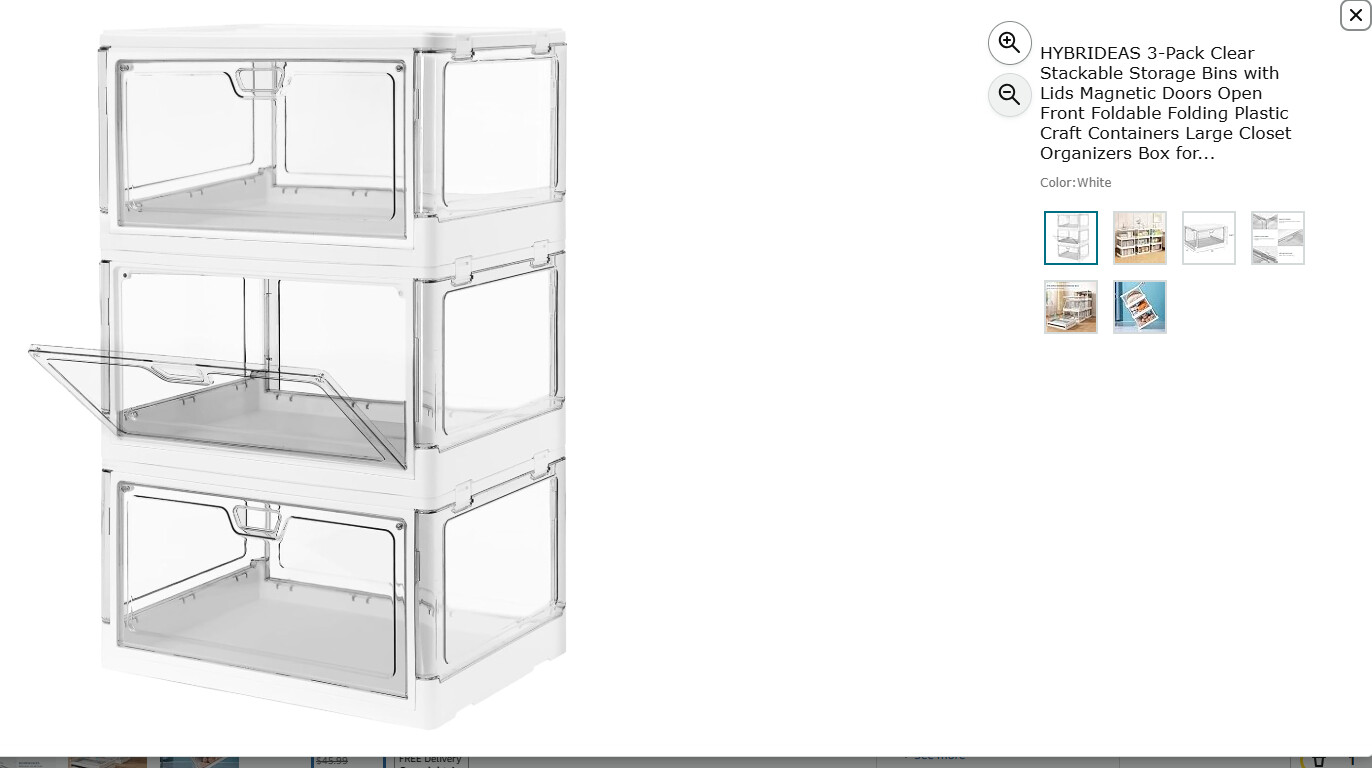
but if there were a version that was airtight, it would seem like an almost ideal way to store filament. Everybody seems to be using containers with lid-only access, so if they’re stacked on top of each other you have to reshuffle them to get to the bin that you want. With these it would be direct access. With these front access bins, you wouldn’t even need shelving. It effectively becomes its own kind of modular shelving that you can easily add-on to.
I had never seen this category of container before, but now that I’ve spotted it, there are probably hundreds of variants along the same theme:

so maybe there’s hope for finding an airtight version?
AMS 2 Pro is still noticeably “leaky” with respect to moisture ingress over time. Although the popular little desiccant containers like:
and their many variants that you can wedge in help soak up the ingress, and are useful in that regard, they’re still underpowered. If you have one or more unused slots, though, you can easily pack in a lot more desiccant into those spaces, with things like:
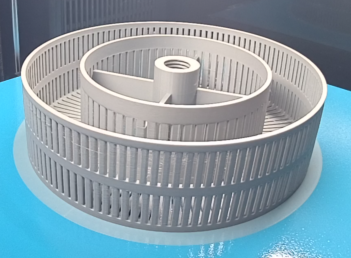
and their many variants, to buy even more time. However, all of these are basically useless for the AMS HT, which doesn’t have the space to store meaningful amounts of extra desiccant, and the spin drying doesn’t work unless you fully demount the filament from the PTFE tubing.
Hopefully whenever AMS version 3 comes out, if ever, it will be a lot more airtight and maybe incorporate the self drying electrically powered membranes that some people like CNC Kitchen and others on the forum have DIY’d to keep things bone dry without having to invoke a new drying cycle.
I got super tired of drying desiccant in filament dryer, so I made these PD USB Rechargeable Desiccant AMS / Spool Dry Pods - print 4 for the spools and 3 for the AMS. Remove and plug in to recharge.
@3Z3D Nice find!
I do wonder though: it says the PTC heats to 220C, so….Is that accurate? It seems perilously close to the print temperature for the ASA/ABS they recommend using, and obviously well above their ~100C glass transition temperature. I’ve also read anything above 150C risks damaging silica desiccant.
Aha, I think I see now. It probably would get that hot if powered at 12v, but it uses 9v instead. That might still be too hot theoretically, but evidently your success with it must mean it’s not an issue in practice, at least with the particular PTC the author recommends? I hate to be “that guy” who brings this up, but I’m just wondering aloud as to how hot it might get. Have you done any measurements, or, if not, noticed any plastic deformation?
I’m sure there is a temperature where it would be fine, as evidenced by bigger desiccant holders that one can just plug-in to recharge, but maybe those have some kind of closed-loop circuitry and/or cut-off temperature, whereas this seems to rely on 9v alone. Is that the case, or am I overlooking something?
If it were me, I’d feel more comfortable using a PTC that’s rated to max out at a much lower temperature. AFAIK, that’s the whole point of using a PTC in the first place. That, and maybe it’s just me, I’d include at least one temperature cut-off switch, as “just in case something goes wrong” cheap insurance. However, I’m not claiming any expertise in this area, so maybe I’m just fundamentally misunderstanding.
I’m sympathetic to the objective though: making it more convenient to recharge your desiccant. Therefore, regardless of anything I’ve said here, thanks for your post. It’s a worthy objective.
Anyone else have any thoughts on this?
I use an S4 or just put the filaments in a drybag with silica
It’s probably fine but the heater deep in the beads will need slow and gentle heat to keep from overheating the beads next to the heater while beads at the edges may not get warm enough? The way he shows regenerating the beads with a fan would keep the outer beads from getting as warm so they may hold onto more moisture.
But there is also intended use. They are probably fine for helping the AMS and if that easy to regenerate, should make for more dry AMS units I guess.