The corners under the cold parts of the bed release.
A while ago there were lots of images like this.
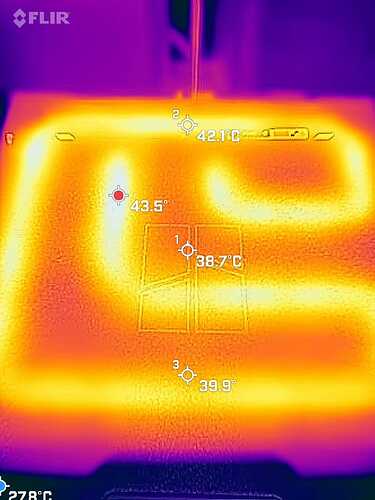
Yes, it becomes more even if you preheat it before printing.
I don’t do that.
The corners under the cold parts of the bed release.
A while ago there were lots of images like this.
Yes, it becomes more even if you preheat it before printing.
I don’t do that.
And there’s lots of images 3 minutes later showing the bed relatively evenly saturated.
This is precisely the reason why we have heat soak timers built into a lot of automated equipment in every segment of industrial plastics processing.
That is the causation. H2 printers have not quite good heat uniformity. Yes, at some point it will stabilize to be “good enough”. Buut the printer itself doesn’t wait for that equilibrium state. It starts the next sequence right after the temp sensor hit the desired temperature.
On the other hand, Prusa printers do have a process called “heat soaking”. BL doesn’t do that.
You get a downvote for that sentence.
Because after 3 minutes nothing is changing. 30 minutes? Yes. Not 3 minutes. Not even 10 minutes.
Okay. I guess I will get out my FLIR later and verify it on my end, but I have not had any adhesion issues with PLA, PETG, PA, PP, ASA, ABS, PPS, and PPA nor the GF/CF variants of each so far.
Please, be my guest. Me and many other users also have similar Flir thermoimagers. It’s been done many times in the past (the link above is not mine btw).
I am sure you have examined your own link there, but here’s what I see:
The timeline skips from showing uneven heating in the first 3 minutes (2:50 to 2:53 PM) to a bed that’s largely saturated and showing more or less the same variation as all other photos by 3:00. That’s a 7 minute window which is unaccounted for.
It’s possible that the thermal distribution shown at 3:00 (and every image after) was reached any time between 2:53 and 3:00. For all we know it happened at 2:55. Some time within 5 to 10 minutes it stabilized.
So my 3 minute exaggeration is a lot closer to reality (5-10 minutes) than your 30 minute claim, so maybe downvote yourself to be fair here.
Also:
It shows just 4-5 degrees variation across that bed, and its to that point in some time under 10 minutes then stays roughly there across the whole series of images. If raising it 5 degrees sorts out the issue then please tell me why doing so is detrimental to your printing process? If that works then the only harm here is that it’s a lower quality than ideal heatbed and it will use a small amount of additional energy. This is a very minor issue.
Again I agree that it’s an indication of a low quality design but 4-5 degrees total variation is better than most of my industrial equipment is expected to maintain. I can hardly be upset about a consumer printer doing so, but that’s a subjective thing.
I would say very low to zero
I imagine bambu might try to resurrect the belt/treadmill printer before they’d try to go larger than the H2 series. The H2 already has a couple toes over the line for package bulk/weight and how couriers operate. I would LOVE to be a fly on the partition of their database and be able to query the real world shipping incidence rate across their SKUs. Those things should be shipped on pallets delivered via wheely jacks or via tandem delivery, and they are not.
I dont personally believe zonal heating is a good feature so if it shows up I sure hope you can disable it. [You cant “turn off” conduction, you just run that small heater segment at a harder duty cycle, introducing more entropy] The mediocre energy savings vs stability are not compelling enough, and this is coming from someone who operates on 100% self generated solar. Just heat the bed and get it stable, then print.
Right, but the printer doesn’t wait like that naturally. It just starts going.
It’s easier to bump temperatures 5 degrees and save the filament profile, than it is to insert gcode waits or use a stopwatch to warm the bed before when printing. It’s also infinitely less annoying; H2Ds already take a long time to calibrate before each print (but the wait is worth it, although still annoying).
To be fair on Bambu, the thing got a LOT better after a firmware update (I had a very early H2D) and it’s now printing OK. When originally delivered the H2D was failing prints that my P1S made, due to warping. Increasing the bed temp and adding a brim fixed the problem at the cost of having to remove a brim. After the firmware update I no longer need the brim.
I just noticed that; wrong gender there.
The robot is certainly possible; the whimsy was making it look like a panda  I considered that less crazy than trying to build a 500mm H3. Maybe for the A3LL.