Interesting to see they can still function after the first 5 minutes in the open 
Yeah, water absorption rate is a complex function of the difference between the desiccant itself and the ambient conditions, and it takes an amount of time to accomplish this uptake.
That, rather beneficially, means it can tolerate exposure to atmosphere for the few minutes you need to work with it without just immediately ruining the stuff. It will uptake some moisture of course.
The sooner you can get it in the better, but there’s practical application vs theoretical perfection and we don’t need to sweat it.
You are asking really good questions and making good points, unfortunately.  The answers get kind of involved.
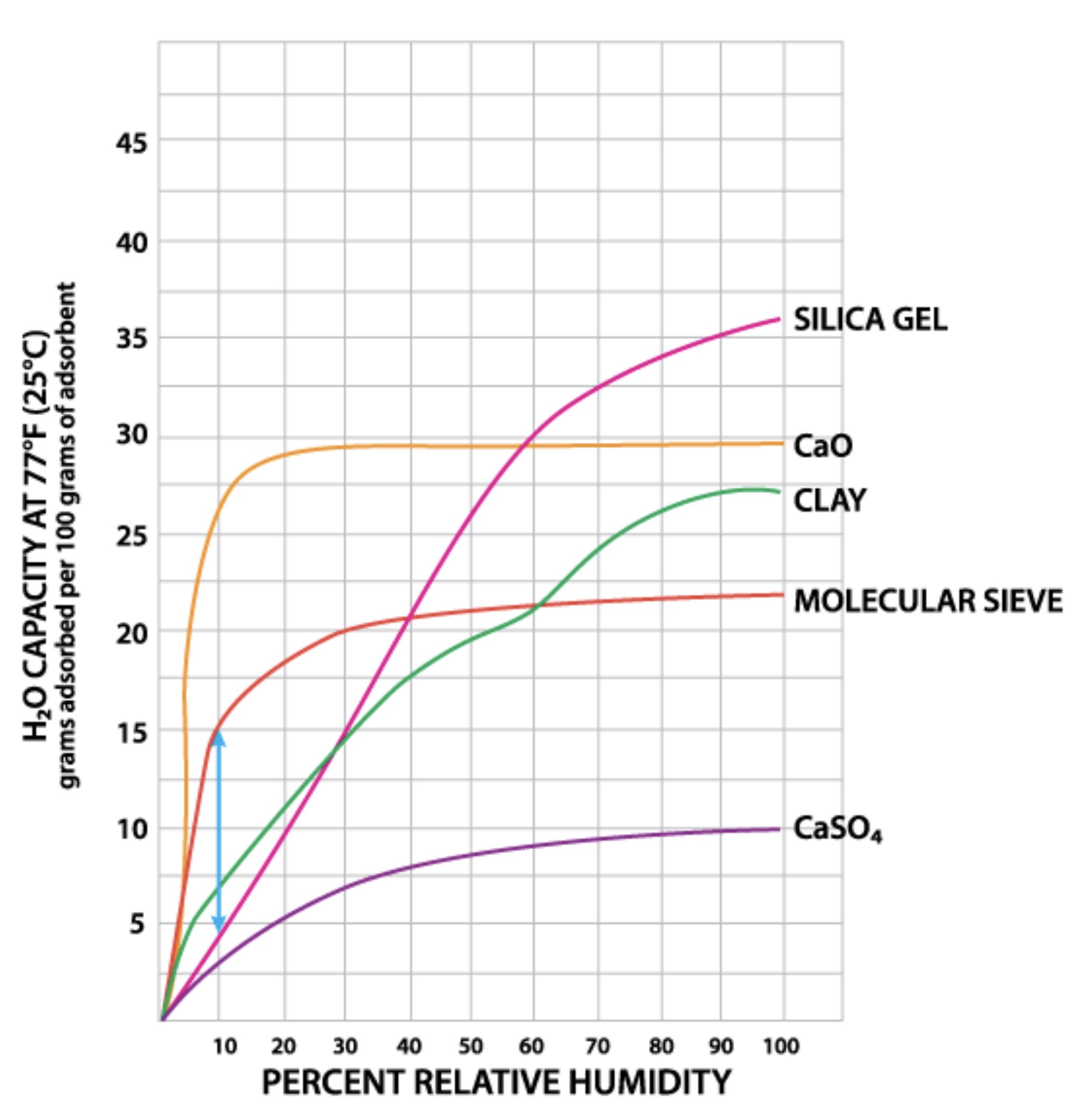
Silica gel and molecular sieves can both go to very low humidity. The difference is that the humidity doesn’t change as fast as sieves absorb water as it does when silica gel absorbs water. If you are trying to maintain low humidity with silica gel, you just need to regenerate it more frequently to keep its water content low so it can dry to low humidity.
Sieves have a steep slope where they can hold more water at a given low RH. Silica gel has a lower slope so humidity rises faster as it absorbs water but it can ultimately hold more water. There’s more to it than that but you don’t have to use sieves if you don’t want to. You’ll just need to regenerate it more frequently to keep the humidity low.
I was trying to find bigger containers but it’s hard to find airtight ones. Most are just offered with a regular lid so I assume they let much more moisture inside 
Thank you! I was considering using the ones Bambu offers, so the default chinese round ones since you can integrate them into the container lid, and place them on a nice rack, something like this:
In general, I would like to try things that are the most common solutions for makers so I can see how well they work and maybe also come up with my own system. So this seemed like the best starting point for an easy storage.
The Bluetooth ones are rather for when you want to place them inside the metallic vacuum bags, right? Since you can’t physically see their measurements.
Do you post-process CF-filled prints somehow to make them safe to handle?
That is incredibly helpful! I was wondering how to check if my spool was affected after being in the open for months in my room  It printed kinda well, no stringing at all, but I do have a feeling that some parts look different compared to my print from months ago, so now I really want to try your method

I don’t know that I’d say more efficient but the answer is “it depends”.
I have to qualify this because I use a modified drying technique that produces very dry filament. For me, that i10 drying cabinet will actually be allowing water into my filament - but at that humidity it shouldn’t matter at all for the plastics I print.
In the plastic boxes with fresh silica gel, the humidity pulls down below 10% which is the limit of what the cabinet can get to. So for me, the plastic boxes with silica gel will probably be more dry as long as I keep an eye on humidity and regenerate the silica gel when it needs it.
Since I mentioned the modified drying technique, all it is is a dry air purge into my “lowly” Sunlu S2 filament dryer. Many filament dryers don’t get the liberated water out of the dryer. The humidity in the dryer rises which slows the drying effect and limits how dry you can go. I use a door prop during the first half of the dry and when the humidity in the dryer starts dropping, I close it up and turn on the dry air for the rest of the dry.
The dry air is just a medium-sized aquarium pump blowing air through a silica gel column with that air plumbed into the Sunlu S2. It makes a huge difference in drying filament.
Oh so that would only happen if a user seals the two together, depending on the initial levels of the silica, i.e. if they dried the filament, then added silica that had a moisture level above what filament had, so filament absorbs what moisture was there in the container, lowering the %, and then freshly added silica starts oozing the extra moisture since it has more moisture than everything else, to equalize the container?
The factory sealed rolls will still continue to accumulate moisture over time though, right? Due to the water getting through the plastic bag and eventually desicant reaching its capacity
You want a container that’s not much bigger than the spool for quickest and most accurate response but it gets back to @Alex_vG’s point. Desiccants have huge water capacity. Up to about 50% by weight with silica gel. Filament is significant too but much lower water capacity - about 0.3-0.5% (3-5 grams of water per kg spool). Air is much lower water capacity - 1l at 25C and 30% RH is 0.007g water - about 1000 times lower than filament.
What happens is in a closed container the filament overwhelms the water in the air and either absorbs or gives up water until the RH value of the air equals the RH of the filament.
That’s why reading the RH gives a handle on filament moisture content. It’s reliable and reproducible and easy to do.
I read somewhere that when you want to lower humidity fast you need silica exactly due to the reasons you mentioned, and molecular sieve for the lower end since it works better there.
So, basically, I don’t actually need the sieve even for TPU and can just as well use my silica beads and only them? Handling sieve seems like a lot of (unnecessary) stress even if not doing it in the first few seconds after they are done regenerating
I just got those spools to start experimenting with them. So I haven’t actually printed with them yet as I didn’t like all those health hazards they come with, and will most likely stay away from them until I secure proper filtration, equipment, etc to deal with it.
What plastic boxes do you use, btw?
IMO, a matte UV protectant spray coating would suffice. I use it on occasion.
However, I have run dozens of kg of CF and GF filled prints and have never considered it a real threat, but I am also the type of weirdo who can handle fiberglass insulation without ending up itchy so maybe I am not the best example.
Not quite. For me it means convenience. The LCD hygrometers need constant babysitting, e.g. you have to regularly look at the hygrometer in each container if the desiccant is already used up and needs regeneration. How often do you do that ? once a month is probably not enough, when a roll sits at elevated humidity for 1 month, you certainly have to redry it . Better once a week? Or twice a week? That gets really tedious.
With the Bluetooth sensors I don’t have to check the values at all. the sensors don’t even have a display. instead I get a message exactly the moment, the humidity exceeds my set threshold and I know that it is time to replace the desiccant within the next few days.
In addition, the round hygrometers only have a range of 10-90% RH, the BTH go down to 0% RH, you also get a history timeline if you are interested.
Here is a screenshot of the sensor in my AMS PLA from September. you can nicely see when I added the molecular sieve and when I opened the AMS to exchange a spool shortly after.

And the round hygrometers are not even much cheaper.
Factory sealed spools can continue to absorb water. It’s a slow process, though, but the plastics industry rates plastic films by water diffusion rate / area. Water is a tiny molecule and diffuses through the plastic film. Nitrogen and oxygen are much bigger and their leak rate is much lower. That’s why the spools look like they are still under vacuum - and they are. But maybe not for water. Lots of water may have leaked in.
But it is a slow process for the water to leak in and the desiccant grabs the lion’s share of the water. Do the bag/cereal box hygrometer measurement on a spool of filament fresh from the bag and you can see a whole range of water contents.
And yep, eventually the humidity inside the bag and outside the bag can become almost the same. The rate of diffusion into the bag depends on outside humidity, inside humidity, and plastic film permeability. I don’t know how long that takes though. It slows as the humidity rises in the bag too because the flow is proportional to the difference.
I don’t follow the first part of your question though (unquoted). What happens is RH is everything and so are those desiccant curves I posted above. Filament is essentially a poor desiccant. The RH values for filament, desiccant, and air will all become equal as the water equilibrates among them though.
This gets tricky and has to do with equilibrium and non-equilibrium considerations as well as “reaction” rates.
I’ll punt and just stick with equilibrium since that’s easier and where things go anyway.
You can use either silica gel or sieves to hit low RH values. It’s just more “difficult” to go low with silica gel since small amounts of water raise its humidity value faster than with sieves.
If you have lots of water to get rid of, you’ll use less silica gel to do it but it won’t reach as low of humidity as sieves. But there is a lot wrapped up in that though. You can dry to the same level as sieves with silica gel but may have to regenerate more to do it.
That is indeed convenient.
The regular ones don’t go below 10%?
And yours are also probably relatively small since they don’t have the displays?
I learned so much from your replies in this topic, almost feels like a whole course on the desiccants, even though it’s ofc just the top of the iceberg.
I really appreciate it!
Sorry, English is not my native language so I probably didn’t explain it very well
I meant the part that is described here:

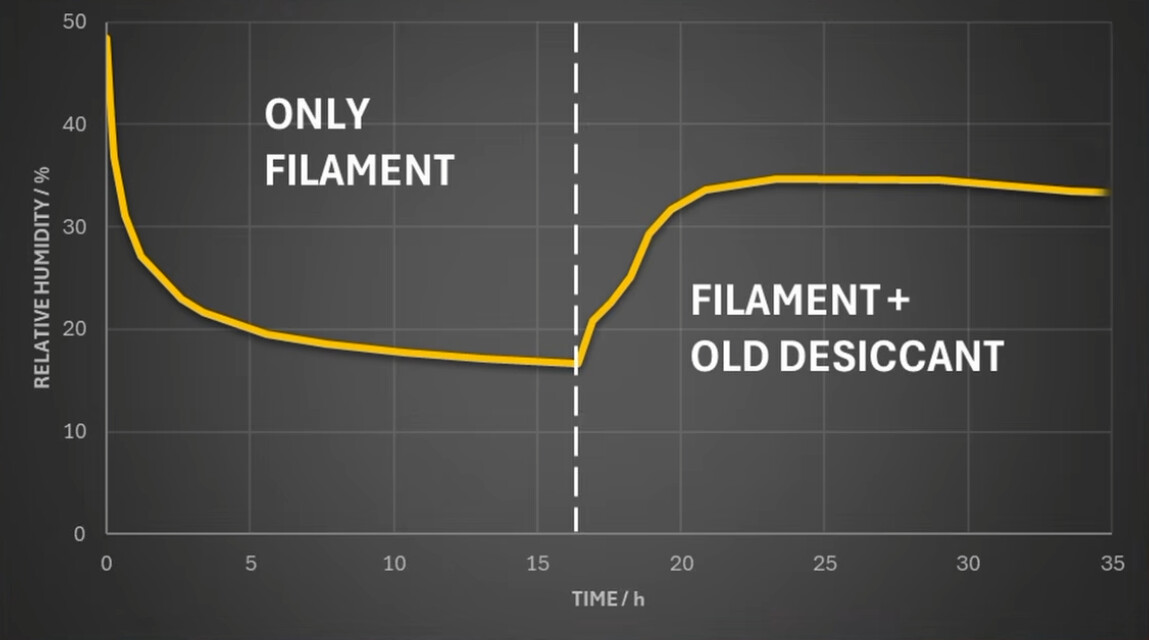
That video shows a number of things all at once but is an excellent demonstration of how water moves based on RH levels.
Had he put that desiccant bag into a plastic container with a hygrometer (no filament) he would have seen the humidity move to that same 35% value. Since he put it into the container with the filament, he saw it move from the filament’s humidity value to the desiccant’s.
The desiccant can hold hundreds of times more water than the filament so overwhelms the filament and air so the RH is mostly representative of the desiccant water content.
But that is a really good video for that demonstration. It also shows the problem - wet silica gel looks just like dry (ignoring indicators) the same as wet filament looks just like dry. It takes some kind of measurement to know the true situation and RH is really easy to use for it. It’s just a little slow.
Some procedures involving RH at lowish humidities call out long wait times just because the different processes are fairly slow and rely on diffusion (slow) to do their thing.
One correction is he says “if the environment is significantly more dry than the desiccant itself”. The process still happens at any differential. The rate depends on the difference but any differences in humidity value will cause water to move.
And his demonstration of propping the dry door open really works and works well. I use a door prop from MakerWorld but same thing. It lets the humid air out and more water can then leave desiccant, filament, or whatever.
I use a convection oven to regenerate my silica gel and same thing - it’s fairly tight for oven heating efficiency but that holds all the water in and decreases drying efficiency. Opening the door occasionally to let the humidity out really speeds up desiccant drying too.