Hygrometer accuracy in Dry Pods

With my dry pod design, some people have been concerned about the hygometer’s proximity to desiccant affecting its accuracy. One solution has been to leave the desiccant out of the pod with the hygrometer.

However, I would argue that it is a non-issue. Given time (e.g. 24 hours), the relative humidity (RH) in the AMS reaches equilibrium, e.g., the AMS, the filament and the desiccant all reach the same temperature, the filament has given up all the humidity that it can, and the desiccant has absorbed as much as it can (at that temperature). So the proximity of the hygrometer to desiccant does not make a difference if the humidity in the chamber has reached equilibrium.

I did this experiment where I put one of my large dry pods in a plastic bag, with other 6 hygrometers roughly equally spaced around the dry pod in the center, and a calibrated Cole Palmer thermohygrometer probe. Note that the dry pod was filled with used desiccant. After letting them sit for 4 hours, the round hygrometers read between 18 and 21% RH, with the hygrometer in the dry pod with the desiccant reading 20%. The 3 round hygrometers across the top of the picture and the one in the dry pod were purchased from Amazon. The lower right round hygrometer and the rectangular one on the left were purchased from Bambu. And an Xiaomi is at the bottom.

At 32% and 34%, respectively, the Bambu Rectangular and Xiaomi hygrometers show very different readings than the round hygrometers. While the round hygrometers are all within 2%RH of each other.

Meanwhile the Cole Palmer (which was last calibrated about a year ago) showed ~25% (24.9-25.1%) RH.

The round (Bambu and Amazon) and rectangular (Bambu) hygrometers are all specified at ±5% RH accuracy, and ±1% temperature accuracy. I couldn’t find specs on the Xiaomi. The round hygrometers are in spec, relative to each other, but the Xiaomi and rectangular units were way off. That’s a big spread! Which I attributed to the poor accuracy of cheap hygrometers, not their proximity to desiccant.

My conclusion are:

  • The accuracy of the dry pod hygrometer is not affected by its nearness to the desiccant.
  • Sticking with a particular model of hygrometer across all your AMS units to get consistent results relative to other units.
  • Cheap hygrometers provide “more of a guideline than a rule”. The value that they read when you fill the dry pods with fresh desiccant right out of a bottle is the best baseline humidity that you can expect. And when they read a value 10-15%RH higher than the baseline, then it is probably time to refresh your desiccant.
  • After opening the AMS, give the hygrometer at least 30 minutes to settle.

Note that the Bambu round hygrometer (lower right) was faulty. Most of the time it would read 10%, then jump to 20%, and a couple of minutes later jump back to 10%.

Also the Amazon round hygrometers have a C/F select button. The Bambu do not.

Any thoughts on this subject would be appreciated.
Good thoughts and great experiment!

I am very glad we have the desiccant pods and one with the space for a very readable gauge! I’ve only had my system since November and have only had to replace/recharge the desiccant once. The gauge, with fresh desiccant reads 10% (which is probably its lowest readout) and when it started creeping up (to approximately 14%) and the fact that I don’t trust the absolute accuracy of cheap hygrometers, I opened up one of the pods and found that the indicators in the desiccant had started to change color. I replaced the desiccant with new and dried the old. So far I haven’t had any issues with moisture and it’s largely because of the great ‘surround’ of dryers in my AMS enclosure.
Good job!

Nice work!

I got all my round hygrometers from Amazon and they are very consistent in their readings. Mostly within a percent but some look a percent out.

And I agree - absolute accuracy is nice but as long as hygrometer behavior is repeatable and close to true values, they don’t really need to be spot on.

What you say about equilibrium is exactly correct. If not at equilibrium, gradients in moisture/humidity will set up and you will see true differences in humidity at various locations in the bag.

If you have canned “air” or some other source of dry gas, try filling that bag with it and watch the humidity reported over time. It doesn’t take long for water to permeate the bag and start raising the humidity in it. Day or three, basically. Desiccant will hide that, though, by scavenging the water.

Last, if making holders for hygrometers it’s important to not cover or obstruct the measurement port. The area around the port needs to be as open as possible for fastest response. Laying with the displays face up there’s only the C/F button sticking out to lift the back up to unseal the port.

I had very similar results with those cheap hygrometers.
I have completely switched to Bluetooth thermo-hygrometers from AliExpress for 1,70€ each. They go down to 0% RH instead of 10% and 12 units are within ±3% of a SHT31 sensor as reference. I tested a few types and I think the ones I use now are called BTH01 + a Bluetooth gateway for 6€.
Instead of having to look at the screen regularly, I get an alarm message on my phone when RH exceeds a set threshold. I currently have the threshold at 10%.

For me that is much more comfortable than a display and I put them in every filament bag. No need to take out each bag regularly to check the dessicant. Instead I get a message when it is time to exchange it. Each AMS has one as well and I don’t miss the display at all.

These hygrometers are ■■■■. Mine remain stuck at 10% RH even if outside in ambient conditions (currently some 37% RH).
I built my own using SHT-41 sensors and a tiny ESP32-C6 with display. The SHT-4x sensors are as accurate as you get these days.
Actual RH inside the AMS is now measuring 17% RH at 25 °C after a few days of stabilzing and plenty of desiccant all over inside the AMS.

They are ■■■■. But they are also cheap and easy.

In the test that I ran, I had one that randomly would jump from its ‘correct’ reading to 10%. Most of the time it was at 10%, but I happened to be looking at it when it jumped to 20%… A little while later it was back at 10%.

Could you share the circuit/code that you used for the SHT-4x?

And a link to the “ESP32-C6 with display” that you used?

Thanks!

I prefer the BTH01 sensors. They are a huge step up from the round or rectangular cheap sensors and give very consistent results. For less than two bucks, I get a finished product with wireless connection.

At least for me, time is at a premium, so I consider twice if I want to invest time for a better solution. But of course that could be much different for somebody else.

Just seconding what mcmaven requested. @user_4073024701 would it be possible to get links to the hardware, code and other details around your ESP32-C6/SHT-41 setup?

I am retiring end of the month, so plenty of things to take care of. I shall be able to round up the circuitry, code (using LVGL with SquareLine Studio for the GUI) and 3MF/STL (enclosure), in the later part of September.
Cheers

Thanks! Much appreciated. Good luck with the retirement!

I got some of the round ones from amazon but I have never ever seen any of them indicate less than 20% humidity. Do any of you know a good way to create an environment that is more dry than that to test the hygrometers?

Oven?
Bear in mind relative humidity varies with temperature.
Just heating the same air lowers the RH. It’s a big difference.
Air with 50% RH at 20 deg C will be 6% RH at 60 deg C. (figures from ChatGPT)

In an air tight box, molecular sieve will extract all water from air so that humidity goes down to 0%.

Or, what happens when you cool air down below 0°C? Freeze drying is a common way to dry fruits. Maybe that works too?

I just ordered one of these.

Christen of CNC Kitchen tested it (https://www.youtube.com/watch?v=n7EWexck8NE). I wasn’t going to attach it to an AMS, but to a 54 Quart weather proof plastic bin (it has a gasket on lid). Plenty of room for Dry Pods and filament.

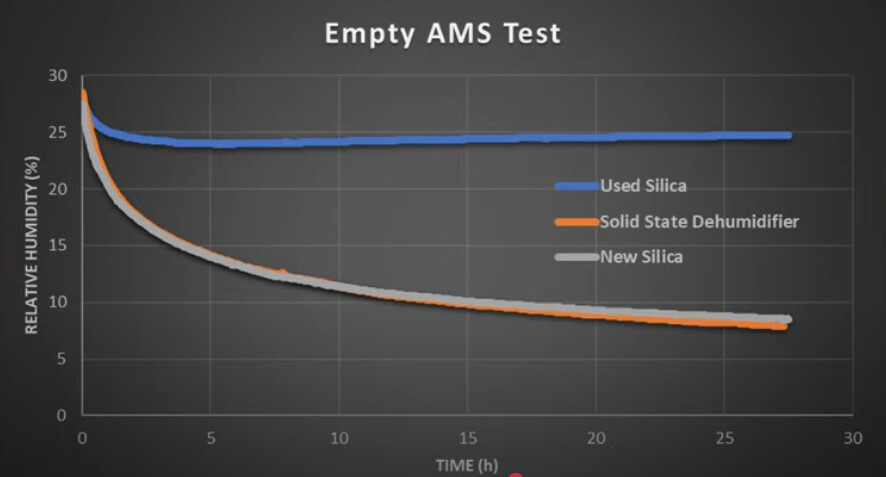
It’s pricey, but I have been really disatisfied with the AMS2 and AMS-HT drying. I can’t seem to get below 24%, even with multiple consecutive drying sessions. One issue with solid state dehumidifiers is that they replace humidity with oxygen. With all the motors in the AMS I didn’t feel comfortable using it there. But I figured that if I used a bin, there would be no energy source that might cause problems, and it should get the humidity down under 10%.

Here are Christens results:

The round ones only go down to 10%. If you put one in a sealed contained with new desiccant, it will get there. I have gotten a fully loaded AMS down to 7% with new desiccant in my dry pods. At least that’s what Bambu Handy read from the built-in AMS hygrometer.

My AMS (gen1) is constantly at 0-5 %RH with some molecular sieve 3A. Using silica gel before, it never dropped below 20 %RH. The molecular sieve needs regeneration more often though. It can hold around 20% water of its dry weight. Silica gel is close to 50%.

Of course a solid state dryer is the perfect fire and forget solution for longterm storage.

Regarding sensors:
I tried a bunch (10 or so) of those very cheap round and rectangular clip-in sensors and the values were all over the place after I had them in the same box for 24h. I think the spread was like 30%RH between lowest and highest reading.

Now I use BTH01 sensors from AliExpress. I tested 8 against a reference sensor SHT31 from Sensirion. They were all within ±3 %RH and range is 0…99%RH. The bluetooth link together with the app allows me to have an alarm when humidity rises above a threshold, so I don’t have to check regularly any displays. I’m not very happy about the china cloud. There seems to be an alternative opensource firmware to integrate them directly in home assistant. But I didn’t find the energy yet to switch. It’s working too good as is :stuck_out_tongue_closed_eyes:
I’m very happy with that solution. And at 1,80€ per sensor and 8€ for the Bluetooth gateway, it is really cost effective too.

I think the value reported by Bambu is not %RH but some arbitrary measure. Something like
100% BambuScore ~= 40 %RH.

That could well be. The Bambu “Hygrometer” consistently reads lower than the ones in the Dry Pods.

I received and installed the Rosahl unit on a 54 Qt sealed storage bin. I filled the bin with dry pods, filament spools and old desiccant packets. That was 2 weeks ago. At the time the humidity was 45%, and today the humidity is 39%. The Rosahl has been on for the 24-7 for the last 2 weeks, generating about a 6% drop in the humidity. The unit appears to removing the humidity from the bin, but it is REALLY slow. There is a lot of material in the bin, but I had expected it to work faster.