I’m just a hobby printer but have four AMS units. Mine are the original and one came with my X1C. I keep the 16 filaments I use the most ready. For me, it’s just the colors and filament type. I like it and wouldn’t think of giving them up. I run my TPU off a side mount.
1 Like
A friend is getting ready to buy an X2D and below is what I recommended for him. For what’s it is worth, I own 4 H2Ds, 1 H2C, 4 X1Cs, and 2 X1Es.
>>Here are the accessories I’d recommend for you to get with the X2D printer… will get you started without going nuts.
Vision Encoder Plate – Better printing accuracy.
https://us.store.bambulab.com/products/vision-encoder?id=720442762127712258
0.4mm Hardened Steel High Flow HotEnd – For printing high-flow PTEG and similar filaments.
https://us.store.bambulab.com/products/bambu-hotend-h2-p2s?id=720440262071091225
Bambu Cool Plate SuperTack Pro
https://us.store.bambulab.com/products/bambu-cool-plate-supertack-pro?id=720441966271152130
Bambu Engineering Plate
https://us.store.bambulab.com/products/bambu-engineering-plate?id=720442376270401538
Bambu PLA Basic (White) - 10 Rolls
https://us.store.bambulab.com/products/pla-basic-filament?id=41078274687112
Bambu PETG-HF (HF = High Flow) (White) - 10 Rolls – Currently out of stock.
https://us.store.bambulab.com/products/petg-hf?id=42735939813512
Nice list!
I’m a big fan of the AMS-HT. They work well and provide versatility. I bought 3, but well worth getting one and using it for the auxiliary nozzle.
2 Likes
I think everything on this list is a good buy, but when you add it all up, expenses really explode.
@3DTech2 didn’t tell us his printing history. Is it your first dive into 3d printing or do you already have some experience?
For a beginner, I would skip many items on the list and limit myself to the things that are really necessary or sure to be used.
For example the vision encoder plate is really optional and majority of people will never need it. And it is like 10% of the printer.
20 rolls of white filament is certainly a good deal, if you print a lot of it. I think I haven’t used that much white filament in 13 years of 3d printing. And I would miss at least a few colors, especially for testing dual nozzle printing.
Use the printer for a month. Then decide which accessories you need or want, if any.
3 Likes
You don’t have to decide on what accessories to buy at this time. Decide it later.
Even when you decide, don’t buy too much. I bought 4 sets of hotends for my X1C. I just had one clogged nozzle on one of my printers this morning (after more than 3 years of use). I decided to skip the unclogging procedure and go for a replacement, because I want these extra hotends to have a use somehow 
I would highly recommend getting the AMS combo AND the AMS power supply. This allows you to run drying cycles on most filaments, and KEEP them dry. The power supply allows it to dry whilst the machine is printing. As others have said it is very handy to keep your 4 most used filaments in there, so you can change colour or material without touching anything or exposing filaments to air/moisture.
If you decide to get an AMS later, it’s about double the price as opposed to getting it in the combo. The AMS HT is also a great option.
An alternative to the AMS HT are these dry boxes below. By printing some PTFE tube quick connectors you can easily connect and feed them into either extruder, while keeping them sealed and dry inside. Using a 4 into 1 tube adapter you can easily connect the filament boxes or the external spool without disconnecting the main ptfe tube from the buffer. You can dry engineering filaments in your oven or even using the print bed with a printable spool enclosure.
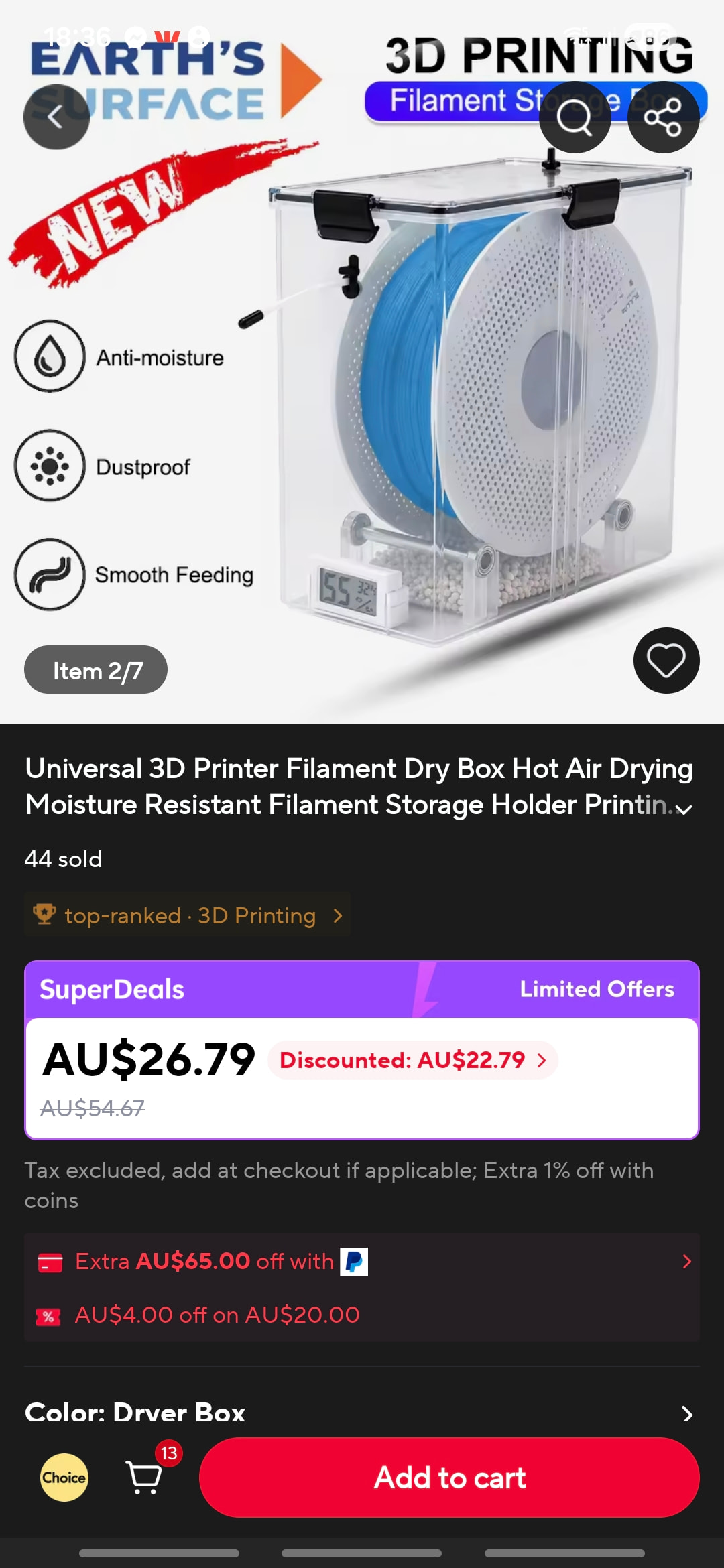
Besides that, a pair of 0.2 and 0.6 nozzles (I like the cheap generic ones with the removable tip), the engineering plate…and shop around for filament.
The plastic dry boxes are a good idea. I use them when I need to cycle filament in and out of the AMS and they are relatively cheap.
Keep in mind that a dry box will not dry filament, only keep filament dry longer than sitting in the open space. These can be purchased on Amazon as 4 liter cereal boxes.
I would not dry filament in a kitchen oven. There are two reasons:
- Kitchen ovens do not maintain a constant temperature. They are designed to cycle or oscillate up and down in temperature by a fairly large degree. You risk over-baking filament.
- Most important, plastic out gasses when it is hot. You really do not want those chemicals inside an oven that you cook food in.
If you need to dry a filament that the AMS Pro 2 can’t dry, I highly recommend the AMS-HT.
The plastic dry boxes on Ali are a bit more expensive than a cereal box, but they have ball bearing rollers, a spool holder of you want to use smaller spools etc, a humidity indicator and other accessories. They keep my nylons dry for ages. No issues there.
I guess ymmv with ovens, I put a thermocouple probe in mine when I cook filament and get maybe 3 degrees max of variation/hysteresis. They are not designed to fluctuate, its just what cheaper ones do because they are controlled by a basic bimetal thermostat.
Maybe on a cheap oven, but I am a co-owner of a patent for cyclic oven temperatures. The theory behind this is that it induces air currents within the oven cavity as the bake takes place.
Nevertheless, the bigger point is; unless the oven you are drying filament in a kitchen oven that is never used for cooking food, it is a bad idea.
You can also buy a small commercial blast oven if you need something better than the filament dryers already on the market.
Interesting.
So is that designed to replace the fan in a fan forced oven?
Yes, it is not ideal to use your house oven for drying filaments. But I do wonder how much is emitted when you are still way beneath the glass transition temperature and how much residue is deposited in the oven, and if it is significant, compared to people printing ABS in their living areas?
The concept is to produce air currents up and down inside the oven cavity. Not quite the same thing as convection cooking setting.
1 Like
The AMS HT is a great product. I love the two I have. The AMS/AMS lite/ AMS 2 are not good.
We’re all different in how it affects us, but drying fresh rolls of filament irritates my sinuses and eyes - nothing serious but there is a reason it’s irritated me. It’s the one thing I have to remember to turn on the exhaust system for because I haven’t automated it even thought HA has the sensors showing an AMS drying or not. I figure its residue from the process more than the filament itself but I’d rather not breath it all day.
If you are new, please buy Bambu lab filament.