
I’m happy to say that my results are improving. I factory reset the printer and re-ran all calibrations (including the heated bed leveling) and printed this little guy as a test of running three colors and he looks much better than the first time I printed him. I’m experimenting now with “new support for PLA”. I’ve had a couple of print failures when the support structure came apart as new material was being added. I need to investigate the parameters and set up Bambu Studio to be more robust because I think it’s just a matter of the software trying to save too much material at default settings.
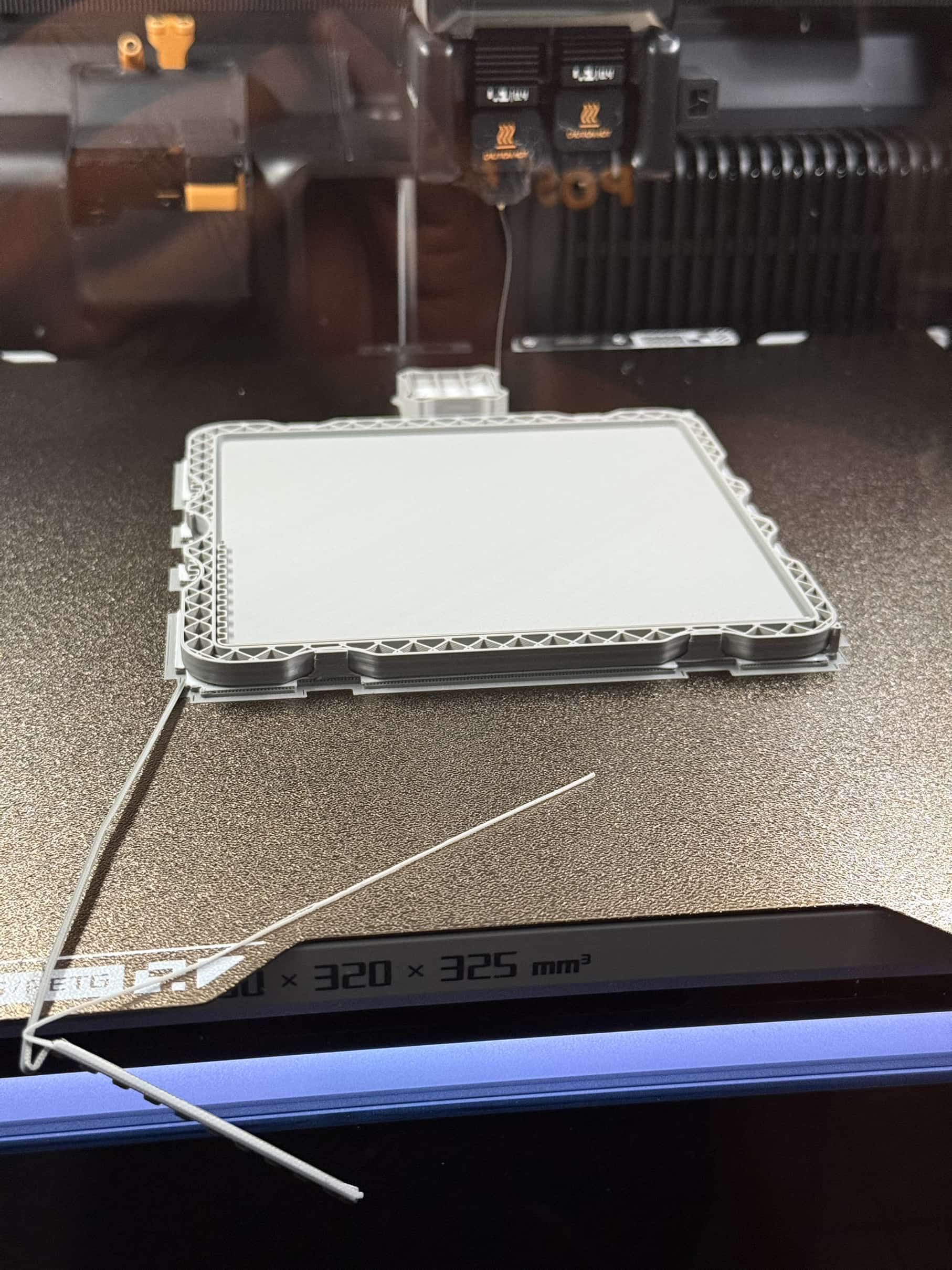
I have had mine for 4 days now. I have yet to be able to print from the right nozzle. I sent a ticket into Bambu 3 days ago, and have yet to hear back. So, I am going to say it’s a ■■■■ shoot.
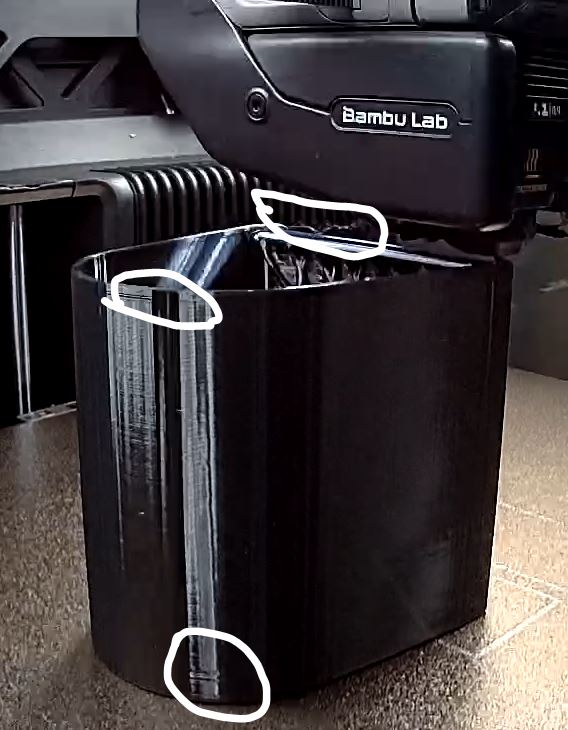
Check how the part cooling fan is performing on your print this has caused issues in some of my previous prints. The cooling controls really need to be more like what Orca Slicer offers. I’m getting too much cooling on the top layers, especially when printing over the interface layer, and then the outer walls are being over-cooled. If I disable cooling for overhangs, they don’t get enough airflow but it stops the problem. I’m hoping this gets fixed soon I’ve already submitted a support ticket in the hopes of a slicer solution soon.
I dont know if your part is getting over cooled check out the fan speed in the slicing result and see what it doing.
This was one of my 0.24 layer PETG parts that got over cooled.The walls cooled too much, and the PETG didn’t adhere properly to the interface layer.
Luckily, the part still turned out okay I had to have overhang fan on do to transition to a round tube.
EXACTLY!
Cooling on the internal bridging layer (interface layer) on H2D is REALLY TOO MUCH.
I read your thread. Sorry to see you are encountering an issue with your right nozzle.
Let’s hope that you get some response from support fast.
Had mine setup for 1 day so far and it’s incredible.
Machine build is high quality.
Setup was extremely easy.
First print didn’t stick to the bed, I had only wiped the new plate down with isopropyl, so washed it with fairy liquid and now on 4th print, flawless.
I come from never owning a 3D printer. Being able to produce these parts with such ease is incredible for the technology.
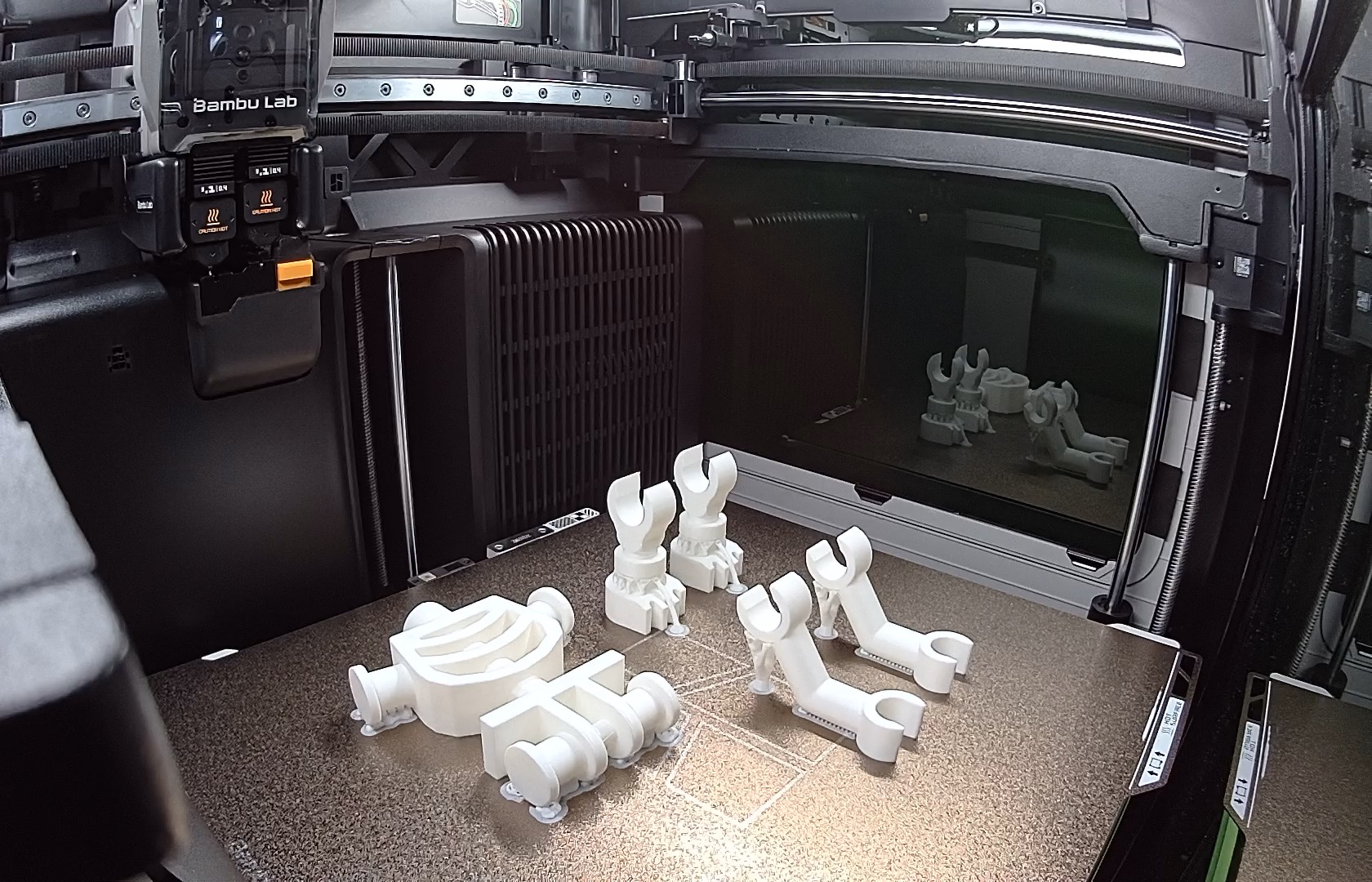
It seems like most H2D owners have owned at least one prior 3D printer, so it’s refreshing to hear the experience of someone for whom this is their first.  Welcome to the revolution!
i´m confused a little bit, imo the first step is always to have a perfect movement calibration (that’s what the Plate should do). After this you can print a defined Part and Calibrate the shrinkage of any Filament. But at least maybe the shrinkage is not always the same on different rolls of the same type filament.
There are so many different Circumstances you get different results just for the temperature inside the the printer at Calibration and while printing, also the belt may cause inaccuracy at different temperatures. I guess for always correct movement you need a ball Screw outside the printer with always the same temperature.
the big question for all of this is, how precise the part you print have to be
I’m happy to report my prints now look great with latest beta firmware, Studio, and Handy. I was lukewarm to the H2D at first, now it’s meeting and exceeding expectations.
Hi everyone,
I’m currently working on a 3D printing project related to custom orthopedic insoles for medical use — mainly for conditions like flat feet, foot misalignment, arch correction, etc. This requires flexible materials like TPU 95A or TPU-HF, and the goal is to achieve stable printing performance and consistent part quality.
After some research, I’m particularly interested in the Bambu Lab H2D due to its large build volume (Y axis ≥ 320 mm), fast printing speed, and smart automation. That said, I still have a few technical questions and would love to hear feedback from those with real-world experience:
- How stable is the H2D when printing TPU 95A or TPU-HF? Any issues with clogging, inconsistent extrusion, or layer shifts during long prints?
- Is the print quality consistent across multiple identical prints (especially for applications like insoles that require precise geometry and elastic response)?
- Do you think the H2D is well-suited for this type of application, or is there another Bambu model you’d recommend instead — and why?
- Does Bambu Lab offer official TPU materials for the H2D? And if so, where can I purchase them (ideally in or near Vietnam)?
I’d really appreciate any insights or experience you can share. Thanks in advance for your help!
Warm regards,
A user from Vietnam
(3D printing for medical-grade insoles)
It’s good enough until TPU 85A. You would need to do a lot of study and research (e.g., watch a youtube video  ) before you start the process. As for TPU 95A/HF, it works quite well on my machine.
However, I would like to also remind you that different hardness of TPU exists, you might want to try different hardness first. The best way is not buy a printer first, instead, you should start from ordering from a print farm and try out all the TPU options they have. Lots of differences here, not only just about hardness, but also the durability. 95A is considered as a rather hard material when you give it enough strength to support heavy things, like human body. The common gel-like silicon insoles are rated usually at 30A or 45A ish.
And yes Bambu do sell it from 85A to 95A to TPU for AMS, which is a very hard TPU. You would find other manufacturers easily.
Anything that is softer than 85A is… nearly not printable on H2D. You would need to go for custom printers for those very soft materials as you need to adjust the extruder tension.
TPU 85,95, and TPU for AMS for me print excellent every time. I just load it with my dry box that has a 608 bearing in the hub. Prints come out as expected each time.
Hello Dear, I have the same project. Is there any chance we can connect and share our learnings? I have not purchased it yet, but I plan to use ESUN95A.
I ordered my H2D right at the start when they started selling it and now printed about 586 hours on my H2D and only minor issues :
One time the nozzle was clogged and the AI did not recognise that. → Bambulab sent me a new heating unit because mine was damaged due to that.
One time the plate was scratched due to the nozzle scratching it.
Bambulab sent me a new plate and upgraded the firmware.
So what….this is totally acceptable for me. There was a firmware-issue, they corrected it.
I have 4 printers from different brands. Bambulab H2D still produces the best and reliable results.
I really CANNOT understand all the complaining about Bambulab support.
Just remember how long they are on the market. Not very long compared to others. Now see what they have achieved. Their printers are really good and they are keen on improving their firmware constantly.
After having used Ultimaker for a long time before, I really appreciate my Bambulab H2D, it´s print quality and accuracy.
I am using Bambulab-Filament only not, only because of the convenience when swapping filaments and automatic reading of the parameters, also because of it´s quality, structure and colours. Have you ever printed TPU90A on a H2D. It is an amazing result compared to the bad results on my Ultimaker.
The Bambulab-Support takes some days to answer, That´s true but I feel that they are really trying to solve problems. Imagine how much support-cases are filed which are „user-incompetence-based“. I work in IT and could really tell you.
I guess most of us haven`t worked in a support-departement yet. Have patience with the Bambulab-supporters and the Company. It is evolving rapidly.
Just a heads up, Bambu doesnt make filament. They use the same suppliers as other filament brands. There are only a few printer companies that also make their own filament. I wish bambu would start filament production. It would probably come dry all the time.
And 70$ per roll for a special Bambulament PLA , Ill pass, ill survive with my 10$/roll and bit of drying.
$70 a roll? They been ripping you off! They only charge me $14 a roll when I buy 6. But I haven’t bought any Bambulament PLA. That must be in a special category hidden from the public.
I use all Bambu except black. Matte black I buy from Sunlu on ebay at $85-100 w/free shipping for 10 rolls. I stick the Bambu matte black sensor on it and it prints perfect.
Read it again 
ITS SPECIAL OK?
Jokes aside, put the color consistency (which is already a huge problem in ANY field using plastic) and a more strict dimensional accuracy regarding the filament (eg, 1.75 ±0.01) in the “package” and boom, the filament already is premium and will cost upwards from 40-50$. Look at prusament tpu for example.