MakerWorld's copyright protection doesn't protect creators

Hi everyone,

I’m a long-term maker who publishes exclusively on MakerWorld (250 published models, 73k+ downloads, 34k+ likes). I want to share my experience with the Creator Protection process, because I think it affects every creator here who sells a commercial license.

What happened

  • I created and published my model “Fishing Chair Mount” for free: Fishing Chair Mount (⌀ 15-50mm, □ 25mm) - Free 3D Print Model - MakerWorld
  • The user @MirceaM subscribed to my commercial license and sold my model for months through his shop, Flex3D.
  • He then cancelled the subscription. When I checked his website afterwards, he was still selling the model.
  • When I contacted him, he replied that they had created their “own” model, which they now sell.
  • Shortly after, the listing was changed. But “their own model” is basically a 1:1 copy of mine. They did not even change the bottom hole pattern. They only moved one small mounting hole.
  • Judge for yourself: the comparison is attached below.
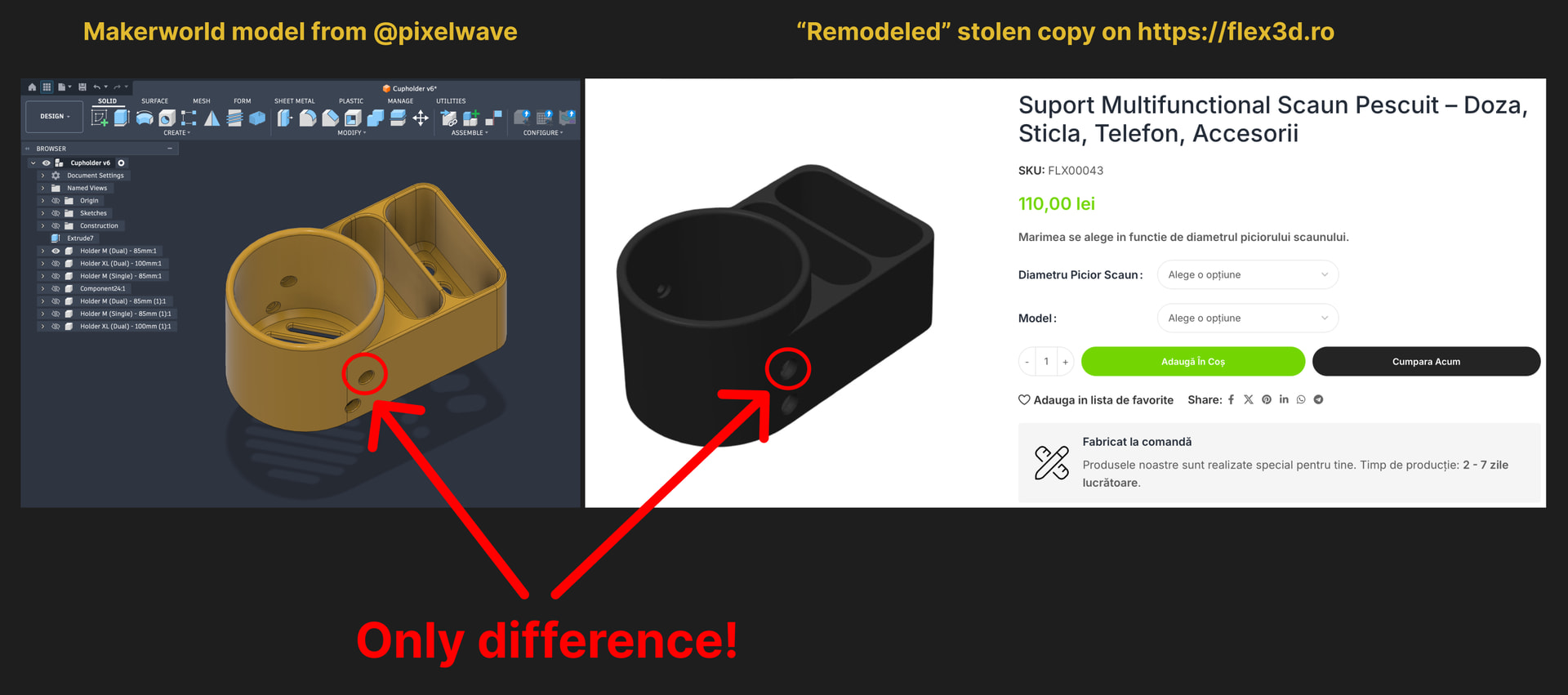
The response from MakerWorld
I filed a copyright claim (#3791965) on Sep 22 with the comparison attached and some extra screenshots from Fusion. MakerWorld’s reply was that the seller built their own CAD file, so my STL isn’t used, and that I should name the “protected elements”. I explained that my claim was never about the STL file, and that a 1:1 re-creation is still a copy of my design. I got the same pre-written answer back each time. After more than 20 (!) resubmissions, the claim kept coming back to “Requires Additional Documentations” with identical text. A human only answered after I emailed the copyright team, and the answer was that MakerWorld has no authority over external websites.

Why this matters to every creator
If this behavior is tolerated, it means this for everyone who sells a commercial license on this platform: a potential customer only needs to download your 3MF or STL, load it into Fusion, run a prismatic trace, and has “their own” model they can sell, with MakerWorld doing nothing. The whole copyright protection is then pointless, and MakerWorld won’t even act against a user who is still active on its own platform.

Nobody expects MakerWorld to police the entire internet. But it controls its own platform, and @MirceaM’s account is still active, even though he used a commercial license and then kept selling a basically identical copy.

Has anyone else run into this? If you sell commercial licenses, you should care. Please share your experiences below, and I’d appreciate it if MakerWorld staff or the Bambu Lab team could look into this.

UPDATE: The seller has since removed the product from his website, and I verified that the listing is gone. MakerWorld’s final answer on the claim was that, because the infringing product isn’t hosted on MakerWorld, it has no grounds to penalize the account. The questions about how the process works for creators who sell commercial licenses remain, so I’m leaving this post up for discussion.

Copyright for FUNCTIONAL parts is complicated and difficult, because if the part needs to be a specific shape to do a task, then it must be that shape.

Consider if you made a dice or screw, and a user sold a similar thing but not exactly the same. Would you have a clear and obvious copyright case?

If your dice has very unique cosmetic, artistic, pattern printed on it, and their is similar, perhaps you do, but if it’s just a dice, you do not.

I have experience of this in typography. If you reinvent a similar font it’s usually ok. However if you trace over it or ship a modified version of files, there is a case for copyright violations.

Bambu are saying this: Other folk have an original file and the design is “obvious” and no logos etc were copied. Therefore not a copyright case.

Usually functional parts are parts of inventions protected by patent and their “trade dress” (the brand identity) by trademark. Instead of copyrights. But some are …

Anyway TLDR this might not be a copyright case. Good luck. (EDIT to both sides, you and the ex customer. Because it’s not obvious to me which is right; I would need to see their files to see if they just republishrd yours directly or had original source CAD).

Thanks for the thoughtful take. I agree that functional parts are a gray area. But a clamp for a fishing chair doesn’t have to look a particular way: the dimensions of the pipe are given, while the hole pattern, the geometry and the proportions are my own design choices, and the copy matches them 1:1. This is also not a dispute over the object alone: the seller held a commercial license for this very model and sold it for months before replacing it with a “new” version. My main point is about the platform: if tracing or redrawing is enough to get around a commercial license, then the license has no value for creators.

I would not say the merchant licenses have no value to creators. The licenses certainly have value to artistic creators making sculptures. One hopes they have value to everyone, but I do not fully understand how it works for functional parts. (EDIT Or whether the problem is with MW, or copyright law, or both)

Thing is, most experienced CAD users, and even an idiot like myself, could design that part in 10 minutes in a parametric CAD program. It is a box and a circles, then extrude upwards and punch holes and slots into it. I am not saying your work is trivial. It has great value, especially to owners of that specific chair. But, if you got this model taken down it would not be difficult for someone to make another, and all we have done is upset the customer, who now won’t be back for other designs.

It’s a functional part. The copyright is on the STL file, not the design.

And what law prohibits this?

Fair points, and thanks for the balanced view. Almost anything looks trivial once you see the finished result. This clamp still took several iterations, prototypes and a lot of trial and error to get the mounting mechanism and the shape right, and that work is exactly what a quick trace or redraw skips. Anyone is free to design their own part, and I’d never object to that. What I object to is a seller who held my commercial license for this model, sold it for months, and then offered a version that matches mine in detail, including the hole pattern, shortly after cancelling. Whether it’s a copyright problem or a platform-policy problem, the practical result for creators is the same, which is why I wanted to put it out for discussion. I’m also not trying to drive customers away. The seller has since taken the listing down.

Good question, and I’m not a lawyer, so I won’t claim this is clear-cut. My argument isn’t that a clamp for a fishing chair can’t be designed by anyone else. It’s that this specific design, with its proportions, layout and hole pattern, took several iterations, prototypes and trial and error, and was reproduced 1:1 (minus moving one hole) by someone who held a commercial license for it until shortly before. Whether that’s a copyright issue, a license issue or a platform-policy issue is exactly what I wanted to discuss. For creators who sell commercial licenses here, ‘redrawn in CAD’ shouldn’t be a way around them.

You can address this with an additional clause in the license that prevents competition for a certain time after they stop paying. Not sure if MW supports this automatically, but it’s an option you and the customer can agree to before a license being granted. It’s more paperwork, of course.

Legally it is for complicated parts. For example: car repair parts to restore the appearance or function of a car are legal, so long as it’s clear they are not claiming to be original manufacturer parts.

I don’t know what complexity test must be passed for this to apply to a fishing chair foot. The repair part exception was intended for complex machines.

You should check the OP’s file for similarity with yours. If the mesh is the same, they might have edited your files, which is NOT ok.

Laws potentially broken depending on your country’s laws.

  1. Trademark Infringement and Passing Off
  2. Registered or Unregistered Design Rights and Copyright

Point 2. Doesn’t require the STL, the completed product holds copyright. Both the design (digital files) and the physical product (the resulting model) are covered under copyright laws in most countries.

=======

I recently noticed someone reproduced one of my models with a unique design and shared it back on MakerWorld, changing one parameter (think 1mm), MakerWorld looked at each one side by side and said I failed to provide evidence!

MakerWorld (Bambu Lab) bow down to external law firms, but fail to provide any real support for its own users. They can provide many excuses of why carbon copies are not carbon copies, why copyright infringement isn’t infringement and that the sky is pink.

They function like bullies, we are not big enough to scare them into performing the service they say they provide for protection, but happily kiss the ring of those who can afford expensive lawyers.

The people who create the designs are the copyright holders/owners and are the ones responsible for protecting them.

Unfortunately many scammers and thieves know that individuals don’t have the time, money, or resources to prosecute lawsuits across international borders.

Unless you put your models in the various programs where MW does (sometimes?) assist in protecting licenses, there is no onus on MW to do much of anything. If your stolen models end up back on MW, then you may have standing to threaten MW with a lawsuit yourself.

In short, without deep pockets to protect your designs, the reality is thieves can see us all as sitting ducks. The only real recourse is if they use storefronts that are responsive to takedowns and copyright infringements. Many have had good luck with takedowns at those places.

But in general, posting a model means if someone thinks it will make them money, it’s going to be stolen. There’s way too many that think that’s ok.

The only definitive solution is to never post your designs.

To be clear, copyright for functional parts is not a gray area. There is none. The functional aspects of designs do not receive any copyright protection. Copyright protects expressive or creative works. And it only protects “original” works. The 3D printing community tends to ignore this stuff and presume that every 3D model is protected as intellectual property. But it is not the case. Assuming patents are not applicable, people are legally free (at least in the US) to copy functional designs. With that said, there could still be some enforcement by the platform where models are posted (Makerworld, or Etsy, or whereever). If you want strong copyright protection for your designs, you should make sure they are not copied from others, and you should incorporate creative or expressive features into the designs.

In the case of your model, they asked you 20 times to explain why copyright would apply, so it’s 99.99% certain it doesn’t.

It could be a license issue, as taking your existing STL and using it directly as a template could be a violation, but you are never going to be able to prove they did exactly this unless they admit to it. Patreon supports arbitrary licenses and you could add terms like “no competition”, but I don’t think Makerworld does, and even still that would only apply to future models. I belong to dozens of patreons and I would never sign up with yours if it had funny language in it like this, but then again most people don’t read licenses.

What is the possible platform policy issue? “On the creators request, it is Makerworld policy to harass people with legal threats it can’t enforce and could easily be sued back over.” That would be nice, but seems very unlikely.

I have experience copyrighting music. The general rule is that once published, a copyright applies by default. But to uphold that copyright in court, the originator has to register their copyright with the US copyright office. In addition the work has to include a copyright notice.

In this sense, Maker World is a bit like ASCAP and BMI. They collect royalties and forward them to the copyright holders, but do not enforce copyright laws. That is what copyright lawyers are for.

Are you sure this is correct, because we are potentially dealing with functional parts?

It sucks as I ran into the copyright issue as my products were considered function which needed a expensive trademark. Makerworld Copyright support isn’t that great. For now I will not be publishing anything that I will consider selling myself.

There’s a Canadian website, BerryBros Creations that was selling a design of mine. I sent him a nice note, but it took a DMCA takedown notice. A closer at the website, he’s selling everything that can be found on maker World. Of course he advertises he’s the designer. I tried to spread the word, as only owners can do a DMCA takedown.

But for what it’s worth, A DMCA takedown has no teeth and has loopholes. For now, a nice message usually has the seller removing my listing. I guess they are selling so much, that they rather not have trouble with anyone.

Just a thought, you could contact the webhost and likely issue a takedown demand there, too.

Looks like 50% plus of his stuff is DMCA takedown-proof as the original model was already infringing (at least for the model creator, not the actual rights holder).

Got to give credit where it’s due. That is pretty clever.

Maybe others will start messing with them.