I recently suggested adding a heat soak function that could benefit any printer setup — even with Bambu Lab’s own original build plates.
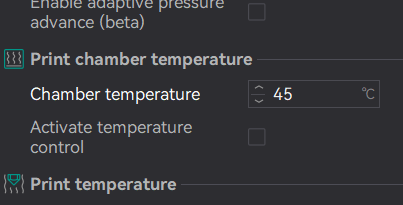
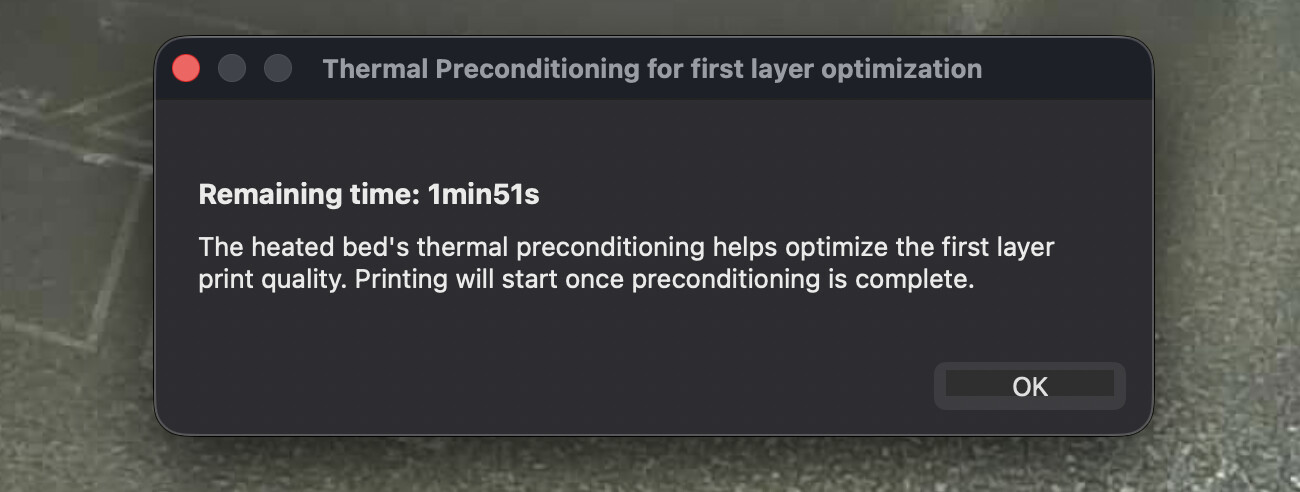
The idea is simple: if the bed is set to, for example, 80 °C and the chamber to 45 °C, an optional checkbox in the interface would delay printing until both temperatures have stabilized for a set period. This requires no new hardware, no new sensors, and no change in the printer’s normal operation — only a software-controlled wait before starting the print.
When I raised this with support, I received the following reply:
Dear Bambu Lab 3D printer user:
Hello!
Your suggestions are indeed very practical!
We have submitted the issue you described to our R&D department, and our dedicated technical staff will also regularly review and filter issues on GitHub. Thank you for your valuable input!
It is true that the bed temperature detected by the bed temperature sensor can be somewhat limited. When using the type of build plate you described, there may indeed be deviations and inconsistencies between the actual bed temperature on the build plate and the measured bed temperature. However, since we do not currently provide such build plates and this issue would require rigorous testing, we are unable to guarantee that this feature can be implemented or commit to a specific release date at this time. We appreciate your understanding.
Once again, thank you for your valuable suggestion. It is thanks to enthusiasts like you that Bambu Lab continues to improve. We will strive to live up to your expectations and bring you more excellent and exciting products in the future!
Best regards,
Bambu Lab Customer Support
While I understand the need for testing, this feature seems straightforward to implement and should not require extensive validation for standard use cases. It would help ensure consistent first-layer adhesion, especially for materials sensitive to thermal fluctuations.
I am confident that many users would appreciate this quality-of-life improvement, as it would eliminate the need to manually edit startup G-code — which can be overwritten during profile updates — and it could be implemented with minimal risk.
For reference, here is the original GitHub request:
I’d suggest adding it to orcaslicer, and if people think it is valuable they might pull it over.
In general I’m shocked at the level of support being offered for suggestions or weird edge-case user printing problems, while simple “fix my broken printer” request end up in support doom-loops. What is going on there? It’s like they have two departments now.
You should definitely heat soak their original build plate, and the chamber as well. Many adhesion problems reported — where certain spots on the plate perform poorly — are caused by unevenly heated plates, and their original plate is no exception. I tested their Textured PEI Plate, and without heat soaking it for at least 10–15 minutes, I saw inconsistent results when printing a single layer covering the entire build plate. With heat soaking, the results were consistent — whether good or bad, they were at least repeatable.
It’s true that their prioritization often seems unusual, and requests appear to get lost far too frequently.
From my perspective, it feels as though they may have only one department, or perhaps even a single developer, now managing all their printers. This could explain the number of strange issues — such as when they copied code from the H2D firmware into the X1C firmware and, in the process, completely disabled the external spool function.
That’s exactly what I’m wondering — this change is purely software-based and would benefit even those who don’t use a third-party plate. Why not implement it if it improves consistency for all users?
Yes, even X and P series users would benefit from something like this, and ultimately it would result in happier customers. However, I am not certain that the X and P series firmware can wait for the chamber temperature to be reached. I implemented such a function relying on passive heating, but it never worked as intended.
This is not an option for P1 series printers as they lack a chamber temperature sensor.
Code added to Machine Start G-code is not overwritten by printer preset updates because it is saved with a different name than the defaults.
With OrcaSlicer, I use the startup code in the link to set a minimum chamber temperature of 28°C for all prints (my shop is sometimes quite cool, 11°C), and also to specify a heat soak period for individual filament profiles that require a chamber hotter than 30°C. The trigger temps are easily changed in the code, any heat soak should also stabilize the bed temp.
The Studio filament preset editor has a temperature chamber setting for X1E, but unnecessarily hides it for the X1C. OrcaSlicer does not.
The code works very well - I do not need to remember to manually preheat the chamber and do not need to wait for the temperature target to be reached before starting a print.
I don’t see any sign that “happy customers” are a Bambu priority.
They seem to believe they can create happy customers by constantly developing new machines, while showing little regard for the older models—even those only a few months old.