Hey there!
I recently switched from PLA to PETG for my prints. PLA worked perfectly, but PETG is a little more complicated, as you know. I’m using a Creality SpacePi X4 to dry the PETG before printing. I have a few questions:
-
Can you print PETG with a 0.08 mm layer height? I achieved this with PLA and the results were great. I believe PETG is more commonly printed at 0.12–0.16 mm.
-
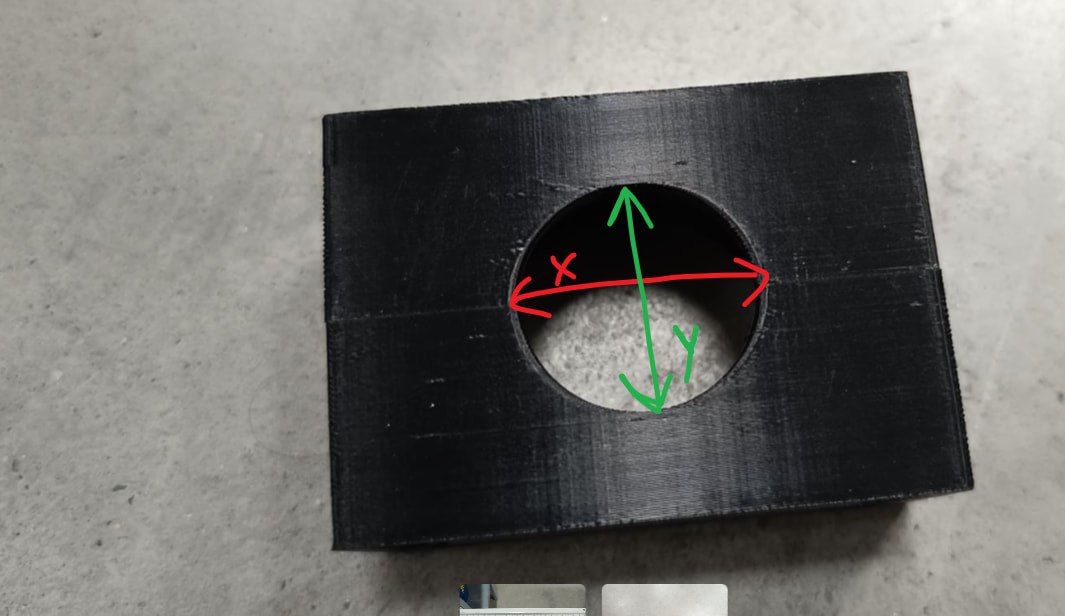
Does PETG tend to flatten during printing (much more than PLA)? I noticed my parts have a kind of egg-shaped profile, and I think it might be caused by the pressure of the upper layers on the middle layers.
-
We know that if you want to print a 100 mm part, you might end up with 99.80 mm (or so). This is called compensation. For PLA, I ran some tests and got about 99.82%. For PETG, I ran some tests and I think it should be closer to 99.25%. Does that compensation value sound familiar to you?
-
The surface finish is not even close to what I achieved with PLA. The nozzle tends to leave small blobs or bits of filament that are not properly attached to the part (see image). Any ideas on how to improve this?
Thanks in advance!!!
- Yes
- No
- Depends entirely on the specific PETG you’re using and your print settings.
- See #3
If you want an idea of what good PETG can do, get a roll of PETG-HF and give it a go. Bambu printers are calibrated for the formulation right out of the gate and most users will see very good prints with no modifications.
Beyond that, you’ve given us very little useful detail of what you’re trying to achieve, so we can’t really comment further.
First: Which brand do you use? In my experience, most PLA are very similar. With PETG, I found that brands can behave very differently.
For shrinking, 99.2% sounds too much for me, I’m usually more in the range 99.6 - 99.7%. So a bit more than PLA, but in a similar ball park.
I don’t fully understand flatten. Maybe you can post a picture?
Those zits and bits could be the brand. And connected to that, the temperature and speed.
While most PLAs print find at any speed for me, regular PETG can’t handle the default speeds. You really want HF / HS / Hyper / when printing at regular speeds. Or you dial back speed quite some.
PETG can print at 0.08 mm, but it needs careful tuning. Most users prefer 0.12–0.16 mm for reliability. PETG stays soft longer than PLA, causing slight bulging sometimes. Lower temperatures and correct flow help reduce that effect. Dimensional compensation varies by printer and filament. Your measured value seems reasonable for PETG. Small blobs usually indicate excess heat, moisture, or over-extrusion. Fine-tuning retraction and pressure advance also helps. Dry filament remains important, even before every print. This PETG guide explains its advantages and shortcomings well.
3D Printing In PETG
First of all, thanks for your answer. I printed a second specimen. With flatten (check image) I mean x-dimension was about 0.7 mm higher than y-dimension, kind of an eggy-flattened-shape.It wasn’t such a big diff in PLA printing. Thanks again!
I do not feel PETG is more complicated. You dry it, and you understand that you can’t really do overhangs beyond 45 degrees, and it otherwise prints like PLA.
I don’t realyl trust this sort of measurement, You should use calipers.
it was measured with a caliper