I’m sure this has been brought up before. I’m new here.
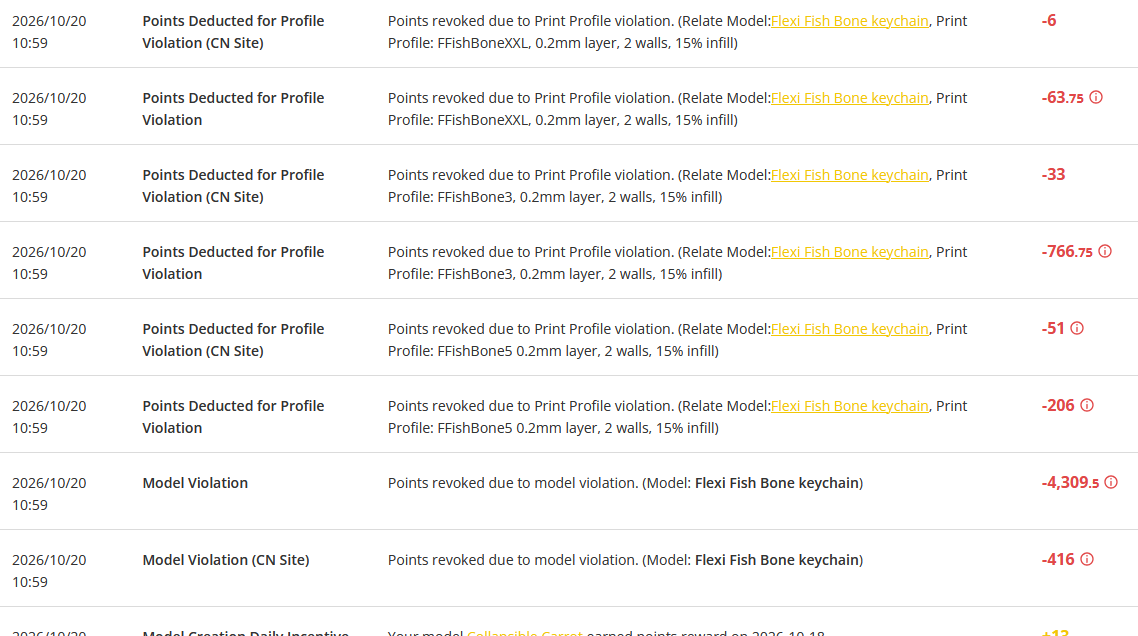
Every now and then I come across someone posting my designs under their own name. I check the platforms for this kind of thing myself when I can, but I have a lot of models, so it’s pretty time-consuming. And sometimes I end up getting reported myself, like today.
Of course I’ll appeal it. The model is also published on other platforms, and the dates make it easy to tell where the original came from. But my question is: after MakerWorld accepts the appeal, they take those points away from the account that reposted my model, and they don’t credit them to me, the actual author. Users are downloading and printing my model, so those points were earned fairly. Instead, they just disappear into thin air. Unfortunately, the model itself is now fully masked, so I can’t see any information about it, even though I’d be interested to know the publication date, for example.
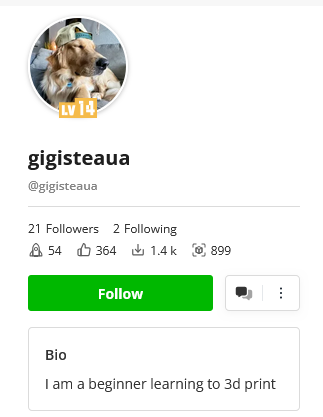
And that brings me to the second issue: a designer has no real standing here, just a level and a follower count. I have to spend my own time appealing because of a user with 21 followers over 2 years.
To be clear, I’m not asking for special treatment. I’m saying reputation should cut both ways. If a designer’s track record earns them visibility, it should also earn them more trust when they file an appeal, and yes, more accountability when they’re wrong.
Maybe some will read this as arrogance. I’d argue it’s the opposite. Right now the system treats a proven designer and an account with barely any history as if they carry the same weight, and that’s exactly what makes it easy for bad-faith accounts to game it.
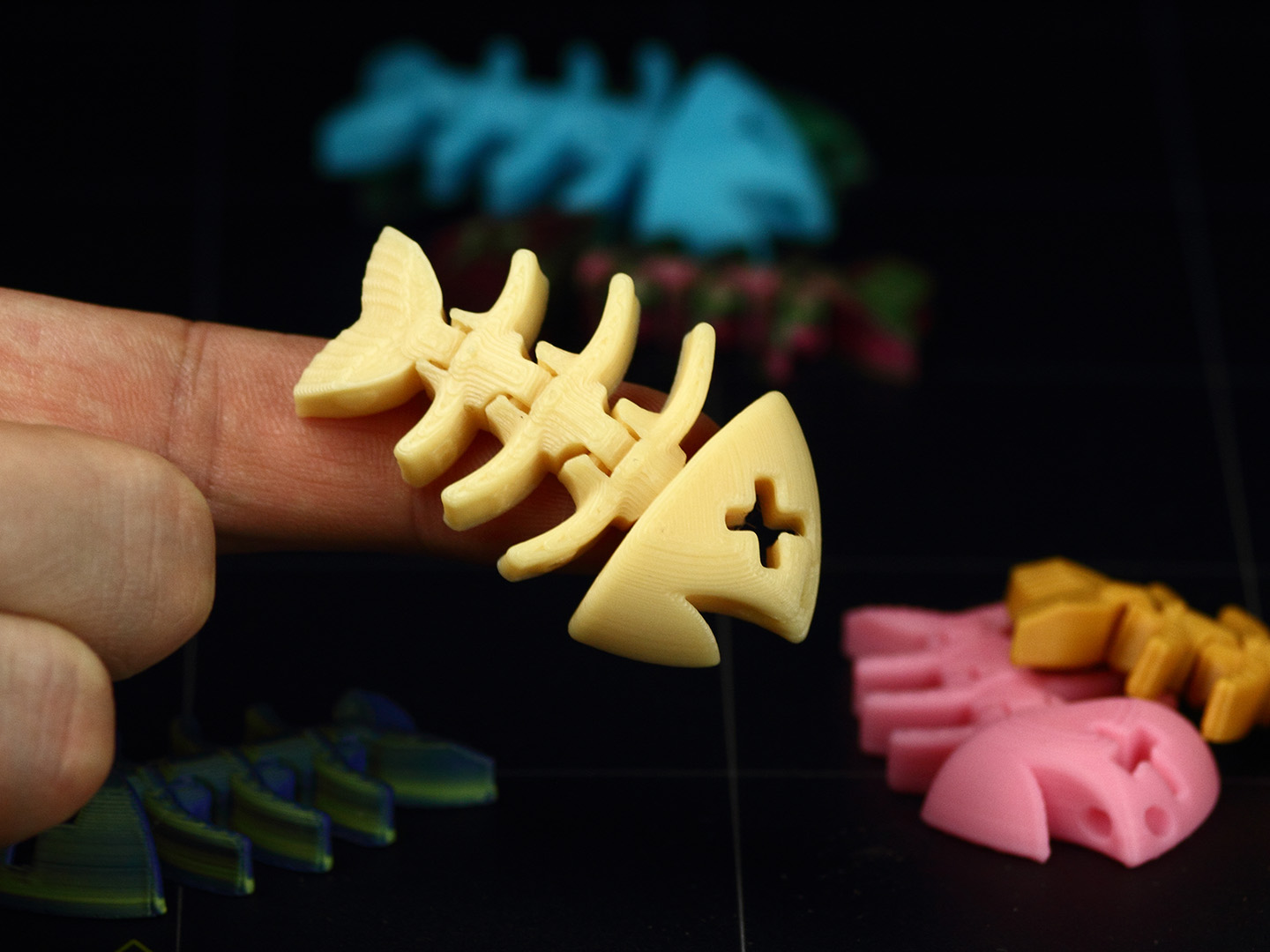
To be specific, the user gigisteaua posted my model in August 2024, and now they’ve filed a report against my original. I think I published the original on MakerWorld later than they did, but that part is simple: MakerWorld wasn’t the first platform where I published this design (January 2024).
Then an appeal should be as simple as linking the original posting and showing the original modeling.
The process sucks, I’ve been through it myself. At the end of the day, if you are in the right, it just means that your model is not going to be visible for 14 days after you submit the appeal.
Simply, MW only responds to reports. They do ZERO investigation into the matter.
While you are at it, I would file an IP claim against them since you still have the original posted on thingiverse.
Thingiverse isn’t the first platform where I published this design, but that’s not really the important part. I’ve been filing reports since long before MakerWorld existed, so unfortunately the process itself isn’t new to me.
I’d like to know, for example, are users with the green badge exempt from this kind of routine? @MakerWorld
This has no relation to anything you are experiencing and does not factor into reports good or bad.
The only reading people have one is to verify the account as it exists on multiple platforms and stops accounts on MakerWorld being made by someone who isn’t the original account holder.
Example: if you have an account on MakerWorld and Printables, you can request a green tick.
MakerWorld then request you take actions to demonstrate you do have access to the stated Printables account. Once that occurs, your account gets the tick.
This doesn’t give anything else, benefits or otherwise.
After X (formerly Twitter) added check marks to paid accounts, the perceived benefit left and it had no such benefit here other than I stated above.
Well, thanks for the answer. That naturally suggests a separate green badge per specific design. You’d point to the sources once, and it would be provided automatically during an appeal or when you file a report yourself, so you don’t have to prove authorship all over again every time.
This is per account, nothing to do with designs as I already shared.
It is entirely unrelated to your original question wondering if having one can influence anything p.
It can’t. It doesn’t.
As someone who just had a model and a 3rd party profile removed today, it carries zero weight. Because the two things have nothing to do with each other.
This is an interesting question: should these reward points be reassigned to the original creator. The idea has some merit, but the actual impact could be complicated as it may encourage frivolous IP claims to game points, even led to copycats filing IP claims against the original creators trying to steal their points or at least to overwhelm the system.
This is an interesting idea that deserves more thoughts and discussions.
That should be a no. Each appeal should be evaluated on its own merit. Otherwise scammers can engage in reputation-building to earn a good trust and then freely abuse the trust later.
Yeah thats the biggest issue, rewarding any part of it just opens it up to game, imagine you got like 5 points for a successful report, then you just end up spamming a bunch of accounts over different emails and IP addresses to farm points by reposting your own model
Sadly i don’t personally see a way this could be incentivised in a way that couldn’t be abused by people, which kinda sucks, but i guess we just have to settle for making it so others don’t profit from our own work
The risk can be solved by verification, meaning checking publication dates. That’s the most common case.
Of course, this is all hypothetical. We can imagine that someone might dishonestly inflate their reputation. But tell me, what does the current system incentivize?
There are two copies of the same popular model that people have been downloading for years. One copy gets taken down. What incentive does the platform have to prevent that, when the copy is generating good traffic?
I am surprised no startup has appeared in the west that offers affordable, robust copyright registration for non-professional 3d model designers. Then again, would designers pay the registration fees?
A startup can’t really reduce the basic patent costs and that’s the core issue. For example, in the EU, you’re looking at roughly annual maintenance fees of around €20 to keep the patent active. It may not sound like much at first, but do the math over the maximum lifetime of a patent: over 20 years, the maintenance fees alone add up to €35,555 per patent.
And that’s for just one 3D model. Now imagine doing that for 10 models, or even 100. The costs can escalate very quickly, long before you’ve earned enough revenue to justify them.
Furthermore, obtaining a patent is only about 50% of the work. The other 50% is actually enforcing and defending that patent with the help of a lawyer. The costs can escalate very quickly there as well, especially if legal disputes arise or the patent needs to be enforced against others.
What’s important to understand is that, in case of a dispute, neither Bambu Lab nor MakerWorld will support you. They explicitly stay out of patent and intellectual property disputes, which means you’ll have to handle and finance any legal action yourself.
The startup you mentioned might be able to help with some of this, but it can’t make the costs disappear, and that’s really the underlying problem.
Which designer is realistically willing to spend €35,555 per model over the full lifetime of a patent? For that to make financial sense, the model would need to generate a substantial amount of profit. Otherwise, the patent ends up costing more than it protects.
…and that’s without even mentioning that you’d likely want patent protection in other countries as well, which brings even more costs.
Was talking about copyright registration for 3d models, not patents. (Yes I know you don’t need to register a copyright, this is just paying someone reputable to say: Yes X made Y on date Z, here is the record X sent us on day Z)
Not saying you’re wrong; I have no experience of patents since they are uncommon in the tabletop game industry, and when I did software we had a lot of separation between engineering and legal.
With traditional media (books with ISBN numbers in shops etc) there is a legal publication process that will vary by country, and this, for most part, also functions as a copyright registration. Generally, registration was done for “unpublished” work e.g. stuff in the archives not yet used, or stuff released in a web blog etc.
For digital files I would imagine the history from a version control system would be a good indicator of proof of work, if that VCS is operated by an independent party. The principle of an agency is technologically simple. Verify ID, offer the client a “write only” drive they can upload to, and produce a copy of the files on a given date with a cryptographically signed certificate. The fact that we aren’t being spammed by such outfits leads me to believe there is some regulatory issue preventing deployment.