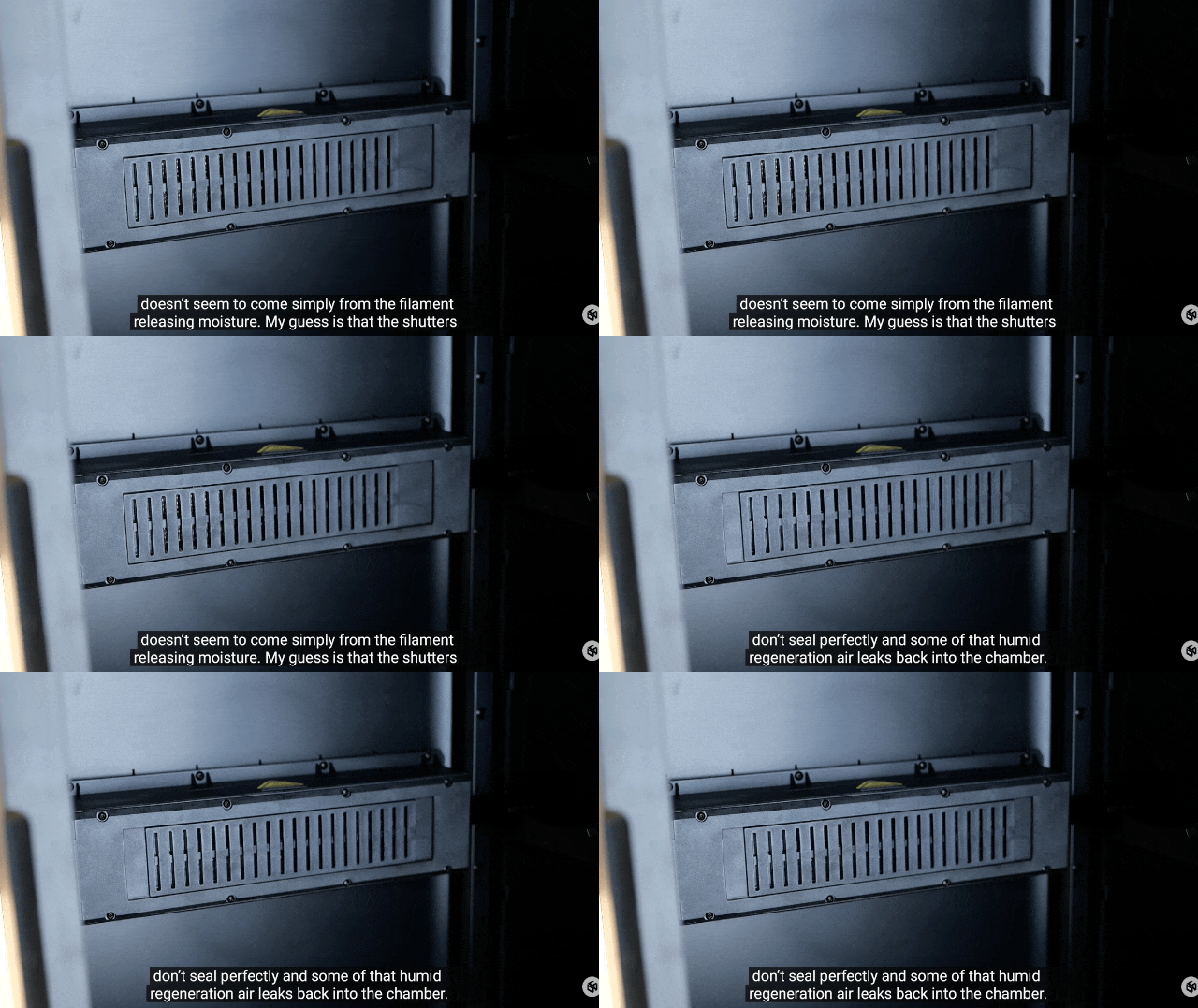
Sliding plate valves can seal really well if the moulding is precise and terrible if not.
I wonder if some light silicone grease might seal it better but depends on chemical compatibility and how much extra effort it would take to slide and their mechanism if it could take more load.
I do like @krellboy’s backpressure idea though. I have a couple of air dryers that could be put into service like that. But first question is do we need it? I think for some filaments it might not matter but bet you’re right for more hydrophilic filaments that a high peak might cause paroblems.
I believe you, but does it look like precision to you? I set this time index to where it shows:
To my untrained eye, it just looks like two pieces of plastic sliding past one another, not machined metal against machined metal. The features of interest pass quickly in the clip, so maybe I missed it if there’s anything more to it.
So, the way I see it, there’s 3 possible explanations:
Your hypothesis that it’s blowing in moisture under from the heated sieves into the compartment. In that case, we’d also expect to see a rise in temperature inside the compartment, and if I’m just now recollecting correctly from some of the other youtubes, a rise in cabinet temperature does accompany regeneration. This would explain why that temperature rise happens.
Through some kind of viterbi effect it’s pulling air out of the compartment and the evacuated air is getting replaced by moisture laden ambient air.. However, this doesn’t explain the rise of temperature inside the compartment, unless it’s just by conduction and convection from being in near proximity with the regenerator.
The gate seal is good, but the box is leaky, so it’s just normal ambient moisture intrusion. This also woudn’t explain the rise in temperature either, unless it’s the same conduction and convection mechanism.
So, after thinking about it, I think @krellboy most likely nailed the correct explanation, but #2 or #3 might still be possible if #1 turns out to be wrong.
Yeah, I agree - hard to say. And how tight you can make sliding plate valves has nothing to do with how tight this one is. I agree - looks plastic. Will be interesting to see how well molded.
But worst case, if this needs attention, is we may be able to lap them or something to get a better seal. But I still like krellboy’s backpressure idea to keep humid air out. It might work.
Something I had forgotten is he clearly says the heater is in the center of the sieves tube. That is probably where the gradient comes in and the lower IR reading on the temperature. Zeolytes are ok at thermal conductivity but not great so there may be a fair gradient.
May not be anything to be done about it. Again, time will tell.
Depending on where you live and may on the season… A better solution would be one that worked all year round.
Or, if you have a second i10 (let’s call it i10#2) whose only job is to hold dry air and not filaments, maybe you could pump dry air in from there to keep i10#1’s interior cabinet air dry while i10#1 regenerates.
I would say :“or use @MZip 's desicant column”, but it would be an ironic fix (though I’m m sure it would work) , if only because that component would still need manual regeneration, which would undermine the value proposition for using i10 in the first place.
An aquarium pump and silica gel column would do that.
And a thermocouple in the exhaust stream would be all a microcontroller would need to read to trip a solid state relay.
And about that. My two spare air dryers have 800g bead reservoirs that are good for about 50+ spools or about 200 hours of drying. At 1 hour every other day that’s over a year.
It does kind of take away from the automatic “no bother” aspect of the i10, but maintenance once a year isn’t too bad. But that’s if it’s even needed. The filaments they tried all lost weight but I don’t remember if the really water-loving ones were tested but do remember they discussed it. Anyway, for me, I just print PLA and PETG so likely won’t have to worry about it. But others may.
I had posted this earlier in the thread when the only info available was from the youtubers posted on the sunlu website. Now, looking back on it with benefit of @mzip’s screen capture from CNC kitchen for comparison, I can see that I had misinterpreted it. Originally I had thought the big 80%+RHY spike was from him opening the cabinet door to maybe add some filament or something and that each of the subsequent oscillations was a regeneration cycle. Based on what we now know, that seems wrong. Instead, I’m now assuming that the huge spike in RH% was incurred during a single regeneration. Although roughly double the RH% magnitude, the time duration would be more consistent with time interval spent regenerating that CNC kitchen observed in the screenshot that @mzip posted.
So, with that as the new frame, one question would be why was the magnitude of the RH% spike so much worse (neary double) than what CNC kitchen observed? Another question would be: just what exactly are those much smaller humidity oscillations that happen afterward? Is it the chamber fan cycling on and off to ensure a uniform humidity inside the cabinet?
I remember that now. A few things - his baseline is way high - 33% or so - so that’s a 50% RH spike compared to around 25% RH jump in the CNC video that had a baseline around 15%.
I can’t say for certain, but it could be the humidity spike is bigger because the sieves are more saturated with water. When the sieves get heated there will be more water coming off them than in the CNC video which had the sieves starting regeneration from around 15% RH.
On that sawtooth pattern after that, hard to say. It’s not even that regular for it to be a fan cycling until after some hours it looks. Maybe some kind of electrical interference or something?
Maybe eddies and currents in the cabinet from the fan? With a 33% baseline give or take, there would be lots of water moving in that cabinet and maybe there’s a wet spool away from the sensor that has water get wafted away or something? Humid air is buoyant so it could be bubbles of humid air being generated in the cabinet?
All a reach. I suspect the sawtooth is real but explaining it is hard.
I went back to CNC Kitchen’s video, and he corroborates this:
(which brings us back to Mzip’s observation that sliding doors can have a decent seal, but that’s dependent on careful design and precise manufacturing & assembly processes. I suspect Sunlu decided that was not a hill worth climbing.)
But we may be able to help it out some with some silicone oil or very light grease depending on compatibility. Down side is that would probably attract dust especially considering there is a fan keeping air circulating. Thinking about the dust aspect I doubt I’d ever try silicone oil though.
If it’s a problem though, @krellboy’s backpressure idea would be clean.
And outside the box a little, depending on the leak rate, slow filling of a balloon in the cabinet would also supply backpressure by displacing air. With a balloon it wouldn’t need to be a dry air source that inflates it.
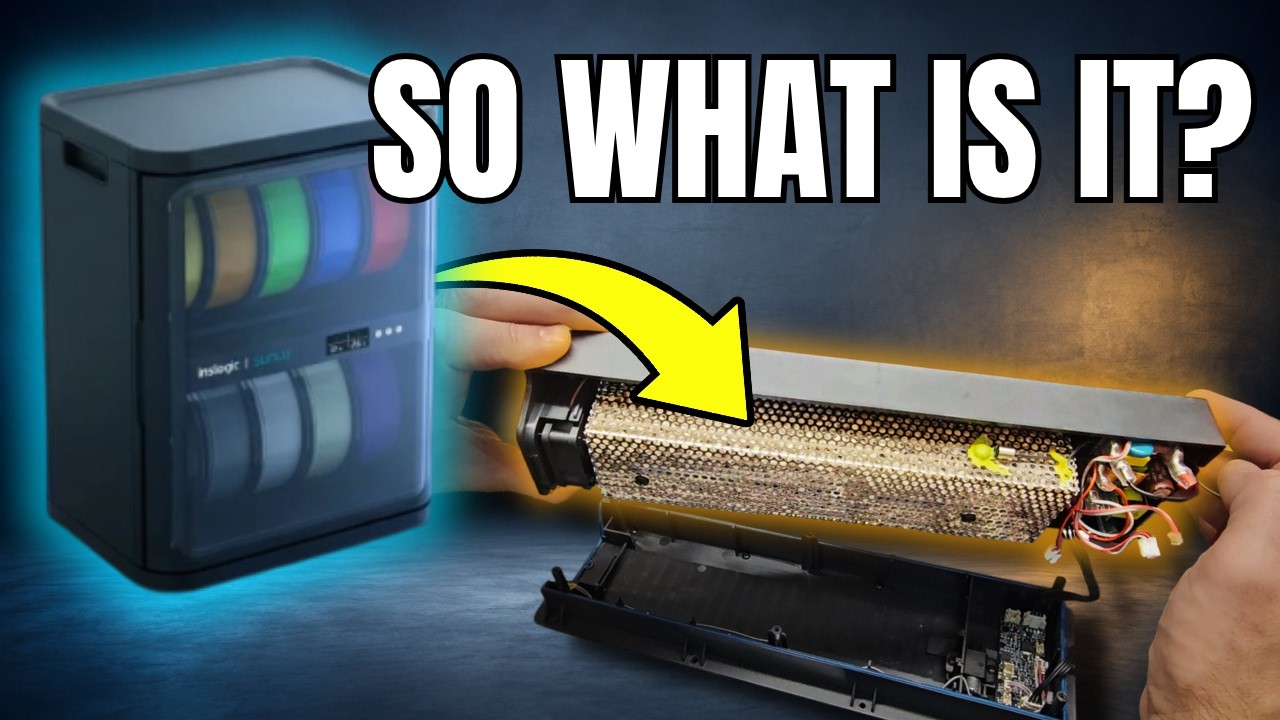
Meanwhile, a company named Autens beat Sunlu to market with a filament “dehumidification” cabinet. @NeverDie has posted about their cabinets before.
Before you get too excited though, looks like the best it can do is 28% RH. Worst case is 60%. The box in the photo is showing 45% RH. Hoo boy that’s, um, bad.
And it also costs $199 but only holds 5 spools. I smell a bargain! (/s )
Someone remind me in december when i get mine lol. I’ve got a 4x TC datalogger and my plan is to put 2 in the desiccant and 2 in the cabinet and let this thing run. See what kind of temp gradient the desiccant is exposed to inside the pod, and if any residual heat is exposed to the chamber.
I also would want to test this thing for leaks. So far this thing is hinting at more capability than perhaps it might be programmed for.
I would bet this might be true. Not because they are sandbagging, but because they likely optimized the regeneration cycles for both dry conditions and wet - which likely means compromises.
By taking over the controls, those running in the dry side might be able to optimize to get even more dry. Those running on the wet side have other issues and optimizing a dehumidifying cabinet might not get them much but maybe that could be modified as well.
Wet could maybe be optimized for better bulk transport that maybe doesn’t hit the same low levels. Dry could maybe be optimized for dryer conditions in the cabinet that does worse with high water loads.
Or not. But those kinds of optimizations helping one side while hurting the other are common. Sunlu would need to accommodate both.
Been trying to mull this over and it might not be as big an issue as I first thought.
A heavy water load on the sieves would probably force this behavior more than a light load. The extra water will have a cooling effect (evaporative cooling) and may keep the sieves from getting as dry as they would with a lighter load, but the next regen cycle will be with sieves that have some amount less of water.
As the sieves remove water, the water load on the sieves will go down. The remaining water will get harder to remove but there will be some migration of water from sieves with higher water load to lower that presumably will see more heat next cycle (since they were already more dry).
I think this might not be much of an issue in the long run. It might be after putting something in with a lot of water in it, but after a while I bet uneven loading of the sieves fixes itself to some extent.

 Depending on where you live and may on the season… A better solution would be one that worked all year round.
 )
)