This is a fork of And the saga continues, A dryer cabinet - #40 by NeverDie
where a different dry cabinet was already under discussion when Sunlu announced theirs. So as not to further derail that thread, this is the new thread for the Sunlu, and frankly anything else. I’m giving full OP permission from the get-go to discuss anything relating to the Sunlu dryer cabinet, or dry filaments,or dry boxes, or filament drying, or desiccants or whatever suits your fancy if it seems related and you’d like to share your knowledge. Everything permitted! The other thread was quite productive, so that can continue here if so desired.
For anyone not already aware of the new Sunlu product, or are unfamiliar with the category, Sunlu describes it here.
Ordinarily I would probably wait for second or third wave reviews from real users before pulling the trigger on a version 1 product like this, but it’s starting to look like it might be an adequate minimum viable product, so I just now plunked down my $1 deposit as on option on a $10 discount whose strike date is October 15. Small potatoes either way. By then I imagine I’ll probably have the answers to any remaining questions and then either pull the trigger or not. As it stands, it looks as though I could either use it as designed or else adapt to compensate if it falls a little shorter on performance or capability than a simple reading of the ad-copy currently seems to imply it will have. I have a working systematic approach to the topic even without the Sunlu product, but anything which removes drudgery or repetitive maintenance (like manual desiccant regeneration) from my calendar and/or todo list is a welcome quality of life improvement even if it’s something I could live without. From my point of view, the more I can automate away bothersome, nagging, repetitive chores of low complexity, the better.
If this particular cabinet pans out, it definitely solves a pain point of mine; keeping my filaments dry. I use desiccant rotation schedules also and I really don’t enjoy this part of 3D printing. I’m also planning on taking a leap of faith and jump on this early too.
It appears to be designed around keeping filament dry and isn’t just an electronics dry box repurposed as such. From what I’ve seen, many cabinets I’ve looked at store at 30%+ RH and so they don’t really meet my storage requirements. If this actually does go down to 10% RH for pre-dried filament, then it’s exactly what I’ve been looking for.
I’m probably going to buy it, as I need an efficient small enough box to hold my round crapload of various filaments. But it’s Sunlu… they are known to do subpar stuff.
Damn your eyes! (Too late!) Did you guys get the full refund protection? For just $1.28 added I went ahead and did it. I saw they were limiting the $1 stakes to the 1st 5000 so for risking $2.28 what the heck. I’m now in too.
My laziness has won over common sense… I just bought one of the coupons and most likely will buy one of these. At this moment I don’t have a place for it, but if it works as expected then I’ll make space for it. I’ve wasted a lot more money than this with my 3D hobby so what’s another 200.00 at this point.
Maybe? I hope so? The FAQ section of the page says this:
It actively maintains low humidity (10%–45% RH) at room temperature, making it completely safe for continuous, 24/7 long-term storage of (…)
There are two ways I can read this:
It can be set as low as 10% and as high as 45%, under any ambient conditions. (This is what I would hope.)
It will get to at least 45% RH under worst conditions, and below that if ambient conditions allow, to a minimum of 10%.
I think they would like the statement to be read as the first, but given that it’s a consumer product, I expect weaselly language.
If I were selling it, I would really hesitate to promise 10% RH to a customer in a 90% RH environment at ~35ºC/100ºF. If I were very confident in my product, I might say 45% under those conditions.
I would welcome something that could deal with the 60-70% RH in my basement during the summers. Even if it could only get to 20% RH, that would be good. Currently I actually use my filament dryer as a “near-line” storage for filament I expect to use soon and want to keep dry-ish. The bags & bins I use for longer term storage.
This would be my reservation as well. I think I’ll set this one out and let someone else provide candid feedback before I consider Sunlu hardware. They are among some of my favorite filaments but their hardware is more like 3rd party integrations that they slap their name on. Particularly their driers as I noted way back in 2024 in this bake-off post between them and creality.
I completely agree with this assessment. I am super skeptical about it, however, I hope that for $199 it would at least work as a sealed box (low bar eh). And if it somehow would keep humidity low in there - great, bonus brownie points.
@Bratling I would put it this way: starting with an empty chamber and entering a setpoint of 10%RH, if it can’t deliver 10% relative humidity, then it’s a fail, and I think we’d be entitled to ask for our money back.. There’s still a lot of remaining nuance in that. For instance, we’d have to accept whatever their humidity sensor reports the internal RH% as the official number, and it’s only accurate to maybe plus or minus 5%.
Then there’s also a question about what kind of hysteresis it uses. Say it succeeds in getting to 10%. Does it start regenerating if it internal RH% rises to 11%, or does it wait until 15%? Or some other number?
On the price topic, I got curious and looked up the MSRP and actual current prices of some of their dryers on their web store:
Product
MSRP (USD)
Actual Price (USD)
notes
FilaDryer S2
$80
$55
1 spool, up to 70ºC
FilaDryer S4
$140
$117
4 spool capacity, some humidity control (min 25% RH)
FilaDryer S4 Pro
$140
$140
4 spool capacity, some humidity control (min 25% RH), max 85ºC, can anneal prints
FilaDryer E2
$350
$250
2 spool capacity, up to 110ºC, can anneal prints
AMS Heater for Bambu Lab
$120
$100
just here for reference
AMS Light Heater for Bambu Lab
$120
$100
just here for reference
FilaDC i10
$200
$–?
a large box with a shelf, regenerating desiccant, and unknown humidity control
I think I’m going to bet on a street price of $180, falling to $150 after a year or so. I would be surprise if it dropped much below that; it’s so bulky that shipping costs are going to be a limiting factor.
This speculation is all ex recto. Take it for what it’s worth…
Sunlu seems to have figured out basic dryer functionality pretty well, I picked up their modular drier/storage boxes awhile back and just installed an AMS heater, it’s basically the same unit in a different physical shell, I’d expect similar here as well.
Whole post is on the money. The easiest thing to dehumidify is the air in an empty cabinet. Put a wet spool in there and the load goes up where the humidity may climb in the box. What it can ultimately hit is more easily and quickly measured empty. To determine performance under load is harder and needs all the procedures and how the load is generated specified.
On benchmarking performance, it would make sense to use a lab grade meter instead on the on-board sensor. Doesn’t mean that’s what they did though.
Humidity sensors themselves are mass produced and factory calibrated and really have pretty good specs. Generally 2-5% for the cheap ones down to 1% for better ones. Things that throw them off are temperatures away from 25C, high humidity, and some chemical backgrounds.
When I bought the cheap round hygrometers for cereal box storage, I spread them all out on a table and let them settle, they all gave the same humidity measurement except a few that were 1% RH off from the others. Didn’t have a lab meter to compare to but even the cheap sensors are really pretty good from what I’ve seen.
These cabinets at room temperature should give better numbers than what is seen in a filament dryer where the humidity can be way high at times with significant temperatures. Intended use in these cabinets is a much more benign environment.
And excellent point on hysteresis and how that affects how dry these might get. Going to be interesting to see how it all plays out.
Not much experience with Sunlu hardware quality aside from my S2+ filament dryer but it seems really sturdy/good. Build quality on mine is great and it has been reliable as all get out. Where the S2+ misses (IMO) is in the strategy/design. It shouldn’t need a door prop or that should have been supplied with the dryer because it makes a big difference. But the humidity measurements have been dead reliable for my purposes. I’m not so worried about the hardware.
Maybe that’s naive, but it’s the other stuff of strategy and design that has me curious. If it’s built anything like the S2, it may be easy to modify/optimize — if it even needs any help. It may not.
One of these will provide a lot of flexibility in feeding my printer and will be where AMS filaments first get swapped into and out of before longer-term passive storage cereal boxes. Looking forward to getting my hands on one.
That’s how I see managing the downside risk. If it turns out the sunlu software and/or sensor sucks, then I seize control using an arduino and do it properly myself. On its face the control logic looks like it would be straightforward.
Of course, I hope theirs works as advertised and that I won’t need to. I’m just saying if push came to shove. As long as the desiccator in the back of it performs, there’s something to leverage, possibly to drive down the RH% number to an even lower number than 10% . If it has that innate capacity, I’m hypothesizing it should just mean continuing its dehumidifying/regenerating cycles to pump down the RH% further instead of arbitrarily halting when it hits the 10% RH that its sensor reports.
Same, @NeverDie. There isn’t much to it and building an Arduino controller should be trivial for those who use/have used them. Or a number of other microcontrollers. Could even use a controller with WiFi and have it serve a status page. Trickiest and no real hill would be taking over the input and display bits so the direct human interface doesn’t change. But then we also have 3D printers and it’s probably not hard to just replace the stock front panel — if we even need to.
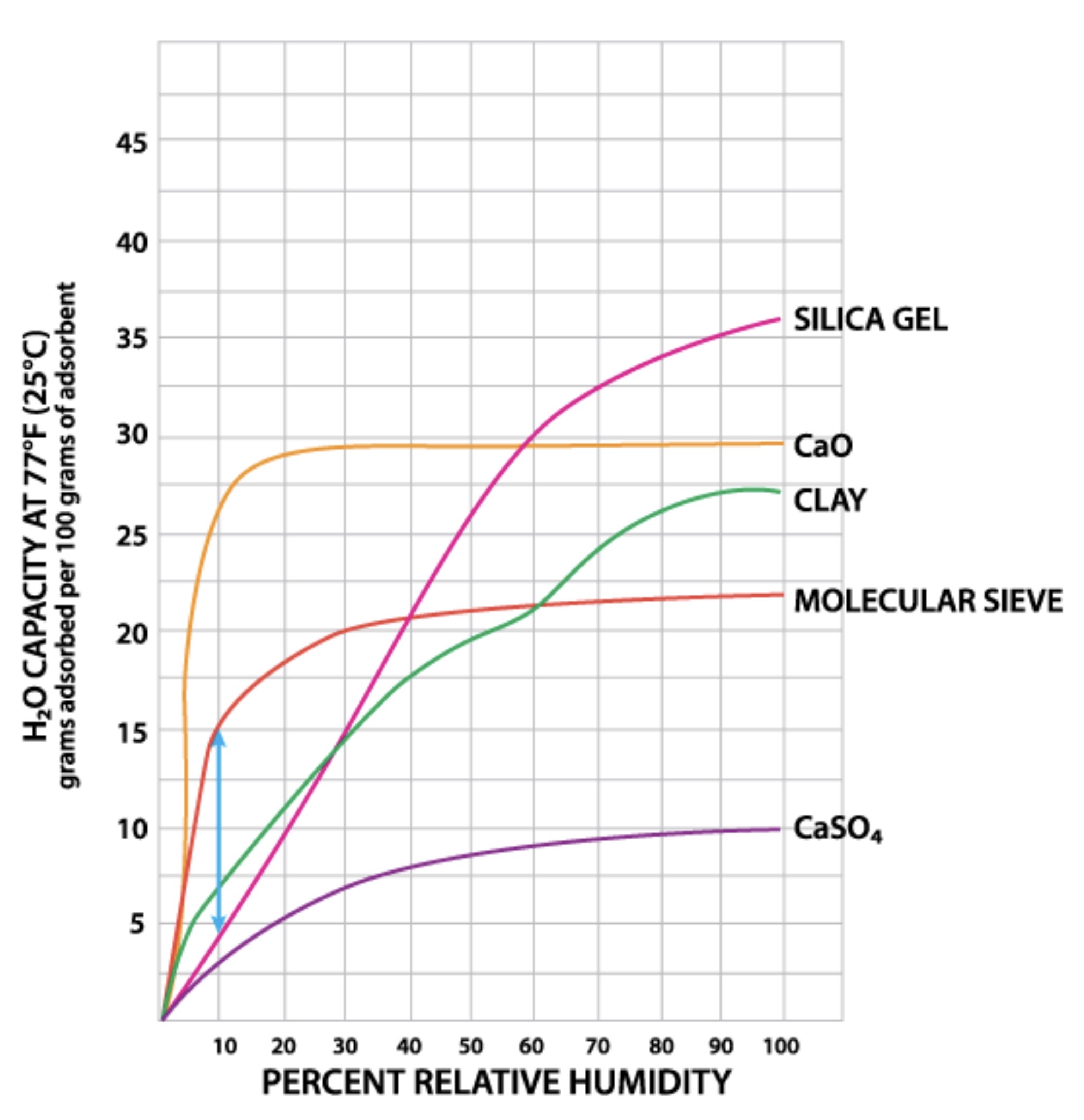
I’ve been thinking about that 10% floor with molecular sieves and I’ve said before, my air dryers crank out about 2% RH air or in that neighborhood. So why can’t sieves hit that too? And I bet I know why - possibly temperature constrained on the regeneration cycle by the dehydrator in some way. If they can only regenerate down to about 10% humidity then that’s as low as the cabinets will be able to go.
According to a graph like this, if they can’t hit a high enough temperature to get the sieves close to 0% moisture, then that residual moisture will limit what the sieves can pull humidity down to. 10% RH would correspond to always leaving 15% water weight in the sieves. Or there are leaks, or both.
I’d bet they would go lower if they could since it would expand the market for these cabinets. I really suspect something is holding it back.
But, you are absolutely right - we can always extend the regeneration cycle too in order to more thoroughly dry the sieves depending on what consequences that might carry. Another reason some may want a custom controller. It will be interesting to see exactly what’s going on and what compromises they made and if that’s the limiting factor. Obviously regenerating for longer time (if temperature constrained) will drive up energy use too.
A homebrew controller would also allow inhibiting that 500W regeneration cycle while you run other big loads on the same circuit. That’s a need I have. Between my printer, computer, and battery backup, I’ve got to balance significant loads at times or the cabinet may have to live in my garage.
More I think about it, I bet their controller is a blob chip attached to the circuit board (what they used in the S2) so might make it harder to modify or maybe not. So many questions…