I’m a pretty noob here, trying to get into this “3D mess” as quickly and painlessly as possible, so please be kind if my question sounds stupid. OK, here it is:
I have a PETG print (body) and wanted to use PLA as a support (interface) … I get a warning in Bambu Studio, regarding using different filaments. OK, understand … there is an article at BWiki, with explanation and recommended parameters adjustment for both materials for such print. It sounds reasonable, I understand the reasons why such changes are necessary. Simply, I get it.
But now … instead of ordinary PLA, I’d like to use a special filament from Bambu “Support for PLA/PETG”. Again, just for the support interface (the main object and body of support will still be the PETG). Even now, Studio sends a warning (the same as before / different filaments). After reading some discussions, I understand that the warning is “a little bit generic” and doesn’t take a special filament into account. Weird, but OK, no problem …
But now the main point of my question … when using this Special filament for PLA/PETG support, do I still need to change parameters as was advised in BWiki (for ordinary PLA and PETG)? Or should I just ignore the warning and use the filament’s parameters as set in their default profile? This sounds logical to me, as a special filament should be OK as it is, without the need for user adjustment/input. But “logical” doesn’t mean “correct”, sometimes
That is a good question as this (strangely) isn’t mentioned in the wiki. It should be mentioned on the same page, at least.
@SupportAssistant can you clarify this? Searching for “Support filament” or “Support W” in the wiki yields over 1000 results (which is another problem you need to fix - only pages where both words are mentioned should hit that search).
Welcome to the forum
Great start question; my view, backed up by official info, but not backed up by experience:
According to the datasheet of PLA/PETG, it is PLA, which may trigger the error.
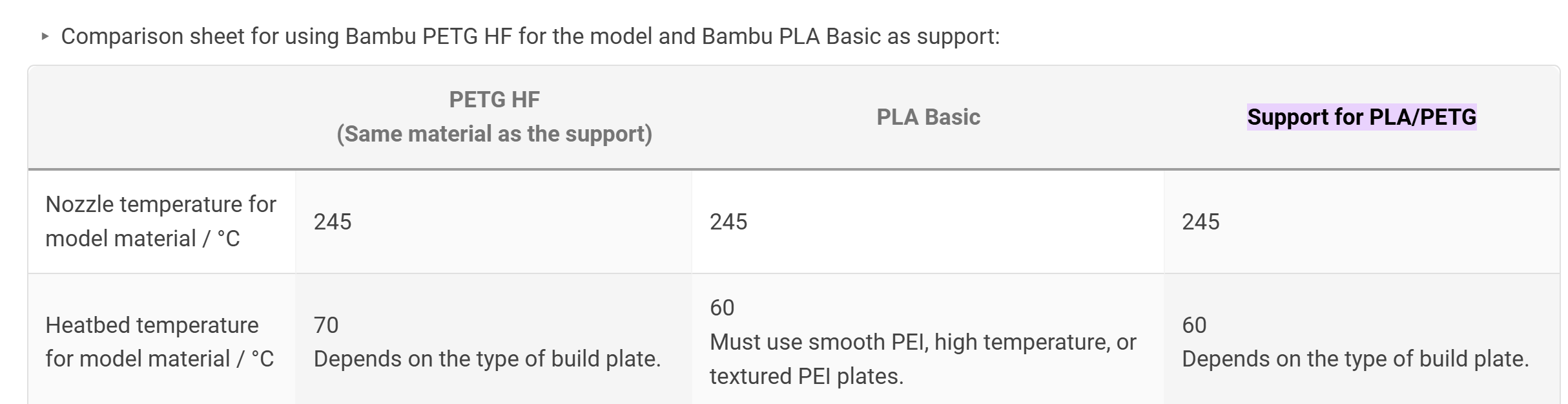
Their wiki is quite extensive on the topic. What I would not ignore are the printing settings for the PLA/PETG support when supporting PETG:
Nevertheless, the settings respect the support for BL PETG HF. If you use a different brand, you may need to tune it up. I would try to match the support filament extrusion temperature to the PETG.
In any case, I would do a sample test before venturing into larger models.
@JayZay I believe the topic is about the specific support filament called “Support for PLA/PETG” a.k.a “Support W” or “Support White” - not using PLA as support for PETG. It is probably the same, but info is hard to find on the wiki.
The issue with PLA and PETG is that the filaments have very different glass reflow temps. PLA’s is quite a bit lower than PETG’s. When you run the printer hot enough for PETG, it can make things too hot for PLA, and you end up with an extruder jam. So you have to manage both extrusion temps and build chamber temps carefully.
But that having been said, if you’re doing this on a P1 or X1 so that it a single extruder for both, you need very high purge volumes when going back to PETG. Even the slightest amount of PLA mixed in with PETG will significantly weaken the print.
I gave up on doing PETG prints with support material because it was really wasteful of the support filament. Especially if you have a filament switch on many layers.
OK, guys. I appreciate your comments, of course. But let me clarify that my question was primarily focused on the special filament “Support for PLA/PETG” (not ordinary PLA, which is commonly used for supports, has its limitations in combo with PETG, and its usage is pretty well documented).
So … does that “Support filament for PLA/PETG” behave the same way as ordinary PLA and do I need to change its parameters in Bambu Studio when using it as PETG support? Or can I leave/use it as it is preset (default) and simply assume that Bambu solved this material conflict on my behalf?
If it has a higher glass transition temp, which is indirectly a function of the extrusion temp, then yes, it will work better. The GTT probably isn’t available but the print temp is, and the support stuff prints at a higher temp than PLA (don’t remember exactly, but I’ve used it). Addresses the problem of extruder jams from heat creep with PLA. Doesn’t fix the problem that you need huge purge volumes or the print will be too weak to function (I’m assuming you’re using PETG because the parts are functional not decorative).
Dedicated supports for decorative prints = yes. But for functional prints = no unless you’ve got a H2D with two nozzles so the support never mixes in with the PETG by going through the same nozzle.
That sounds like a very reasonable answer. I was tempted to mark it as the solution, but then I decided to leave the thread open for further comments. You can never have too much good advice
Anyway, thank you very much for your opinion.
Concerning settings, I would advise changing the filament preset extruding temperature of Bambu Support for PLA/PETG to match the PETG filament extruding temperature. I.e. the default print settings (at least mine) show a low temperature for the nozzle temperature:
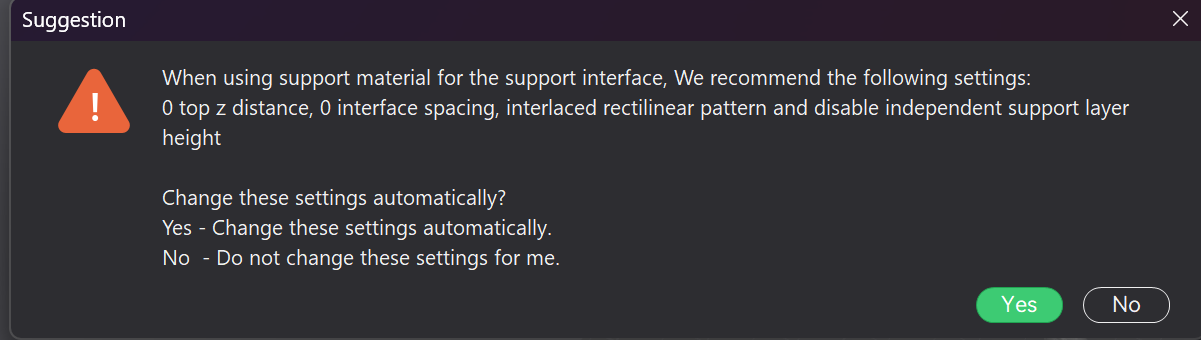
Besides that, there are the recommended settings that should prompt as soon as you select the Bambu Support for PLA/PETG as support material, and which I would also use:
I would ignore the alert for the PLA/PETG, which I believe relates to the Bambu Support for PLA/PETG composition being stated as PLA (at least in the datasheet).
In any case, this is my opinion, i.e. what I would do if I were in your shoes; and I would do some tests before advancing.
Definitely, I’ll do. But actually, failed print is not my biggest concern. The clogged nozzle is. That’s why I’m a little cautious/nervous of higher temperatures. But I understand that 245C comes from Bambu’s source, so it should be safe.
I got you, and your caution is pertinent.
I don’t have this filament, so I can’t test it.
I can’t find any relevant user experience report. This isn’t bad, as it may have worked with others, so no issues were reported.
The best info I got was in the shared wiki and datasheets.
Concerning temperatures, on the store webpage, the recommended print settings indicate nozzle temperature between 190ºC and 220ºC; however, the technical data sheet (TDS) shows a broader range, 190 - 240°C.
Despite the TDS indicating PLA, the safety data sheet shows that the filament comprises a mixture of PETG and TPU.
The wiki has the recommended print temperature of 245ºC. After reading the wiki, it seems to me (not BL indication, so it’s just a guess) that they tend to set the support filament temperature near or identical to the material to be supported, reducing the gradients.
Those were the basis for my recommendations, which aren’t official and thus prone to risk.
Besides those, I would also check the bed temperatures, as it seems pointless to change it when printing a support layer, and it may result in unwanted behaviour, such as fan activation. Also, if you want to reduce risks, taking @RocketSled’s recommendation to purge a larger amount of filament can be helpful.
I can try to help if something goes wrong, but I can’t promise it won’t happen.