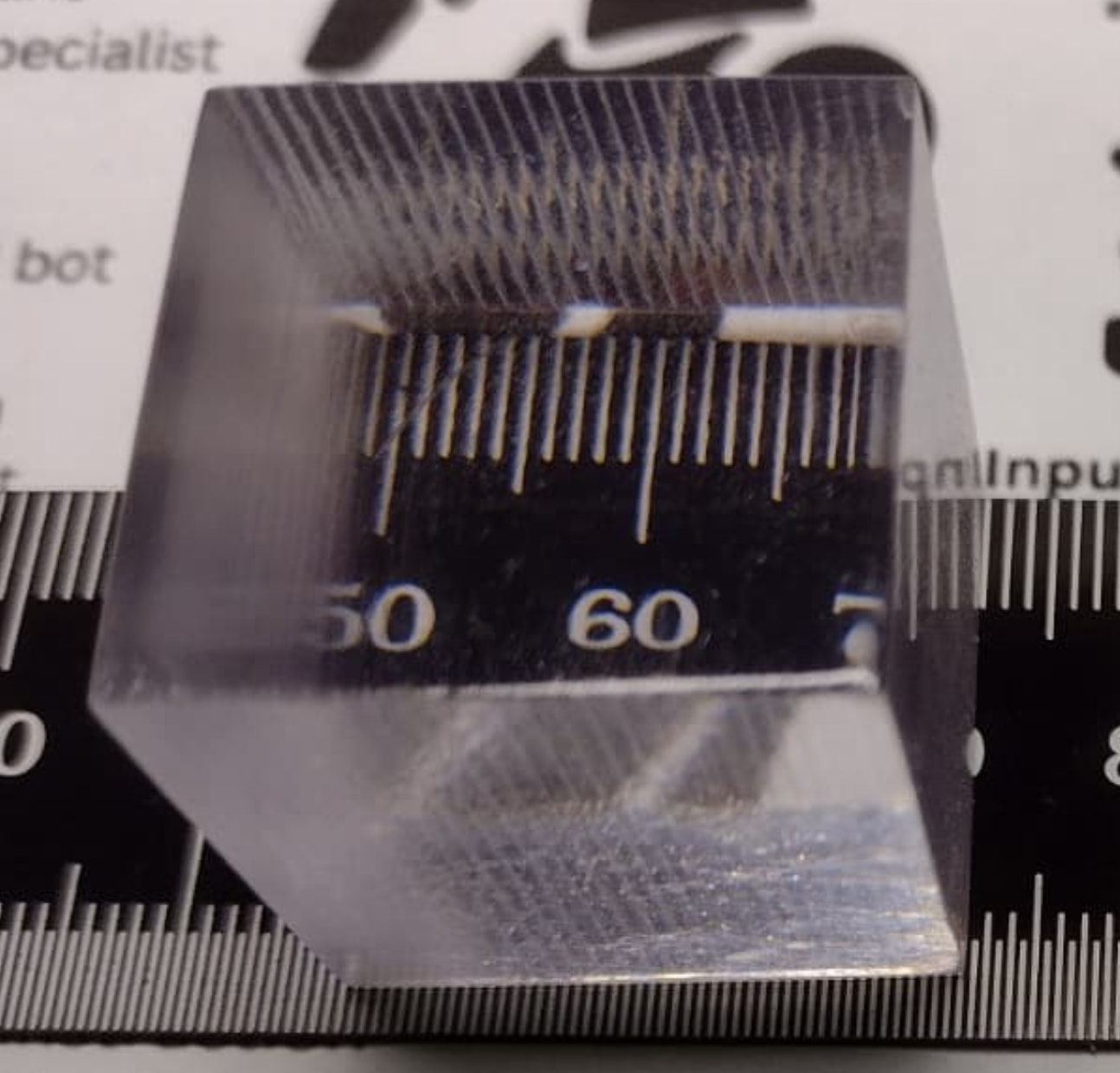
I came across a spool of transparent PETG at Best Buy today. Having never heard of anyone making transparent PETG and the only transparent filament I have personally heard of is PC (polycarbonate) so curious if anyone has heard of “Transparent” PETG. If yes, what brand(s) have you seen? The brand of filament Best Buy was selling is Insignia which is a Best Buy house brand. Since Best Buy is not making filament, knowing who is currently making transparent PETG might give a hint who is making Best Buy’s filament across the board.
Worth noting that when they put the printers out on the shelf last week there were 4 H series combo’s and 4 A series combo’s. There was a single H series printer left on the shelf and all the A series combo’s were gone.
PETG as a pure plastic IS transparent. The first PETG filaments in 3D printing were transparent, opaques came later and high speed formulation came after that.
Bambu has sold it for years as well, it prints like traditional PETG, needs to be very dry, strings a bit, and has the shrink/curling issues of old school PETGs.
There are also PLA Translucent filaments. I have used Bambu Lab PETG Translucent and PLA translucent. They both work well.
There are some differences: the PLA translucent diffuses the light while the PETG translucent lets the light going through. Only the PETG translucent has a Clear option. I asked for a PLA Clear color when the PLA translucent were out but so far there isn’t one. Added: PETG translucent also have higher shrinkage, so keep that in mind when designing for tolerance.
I just finished printing some hanging light shades from some Translucent PLA. I was going nuts over the past few days because I printed the first set a while back and had no issues but this time around I couldn’t get the print to stick to the bed! I assume it is a combination of my print, which I will have to go back to the drawing board and tweak one day, and the high humidity the past few days have achieved. I finally remembered I have one of the super tack plates and after drying the filament and putting that on my printer I had no issues.
I really like how the filament diffuses the light. I am sure there is a lot more I can do with it, but at least I have some cool lamp shades in the meantime!
I’ve been printing prototype parts using transparent (see through clear) PETG a few years before Bambu. I’ve gone through at least 30 rolls of transparent PETG (as hobbyst), mostly no-name from ebay, like kingroon, sunlu or labeled as “3D printer filament” as brand name… You know, those are mostly for draft prints to see the internal if there is any weak area and of course usually get thrown away after that.
PETG originally is transparent, they just add dye or addictive to make it translucent or solid, which also change properties of PETG slightly, mostly I have to change flow-rate slightly from one color to another.
Maybe I print transparent PETG too much so that I prefer it over colored PETG.
I am trying to fix this but I am Wsquared58 and posted original question.
Transparent and translucent are not the same thing. The sales and marketing folks may fudge some but think of transparent as like the windshield on a car.. Look at at an object through something with no distortion.
So-called transparent filament is a matter of who calls it transparent. My definition of transparency is optical clarity. Other filament companies mean anything that is not colored.
This was CC3D PETG printed using the techniques in the post linked above.
I was very surprised that almost no company makes transparent high flow petg. The only one I found is Creality Hyper PETG. Prints well and has very good layer adhesion, much better than both BambuLab PETG basic and HF. When you want true transparency, you want very slow speeds, so that high flow is not a concern. If you just need translucency but want to print at default speeds, I can recommend it.
I don’t think you will ever get a perfectly optically clear print. Unavoidable minute voids and inconsistencies as the molten plastic is laid down by the nozzle will always cause at least some cloudiness and scattering.
Like I said, due to the way the nozzle lays down molten plastic there are unavoidable artifacts in there, albeit minor, that would result in some scattering. Adjusting print settings can only do so much. I don’t know how this plastic would respond to polishing and it would probably require coating and rather a lot of manipulation.
So, good effort, interesting what can be actually be done.
The words are different in dictionary, but they could be used by different filament makers to market the same thing. For example, one company’s PETG Transparent could be the same as another’s PETG Translucent.
See it looks like that because it’s all flat, but in reality you are going to print something curved like a cockpit canopy for a plane, or a vase, or something, and that is going to look bad.
Also if you’re going to print a flat surface, you could also leave a hole in the model and insert a sheet of clear polycarbonate or arylic, and you’d get a much better result.
Of course there are some times when you need to print a transparent thing in FDM so it’s not always a terrible idea.
Well as I believe I posted back in 2023 when I pursued this grand experiment, my goal was to see if I could produce a Fresnel lens. There were two objectives, first, explore the feasibility of printing optically clear using FDM. The example above proved it is possible. The second was whether or not I could produce a stair stepping affect in order to produce a Fresnel lens. Once I tried that I realized it is not possible to produce a curved surface in the Z plane using X-Y printing.
I’m eagerly awaiting the non-planar printing technology to come into the consumer realm. That holds promise. I saw one example the other day on YouTube where they retrofitted a CoreXY system with a gimbaled hotbed. Unlike the other non-planar approaches that tilt the nozzle, this guy tilted the build plate. This was exciting to see because it held the promise of a retrofit kit to any CoreXY printer.