Using TPU, my trials and tribulations

So the Grandson wanted this NBL ball and I told him we didn’t have the right filament for it. But we printed it in some BL PLA South Beach filament and it came out nice and colorful. When they got home Grandma took it over to him and he removed the support from it. First thing he did was to try and bounce it. It broke clean in half.

Maybe he can glue it back together. But it won’t ever bounce, just like Grandpa told him.

So that brings me to TPU. I got two spools and I’m determined to make something of a ball shape that can at least be dropped. I put the outside spool holder on my P2S and successfully fed the filament into my printer then printed a pickleball with this black TPU. Almost…

The top of the ball didn’t finish worth beans. And it kinda bounces like a wet sock. But I’d like to at least use the TPU. What I have found makes me wish I hadn’t bought it. And too late I discovered BL makes a TPU that is AMS compliant. Wish I would have known. Now I’m stuck (sort of) with my two spools of generic TPU. But determined to figure this out. (I turned around and printed a copy in PLA so I know the file is good. I just want a better material (TPU).

My next rabbit-out-of-my-hat is to print a spool holder that simply clips onto the upper edge of my P2S to allow the TPU to feed right into the extruder like is recommended. That way I hopefully won’t have to dismantle my AMS2 Pro stack again when I want to simply use this devilish TPU.

Does anyone have any recommendations or see any other pitfalls I’m walking into? All I want is wubbery toys in the outcome. Thanks for any help in advance.

Oh, and I’m a little reserved about printing with the TPU with the top removed (or partially opened) while using this TPU stuff. Maybe I’m dumb, but I am bold. I may never again fool with this TPU, but I have it and I am determined.

Not one to miss a beat, I also got some ABS to try for some of my Jeep Badges. I’d prefer some ASA for its characteristics, but ABS is almost as good from what I’ve read. These are to be (if desired) mounted on the outside of 4X4’s in the direct sun and heat. For example:

20210919_120353-jpg.512211 (1200×1600)

(Before any of you go off half-cocked, I very well know I have to make my own original and not plagiarize Jeeps design.)

OK, your turn, start throwing your rotting vegetables at me. :roll_eyes: :rofl:

TPU for AMS likely wouldn’t have helped you anyhow, it’s extremely hard material to be able to feed via AMS.

SOME true TPUs can be fed with an AMS with a very well optimized PTFE setup. It’s at least worth a try.

I’ve printed lots of balls with TPU, I find minimal walls and a relatively open design coupled with a softer TPU gets good results.

What you really want to look at is either PEBA or something like a PLA-HR, those actually have excellent rebound characteristics.

That said, the TPU assist is a great help for achieving good TPU prints. Not necessary, but close to necessary. Another option is the Mellow LLL Plus buffer system - it works similar to the TPU assist but is independently programmed and powered.

Hi Sonny,

So, did you dry it? Which brand TPU? Which hardness? What slicer settings did you use?

All that, and more, matters.

“Generic” as in some no-name brand off Amazon? Maybe throw that out while you still (presumably) have any hair left. :slight_smile:

Does it slow down as it gets towards the small top of the ball? Was anything else amiss besides the top?

Did you have feeding issues originally, or is the new holder purely for convenience? (IMHO the printer insides should be easily accessible from the top anyway w/out any hassle.)

Proper bouncing also requires careful combinations of walls and infill to match the material being used. Getting the most/best bounce is a lively competition among some makers, apparently.

Also, for bounce – PEBA.

Cheers,
-Max

PS. Just saw your post in another thread… don’t use Ludicrous mode for TPU. :slight_smile: (Not that you said you did, but just to be sure.) If anything, slower is better.

I recently completed my first TPU 90A print on my X2D. I did not do a ball but a plug and some small feet. My setup is obviously different from yours, but here is what I did:

  • dried the Bambu 90A TPU in my AMS HT. It was 75* for 18h as recommended by Bambu.
  • fed the TPU from the back of the AMS HT
  • I have a desiccant holder in the HT that is also a TPU riser so the spool spins freely with no resistance
  • from the AMS HT, I fed the TPU into the Bambu TPU Assist Module
  • I have a PTFE splitter and one slot is dedicated to the PTFE output tube of the TPU assist module
  • I used a new 0.4 nozzle that I plan to only use for TPU. If you are using a nozzle that you use for other filaments, make sure to do a cold pull on the nozzle before printing TPU
  • The prints I did were from MakerWorld so they were configured for TPU. As mentioned, TPU prints were much slower than standard filaments

Prints turned out great. My only issue was on unloading. It looks like the TPU got stuck in the extruder. I was able to cut it and manually pull it out of the extruder with having to disassemble it.

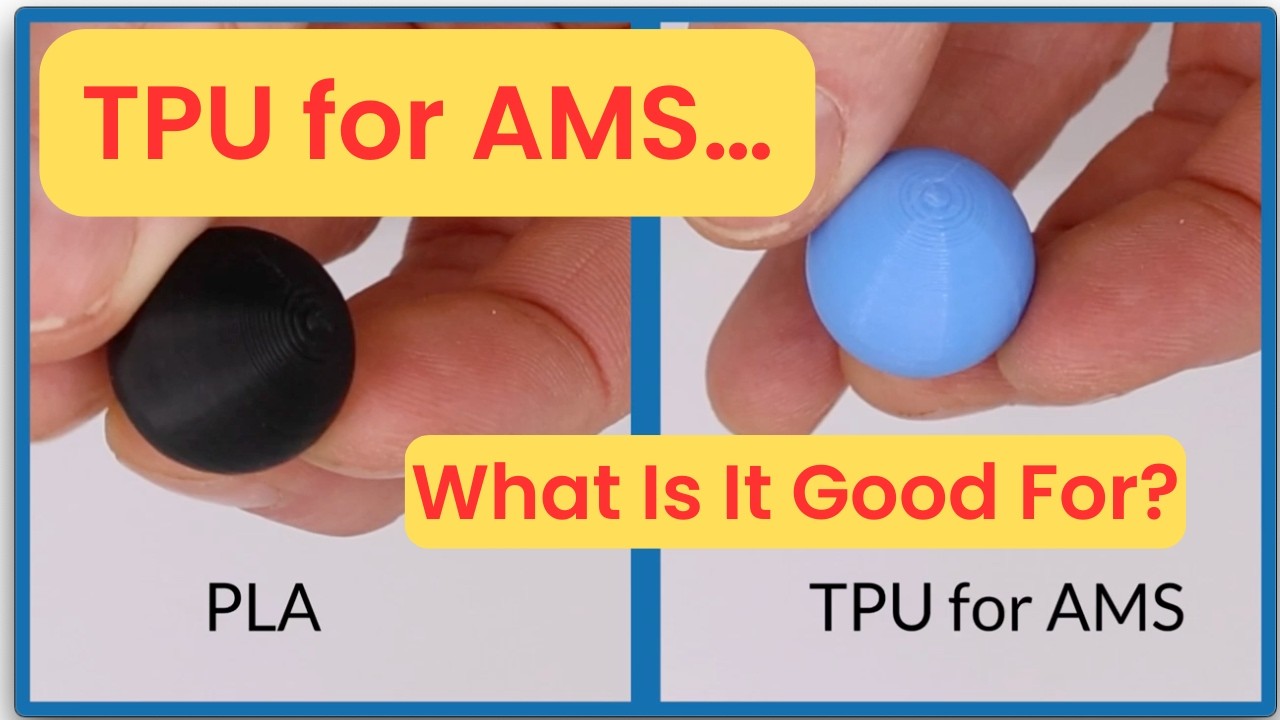
TPU for AMS is not soft. But it does bounce. Here is a good video comparing TPU for AMS against regular TPU and PLA. Spoiler: TPU for AMS is probably closer to PLA than regular TPU.

HI

I am a newbie. I have a P2S now for 1 year. Its my first printer. I have used mostly PLA and am now using PETG and ASA so that the models I give to my grand kids will last. I am like you just begining to experiment with TPU. I have used BL AMS TPU and also a few generic brands. I printed a spool holder for TPU to feed it directly into the extruder. Used it succsessflly on day one and then on day 2 strining and failed prints led me to question the need to have an enclosed system. So I just purchased the TPU feeder. I think that will help you alot. I just printed the housing and plan on installing it this weekend. If you plan on printing TPU, I would suggest you get that as well. If you are only going to print a few things, then, feed the TPU directly into the extruder but you wll have to take the top cover off and print a bracket to feed the spool. I used a spool holder that has ball bearing to minimize any drag. Good Luck with printing a ball.

Thanks Carbon Forge. I’m a really simple guy, and if I could just stick in in the ASM2 Pro, and then print something, it would be great. So that was why when I discovered BL has an AMS friendly TPU I was naturally intrigued.

I did, in my usual way, just bulled ahead and tried to put it through my AMS2. It got all jamulated and was a royal PITA to remediate. But I did, whew! :laughing: Since I had to take things apart anyway, I moved my AMS2 stack away, then used the ext spool arm to hold the spool of TPU and fed it that way. It succeeded, and I printed the first ball with it.

I did not run a drying cycle with it because it was vacuum sealed in a mylar bag. It did print OK for me although not what I would call great results. And performance wise my first attempt was pretty dismal. But hey, let the good times roll. Not worried. Not the worst waste of materials for me. :roll_eyes:

So I’ve read up on TPU and I have one top feed arm I printed, and I’m printing a spanning type spool holder out of good on PLA to try. Using the first aux spool holder to try it out. It works, but not crazy about it.

I am about as crazy as a pet raccoon, so apt to try a lot of goofy stuff. I think this 3D printing is a lot of fun.

Hi Max ThreeD, well certainly I’ve tried it. It is Best Buy’s house brand, Insignia. The only TPU they had. $19.99 a spool. 95A shore hardness. I didn’t fiddle with any of the slicer settings. So I recon whatever the model builder put it, or the printer put in was what it was. I wouldn’t have a clue anyway. I’ve barely got brims down. :laughing: (Love brims, BTW)

Trying to just put it in one of my AMS2’s was a disaster right off. One I got it unjammed I went for the Ext spool holder and bulled ahead again. I’m not afraid to be stupid, I learn a lot that way. I found a topside spool holder that appealed to my sense of “Hey! That might Work!” And it does, but not great. So… I’m printing a bridge type that will straddle the printer’s box with the glass top removed out of PLA. I shouldn’t have to move my AMS2 stack to access the top of my printer to do external spool use with it. (My two AMS2’s are beside my printer on the right, facing out on a shelf system.)

I think being able to look down into the printer is cool. By the time I get over this TPU experiment I might be a lot happier all around.

The Internet says Polymaker makes the Insignia brand TPU, specifically what they sell as “PolyFlex TPU95.” I have no idea, but seems as likely as any. Polymaker does publish filament profiles: Printer Profiles | Polymaker Wiki

Which filament was selected in the MW project you used? If it was 95A HF then some settings could well have been off – the high flow formulations can be printed a bit faster than “regular.” Polymaker also makes a 95A HF version, but from what I can tell the Insignia one is regular.

I’m kinda blown away that there is zero printer settings information for the Insignia filament. I mean even if it’s the same as “most 95A TPU” it’s just weird not to publish anything. :person_shrugging:

W/out drying your filament or printing from a dry box, it sounds like luck is actually on your side. If you tell us the printer is also in an non-climate-controlled Florida garage, I’ll really be impressed! :slight_smile: Anyway, just because it’s sealed doesn’t mean it’s dry. And as others have mentioned, unless your printer is in dry desert conditions, printing from an enclosed and “desiccated” enclosure can really help. And it’s (almost) definitely not dry now that you’ve had it out and about.

I just feed TPU/PEBA into my H2C via a spare PTFE tube connected to the print head, through the buffer bypass port on the back, then connected directly to a feeder box with rollers which sits on a shelf just above/left of the printer (I print/make my own but one can buy similar for relatively cheap). No assists or overhead mounts. But 100% clean feed path with minimal bending, no splitters or other restrictions. I do use dedicated TPU/PEBA nozzles now. But before that I never had to do any cold pulls or manual nozzle clearing before using 95A (just lucky, I guess).

Keep having fun with it!
-Max

Its got the basic printer settings.

I am more blown away that nowhere on the box or the spool says what shore hardness it is.

This is a white label for the polymaker tpu 95. It is not HF.

Its actually not that bad. Bestbuy had it on sale for 9.99 about 6 weeks ago, so I went ahead and bought 3.

I like how they used the same spool but printed in a different orientation… :laughing:
Oddly the PolyFlex 95A product page lists 20-40 mm/s print speed while this one claims “up to 100”. The PolyFlex 95A HF says “40mm/s - 100mm/s.” The print temperature range matches PF 95A recommendation, while the bed temperature range matches the HF variant. And HF comes in 1kg rolls while regular only in 750g. Maybe it’s a new mix? :smiley:

And 3mm retract length? Their own P2S filament profile I just downloaded has it at 0.4mm, like other generic TPU.

$10 sounds like a steal for either version!

-Max

Thanks a lot for that video, Clogged Jet. That is a great example. And a really good comparison I think others could relate to. Like every other hobby I’ve gotten into, just throw money at it. :laughing: An AMS HT now. :rofl: I do have other options, two heated AMS2 Pro’s I’m presently drying my TPU in one of. So maybe in a week or so I can run it. Building alternative spool holder as we speak. Not that I mind, oh, far from it. This 3D printing is a lot of fun to me. Kind of mind boggling, but not so much I fumble the ball a lot. Trying to ease into the nuances of the filaments. (And not have a ball that took 3 days to print broken immediately.)

Personally, the Insignia Brand is still under scrutiny for me. I tried a roll of Black PLA and it worked as good as BL Black PLA for me.

So with that under my cog belt, I decided to get some white and black PLA. So far, so good. Then I couldn’t resist trying this TPU to see if it lived up to its elasticity claims. That has lead me down the rabbit hole of removed covers, special spool holders, and troubleshooting. Nice challenges to make things work for my printer, in my environment, and a lot of help from my friends.

I had to go back and find the 95A shore hardness when asked what it was. I knew I’d read it, but had to fritter through a bunch of wrong places before I found it on the front page. Great specifying. Insignia™ TPU 1.75mm Filament Black NS-3FTPU2BK - Best Buy

Anyway, just a dotard getting places with my new P2S and glazed eyes of wonder. I probably jumped too far ahead of myself in grabbing onto TPU, but hey, that’s me. I jumped into Astrophotography ~16 years ago and have finally gotten to where my ponderings and dreaming was back then. Talk about steep learning curves.

So 3D printing by day, Astrophotography by night. Did I mention I like challenges?