Nice! I use:
scattered about the houses to keep track of temperature and humidity, I should go toss one in the dry-bucket…
Nice! I use:
scattered about the houses to keep track of temperature and humidity, I should go toss one in the dry-bucket…
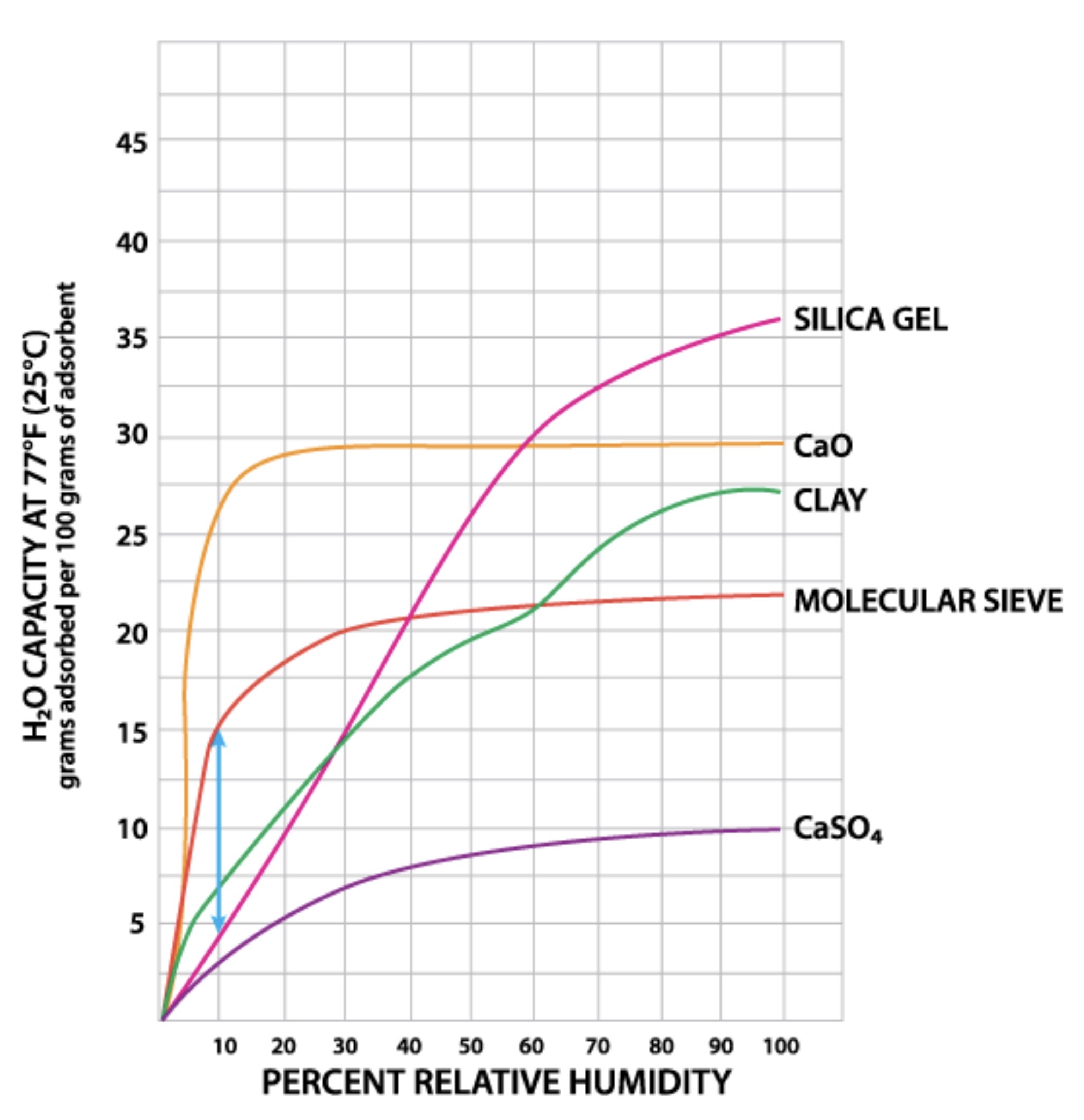
Here’s that as a graph. One thing though is silica gel can pull humidity down close to 0. All these desiccants can. It’s just that as it picks up water the humidity it can pull to gets impacted faster than with others like molecular sieves. (Another way to say it.)
All of these can pull humidity down to near zero, though. It’s just molecular sieves will hold near there longer as it picks up water. It’s more of a capacity issue than how low the humidity can go.
So Molecular Sieve is 4X as effective at 10%RH, but above 40% Silica Gel wins (and is rechargable at home). Of course, Calcium Oxide wins at the low ranges we’re aiming for(*) but try to find it anywhere in retail quantities, and then it’s not rechargable…
(*) I’m not even sure what range we’re aiming for, but 10% probably isn’t awful. [Yes, I mean 10%RH in the air after enough time has passed for the air, desiccant, and filament to equalize.]
Filament doesn’t need to be completely dry to print well. Actually, completely dry is kind of a misnomer. Like so many things there are diminishing returns involved. The last water is held much tighter and is harder to remove than the first water that comes off. There will probably always be some water in filament no matter what we do.
What to aim for to an extent is just what prints properly. More dry than that gives headroom for water that leaks back in though. Headroom is good so you don’t always need to re-dry.
And last, relative humidity is highly dependent on temperature. When specifying an RH% you always want to specify at what temperature. When I dry PLA, for example, I dry to 19% humidity at 55C. When the spool cools in a sealed poly cereal box (without any desiccant) the humidity pulls down below what my hygrometers read - 10% at around 25C.
For storage, though, I use 50g packs of silica gel in those poly boxes to scavenge water that leaks in. But just for testing humidity, no desiccant is used or it would overpower the humidity from the spool.
I think it is not only capacity but also adsorption rate. At least in my experience, molecular sieve reduces humidity at a very constant rate down to zero. Silica gel becomes slower and slower until it stays at an equilibrium around 10 to 15% RH.
Actually, the capacity has virtually nothing to do with adsorption/absorption rate. Those humidity vs moisture content curves are at equilibrium all the way.
I think what you are saying is that moisture content changes linearly with humidity at low humidity/moisture content.
Discussions about rates have very specific places in chemistry and physics so you have to be careful how you say things or else it can be misinterpreted.
But back to point, those curve shapes reveal some chemistry going on. I haven’t looked into it but the molecular sieves curve can really be broken into three different somewhat linear regions. At first blush I’d say there are at least three kinds of sites where water sticks down each with different strengths of bonding. Silica gel possibly has just two (though there could be more with similar energies). The first sites populated will be the ones that hold water the hardest. Next up are the next strongest, etc.
Along with bond strengths there probably are rate differences too but that’s not contained in humidity vs moisture content curves and there’s lots more involved in reaction rate discussions.
I thought for a given amount of moisture in the air, a higher temperature would be a lower RH, as the air cools it can hold less water, so the RH rises…
You are exactly right but there is a complication that I left off when I said what I said. There is a lot of detail to this water stuff that makes things seem like a puzzle.
In the dryer the humidity measurement is in a dynamic and changing system. There is water coming off the filament still that is being flushed out slowly by my dry air purge. So there is kind of a steady state thing set up where water coming off the spool is balanced by the dry air flow to where the humidity in the dryer is 19% at 55C on a drying PLA spool when I pull it.
After it cools, the RH drops because the cool spool isn’t emitting water. In fact, being cool and having much (hopefully most) of its water removed turns the filament into a poor desiccant. That low humidity reading is because the spool has cooled and now is a stronger pull for the water than the air in my storage container.
I didn’t relate that to the graphics, so what I wrote is not deduced from it. Instead, I wanted to say, that in addition to a higher capacity at low humidity, molecular sieve also is able to take humidity out of the air at a almost constant rate independent from current humidity, so that humidity readings are dropping linearly with time, until they hit zero. Probably not true zero but a value that is lower than what my hygrometers can read.
Silica gel is getting slower and sliwer dropping humidity until it completely stops at some equilibrium around 10-15% RH.
I think MS is binding water much tighter. That is also why it needs such high temperatures far above the boiling point to get it released again.
Does that make sense?
The sieves do hold water much tighter which is why they take higher temperatures to regenerate them.
I think there may be misunderstanding here. Imagine the tiniest amount of water in there at first. As soon as the MS starts absorbing (adsorbing) the water, it has some moisture content and can no longer pull the humidity to 0. It’s odd to think about but as soon as you add any moisture to these desiccants, the humidity can no longer be zero. On the graph I posted you’ll be moving to the right on the moisture content axis and any moisture content corresponds to some level of humidity.
I don’t understand where the 10-15% is coming from. Silica gel behaves similar to other desiccants like molecular sieves in that humidity and moisture content are related by a curve particular to silica gel. Molecular sieves have their curve. But you can see in those graphs that none of them stop at 10-15% RH. The curves extend to 0.
It sounds like you are saying silica gel can never reduce humidity below 10-15% which is incorrect. I do it here every time I fire up my dry air for filament drying. But maybe I’m not understanding what you are saying?
That is just what I observed in the AMS when I switched from silica gel to molecular sieve: humidity usually just stayed at 15% RH with silica gel and took several days to get there. With molecular sieve, it always drops to 0% within 1 day.
I think your setup is very similar to a classical column, right? Maybe that changes the situation a lot. E.g. maybe silica gel brings humidity down to zero, when it still is completely empty. so your column might fill up from the inlet and only when the last beads start adsorption, then humidity at the outlet starts to rise.
While in a setup where just a container of silica gel takes up the water, all beads simultaneously fill up, so when humidity is down to 15%, all beads have taken up e.g. 10% of their capacity, but that doesn’t allow them to reduce humidity anymore. If instead half of the beads are filled to 20% and half are still empty, they would be capable to further reduce humidity, but that just isn’t what happens in closed setup with some added silica gel.
Ah. Did you still have the pouch desiccants in there or just silica gel or sieves? Rates may be playing a part but in an AMS or in a dryer where there is a source of water (filament/leaks) it’s a dynamic situation and gets hand-wavy.
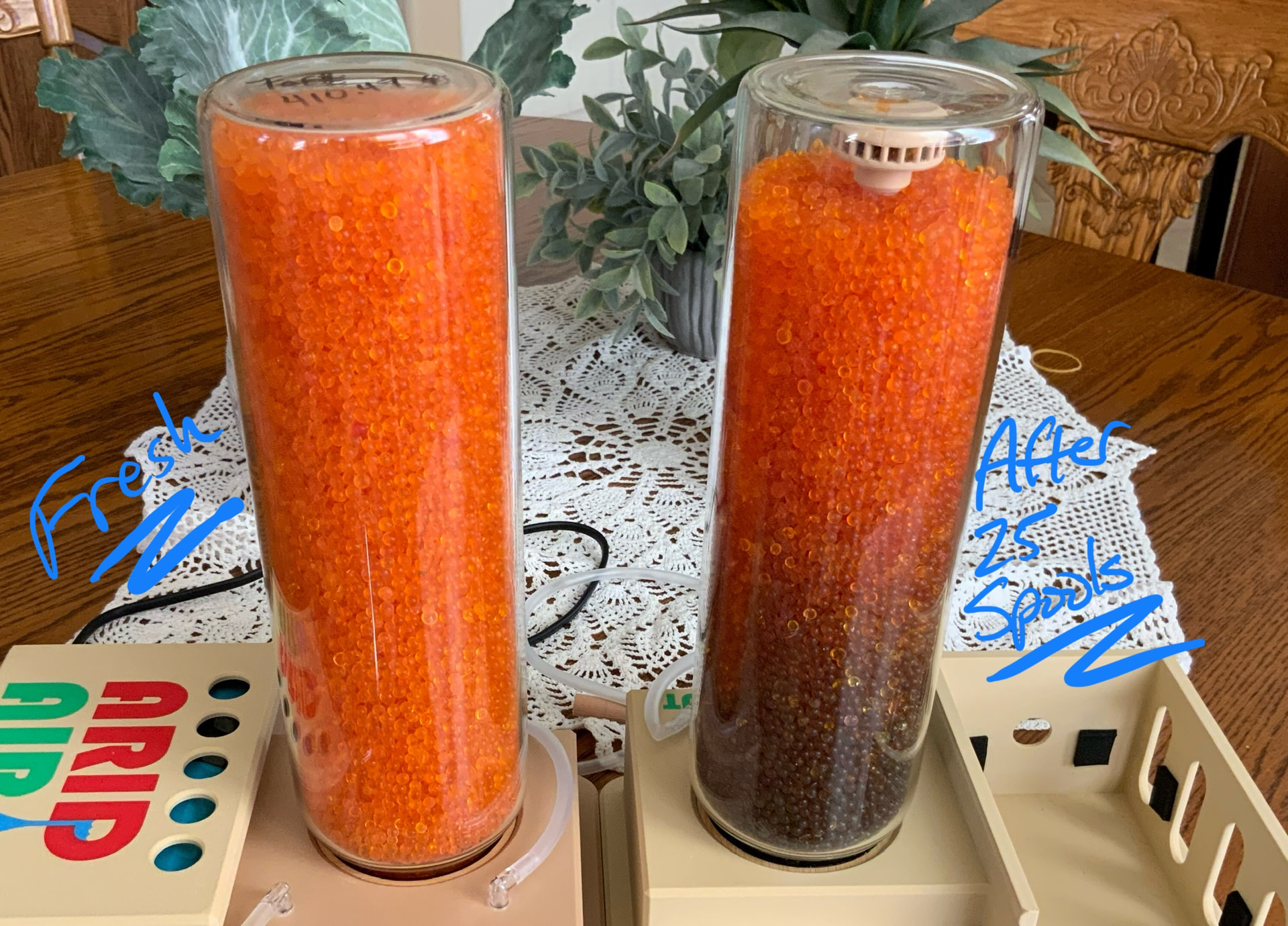
Your reasoning on the column is absolutely correct. I use all indicating beads in my air dryer and does exactly as you describe. The water largely drops right out so a gradient sets up in the column. Air moving through sees progressively drier beads so itself gets drier and exits at the humidity of the beads at the column exit.
It’s pretty cool to see how it behaves as I use it. Also, there is a big design flaw in the photo. Humid air rises. Water vapor is more buoyant than O2 or N2. Humid air should enter at the top of the column so the most humid region is at the top. The way I did it for this photo is to add humid air at the bottom. In practice it isn’t a big deal but there will be a contribution to shortened column life from water vapor always trying to rise. It’s a little like always having a low flow of air going through.
Also, sorted getting longer life out of the beads by not running dry air the first half of the dry. Water is coming off the filament fast enough that propping the door on the dryer open a little does a better job of getting the water out. It roughly doubled the column life to around 50 spools dried to look like the photo. There’s not much water in room air so a charge of beads can generate a lot of dry air before getting saturated.
Got a better new version that fixes the flow direction and simplifies things.
This is like using silica gel beads or sieves in a dryer or AMS and is the problem with loading them up with desiccants. They all start coming up in moisture content and their humidity value starts climbing. Keep them more dry than you want the chamber humidity and you’re golden. Let them pick up too much water and they can become sources of water too and slow drying or hydrate filament.
But how it behaves will follow those curves but those curves are for equilibrium. In dynamic situations where water is leaving one thing and being picked up by another you can see humidities that aren’t at equilibrium and then the rate stuff can certainly matter - as you mentioned.
@Alex_vG : I concur with @Mzip. If you throw enough silica gel that has been maximally dried (120C+ for long enough), you can drive your AMS 2 Pro RH down to where it reads 0% (not that it’s entirely accurate, but that’s what it will report). I do it all the time. But if you’re using only a couple of those dinky little silica gel packets that come with the AMS… then I wouldn’t expect much.
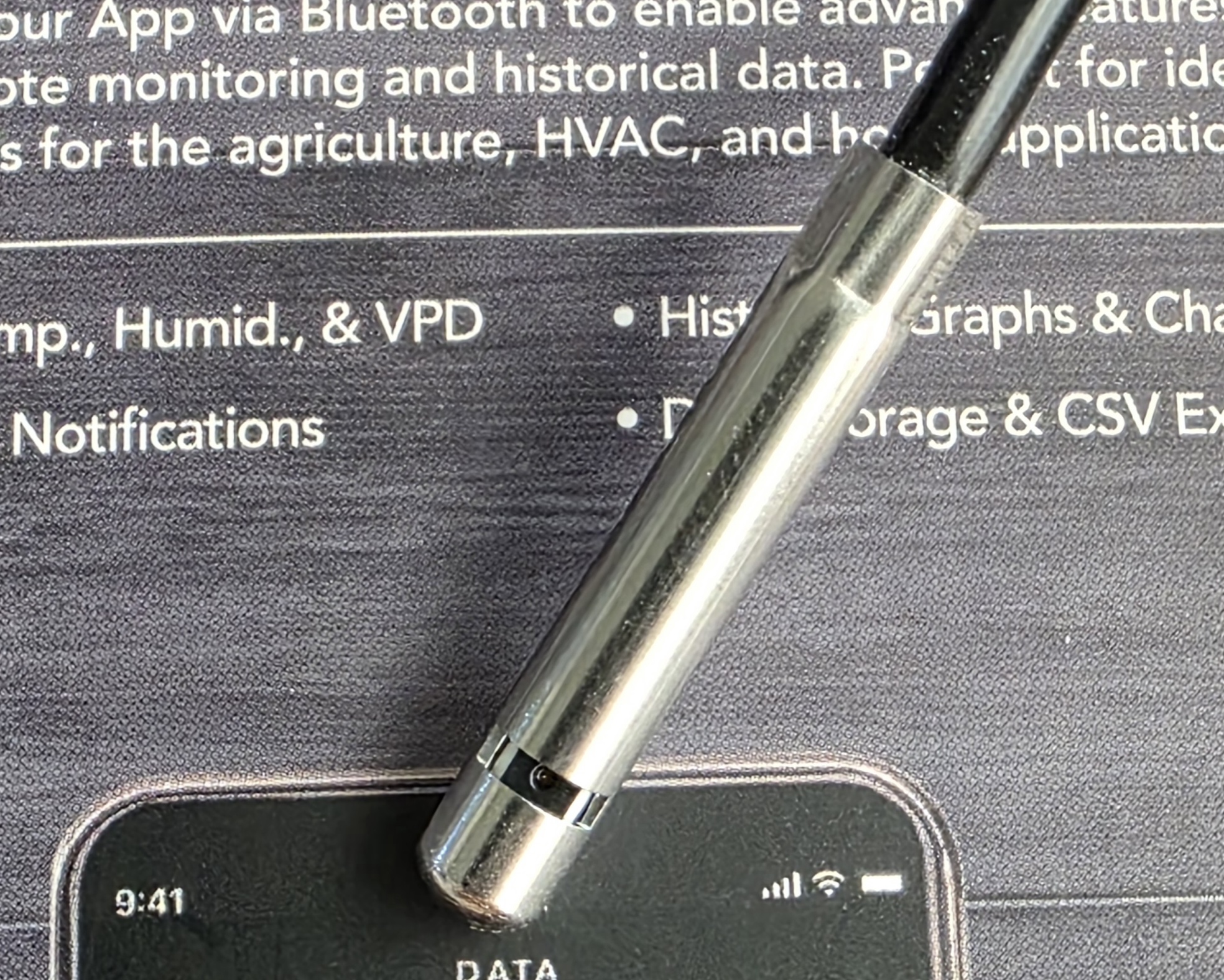
By the way, I just today received this TH sensor that includes the humidity sensor in the probe tip. It can withstand up to 90C.
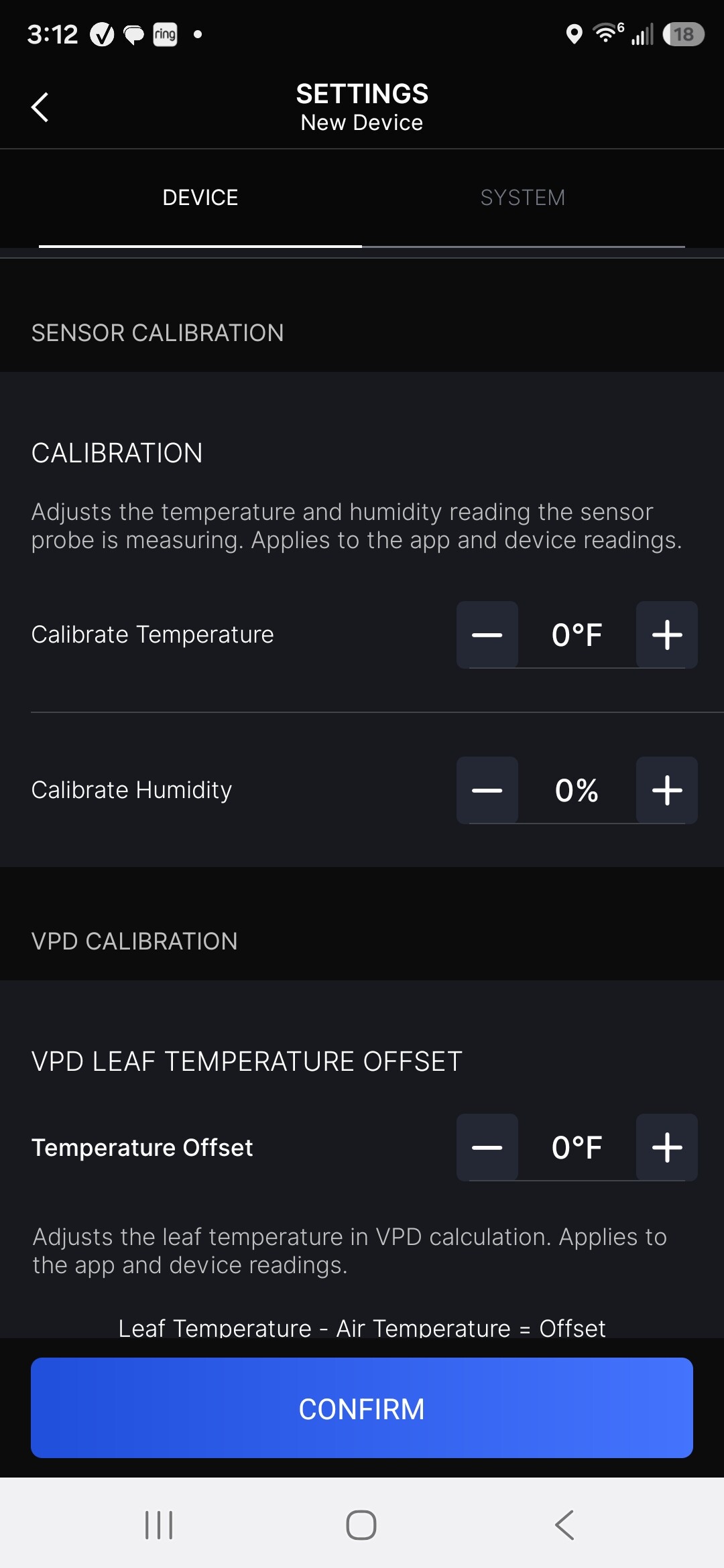
The app is nice because it allows for humidity calibration, should it be needed.
Nah, in the past I used organza sachets that I filled with silica gel or later molecular sieve and fitted them between the feeder motors, not those strange things that came with the AMS.
But you both convinced me that one can achieve really low levels with silica as well. Thank you for that 
Technically the sieves will hit lower humidities all by themselves in a container, but once you add a spool of filament and water starts moving, it doesn’t make much difference.
Where sieves shine is in maintaining especially dry environments, where certain chemical inertness is required, in high temperature environments, or when wanting to remove water specifically in mixtures with other chemicals.
In an AMS, none of those really apply. No reason you can’t use sieves though.
EDITED with an update of my initial experience
Initial impressions on the Wander Ridge bags are very good … okay.
Plus sides:
I’ve only put three into use but all worked fine, which is already better than the blue ring bags. two out of the three had lost their seal by the next morning.
I already had one of those rechargeable electric vacuum pumps, so I didn’t order the bundle which included one. It worked fine. But note: make sure there isn’t dirt and dust on the pump’s silicone seal or it will leak and not pull air from the bag.
I sealed a few rolls with those little $2 hygrometers in each. We’ll see if they leak or increase in humidity any faster than the blue ring bags. They leak. I’m going to test a few more but so far they are showing similar reliability to the blue ring bags.
Another related question:
If humidity is really bad for filament, is humidity equally bad for printed products? Does something about the melting/extruding/cooling process change the plastic (in which case recycling wouldn’t work?) or does it not matter? I’m in a very humid environment, and I’m concerned that my prints might age poorly…
I don’t know if there is a good answer yet or I may have just missed it.
A lot of the water / bad print effects happen because the water gets liberated and converted to steam in the extruder. But once printed, none of that matters.
I think in general the worst you’ll see would be prints getting brittle over time. There is a thread here where someone put a spool of PETG (IIRC) in water and it started just breaking apart after a few days.
On the other hand, I printed a nozzle in PLA for an outdoor fountain maybe 5-6 years ago and it’s still going strong. Hasn’t broken up or cracked and it gets exposed to sun and water a lot. Dawn to dusk.
At least in my experience PLA is holding up nicely with near constant water exposure. I’ve got PETG HF stuff outdoors too that doesn’t see as much water (but still some) and it’s just faded a little on the sunny sides. Haven’t strength tested either though but they are holding up fine in their intended uses.
Actually I don’t care very much if the bags loose their vacuum. I’m much more interested, if they have thicker plastic to slow down permeation. A vapor resistant barrier would be even more interesting.