Back in August, I uploaded my first model here: a rack that holds five lap whiteboards upright, with a caddy for markers and erasers. Made it for an elementary school classroom. Free, no license, nothing clever.
Within hours, a user commented that they were the original creator, that this was my cease-and-desist, and that they were filling out the DMCA right now. No link to their version. No publication date. No similar model anywhere on their profile. Just vibes.
The model was down the same day.
The paperwork speedrun
Here’s the fun part. Filing that complaint took about two seconds and required zero evidence. Getting the model back required, from me:
- A formal counter-notification under 17 U.S.C. § 512(g)(3), sworn under penalty of perjury
- My legal name, home address, and phone number, forwarded directly to the person accusing me
- Consent to federal court jurisdiction, because that’s a normal thing to do about a marker holder…
- Filesystem metadata and SHA-256 checksums for every file in the project
- Diffs between all five saved revisions of the source
- Renders of each revision, generated from its own unmodified file
- Proof that the published mesh regenerates from my OpenSCAD source exactly - same 5,520 triangles, same geometry hash
- A 19-page technical appendix
- And then, after all that, a video
Four weeks, start to finish. For two dollars of filament.
About that video…
After reviewing the technical package, I was asked for a time-lapse showing my entire creative process from start to finish.
I don’t have one. I designed this on a Sunday afternoon without recording my screen, because I am a person who was making a whiteboard rack, not a person anticipating litigation. I’d wager that covers roughly everyone reading this.
Which is the problem. That requirement can only be met by people who decided in advance that they’d need to defend themselves.
It also grades the wrong homework. A convincing video of someone modeling an object is genuinely easy to fake once you have the object. Parametric source code that regenerates a published mesh triangle-for-triangle is not, because deriving that source from a mesh isn’t a thing you can do. They treated the unfakeable evidence as insufficient. The fakeable evidence was mandatory.
The actual point
Most of what gets posted here is free. Someone designs a bracket, a bin, a holder, and puts it up because somebody else might want one. That only works if posting is low-friction. If an unverified accusation can pull your model the same day, and clearing it costs a month of evenings plus your home address handed to your accuser, the sane move for a casual designer is to stop posting.
Three things that would help, none of which require changing safe harbor law:
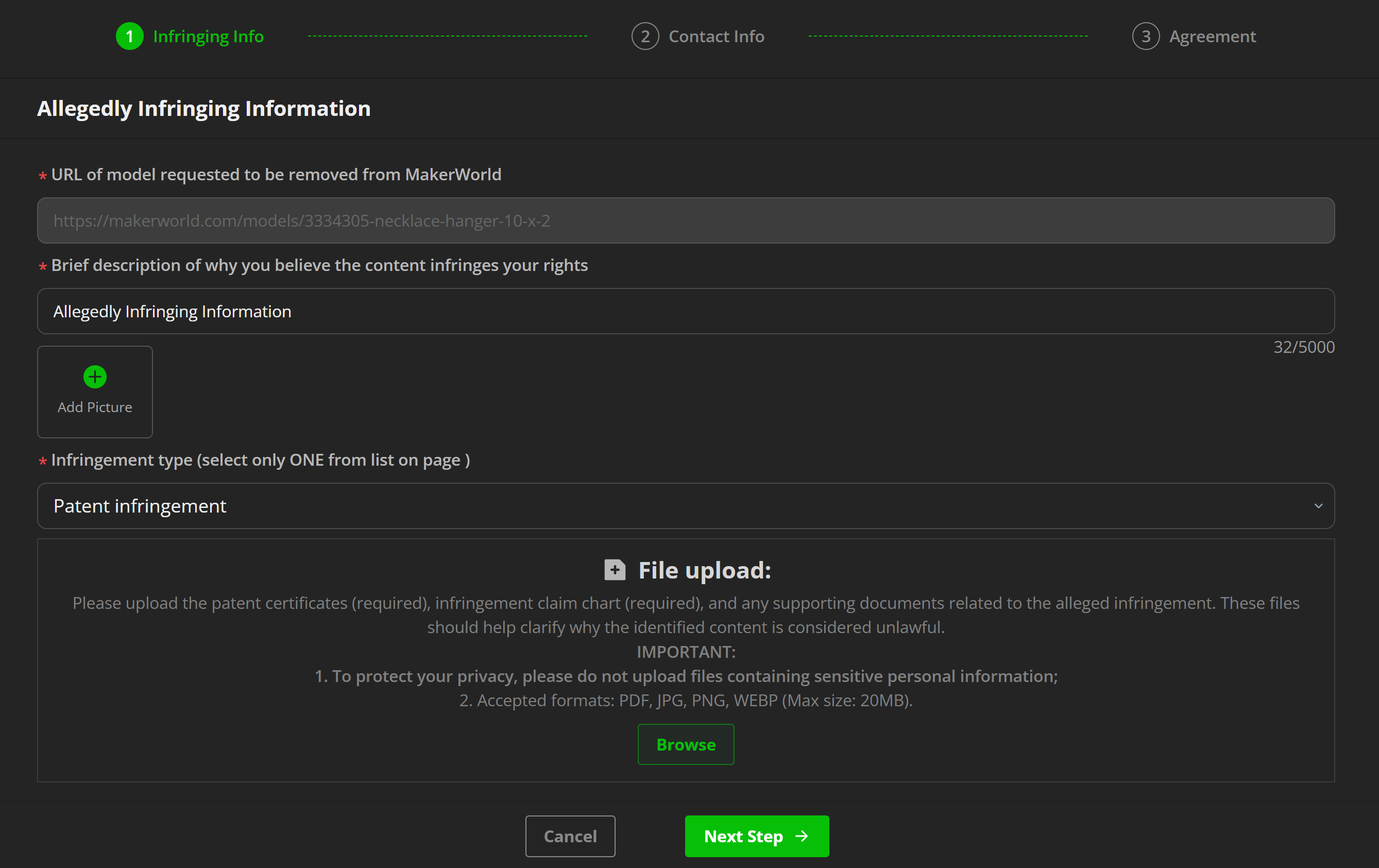
- Make complainants name the work. A URL. A date. Something. I went three rounds and was never told what I supposedly copied.
- Scale the burden to the stakes. A free, unlicensed STL shouldn’t face the same documentary standard as a paid design.
- Let technical provenance close the case. Source that regenerates the mesh exactly should be enough. It’s better evidence than video, and a copier can’t produce it.
Model’s back up, still free. I do like it here - the swap to Bambu was a good one. It just leaves a bad taste in my mouth. I guess that’s why I’m posting this instead of leaving.