Ask them to prepay your flight to Nigeria and back, a hotel room for 2 nights, and the full price, and you can bring them the printer in person 

I live 30 minutes(at 60mph) outside a large city. But I feel your pain. I cant remember what I paid with tariffs, but Maybe someone else knows what they were at release.
I had an x1c with 13 plates on there for $700. Highest offer I got was $400 so I took the ad down after a month and a half
actually, at only 15 minutes (at 120mph)… pretty darn close to that large city, but despite being that close, still no one wants to pay for the fuel to get that printer…
No way, this orange dude I saw on TV said its $1.99 per gallon lol
There are two sides of this story: the lukewarm scifi feeling you get in front of the tv (listening to that dude ), and the freezing cold feeling you get in front of the gas pump (looking in your wallet).
Before the firmware becomes open source, all Bambu printers urgently need a decent API so that software and hardware developers can reliably develop for them. That would be the step before open source.
No idea whether I should briefly explain API? Those who already know can skip this part: “An application programming interface (API) is a connection between hardware or between hardware programs. It is a type of software interface, offering a service to other pieces of software”
- You want to start printing from a third-party program? API
- Benefits of using third-party hardware such as displays? API
- Tell all printers in your print frame that they should print the same thing? API
- Whether it’s an app, website, Linux, Windows, or whatever else, what kind of access do I need? API
Full access to the firmware is not actually necessary if the API is programmed properly. It would be desirable, but not necessary. If the API weren’t so neglected, I would have programmed for it long ago, for example - this is my personal opinion, of course.
API is such a powerful tool, yet it keeps getting overlooked, unfortunately both by Bambu and by the community, which doesn’t demand it strongly enough. Because that would be an argument for print farms and a selling point.
Yes, there is an outdated API, but all you can find about it is this…
https://wiki.bambulab.com/en/software/third-party-integration
In short, I’ll save you the trouble: nothing except the overall concept. For the SDK (i.e., development tool), you have to register separately and provide proof of a company, which excludes pretty much 90% of the community. Only on some GitHub pages can you find unofficial documentation on this, which unfortunately is not up to date.
Why would you want to do that, for example? Here are some more examples:
- Use your own RFID for the spools or projects. You still need the Bambu token, so copy protection is still in place.
- Your own QR codes (e.g., on print plates) for printers that recognize them.
These are all areas of the API that need attention first, as it is hardware-related and would actually be the more urgent issue. Of course, everyone is entitled to their own opinion, and I am a firm believer in open source! However, a more realistic approach would be for the community to demand an API that is more open, or at least a decent one. This would cover 90% of tinkering without circumventing Bambu’s protection (token).
And for context: The requirements for accessing the API were continually increased by Bambu, even for companies.
Many people mis understand why opensource licenses started its all about someone not being able to take your work and close it up again. Many people (who mostly don’t make any code or designs themselves) take it to a level of worldview on how others should live or work. Been doing opensource work for decades and it’s the number 1 thing i hate about the community and its mostly onlookers who complain to begin with. Both models work fine and they only have to follow the contract that is the license nothing more and nothing less. You are not forced to believe in a world of free love and sex while doing drugs if you don’t want it. Anyone who thinks Bambu (or apple for that matter since thats always the fallback bad guy in this) doesn’t help in the progress of the areas they operate in is just well … something with pink glasses or even blackout glasses come to mind.
The fight for open API’s or cross brand support for API’s is missed most of the time in these discussions and a much more interesting question since it allows internal changes while supporting other companies and even opensource products to interact within your eco-system. Its a much more clean fight to have and much easier to explain the need and commercial value.
I think you misunderstood my question. From those around me that do 3D printing, they are like Apple customers, they just want to use the product as advertised. So they only bought the printer because it was going to give them prints which they download. If it stops working they ask someone else for help. These don’t care about tinkering as they are interested in the product as advertised. Most of these folks don’t even know what open sourced means, lol. I think Bambu opened up a customer base that wasn’t tapped before, and that customer base doesn’t care about or understand what “open sourced” is. I only got into it because the X1C looked cool and did something I never thought could be done at home. I do tinker as I have always built my PCs and make little electronics, restore old stereos, etc. I couldn’t care less about open source, which is why I have Apple products. I’m not saying it isn’t an issue, I’m saying most Bambu customers probably don’t care about this. The fact that A1 minis even sell should tell you about their customer base.
This is one group… the people who posted this thread are another group. It’s a big world with a lot of groups. The whole point of my post was everyone is different and want different things.
You don’t think anyone would need a small format printer? The Voron Zero and Prusa Mini are also popular.
I think many of us do know what opensource means and have been doing it for decades and are getting upset at times if we see extremes on both sides and push back. I am kind of shocked how extreme part of the 3d printing community is on this topic indeed probably coming from the new group of people who are not interested in the printers itself (lets call them the reprap line) but are at times on the same engineering level but just see it as a tool to make stuff. The world is grey at best and progress comes in many ways and taking a opensource as a license and turning it to a lifestyle is fine but that is not what opensource is about and never was. Putting companies or people in one of two camps mostly doesn’t reflect the full story. For example as far as i can tell the posterchild of opensource slicing at the moment (orca) has more bambu code inside and even new commits than from creality (please correct me if i am wrong). Even if i look at the commits sources from 2025.
Yes, you are.
Bambu slicer has its origin in Prusa slicer, and the latter has its origin in Slic3r, so actually, OrcaSlicer has its roots in Prusa and further down, in Slic3r. All of these are open source and have been developed by the community (of which a very large part is formed by those tinkerers you seem to regard so poorly).
Just a note: I’m not referring to any specific comment. Some parts of Bambu Studio are open source. Specifically, the parts that were used from other open-source developments and which must therefore remain open source. This doesn’t really apply to the firmware, though. However, I suspect that some people weren’t even aware of Bambu’s GitHub repository when I read some of the comments.
There are also references to where the code came from:
So, if anyone wants to delve deeper into the topic, they can take a look at it. A lot of the code is still open source. Just not the Bambu special features (whatever those are, but that’s another topic).
In addition, there is the Bambu Research Group, which deals with RFID and BUS.
No i am not i checked the history and how it’s been forked over time and if you check the code flowing into orca at the moment you will see that bambu is just following the license and giving things back in the areas the license demand. Here is are the biggest commitors over 2025 from the orca github. Notice the names of some of the things flowing in 8 of the top 20 seem to be related to bambu. Also i give respect to people not sides many things have been done on both sides of the fence and i have been doing (paid) work on both sides of that fence since the 1980’s
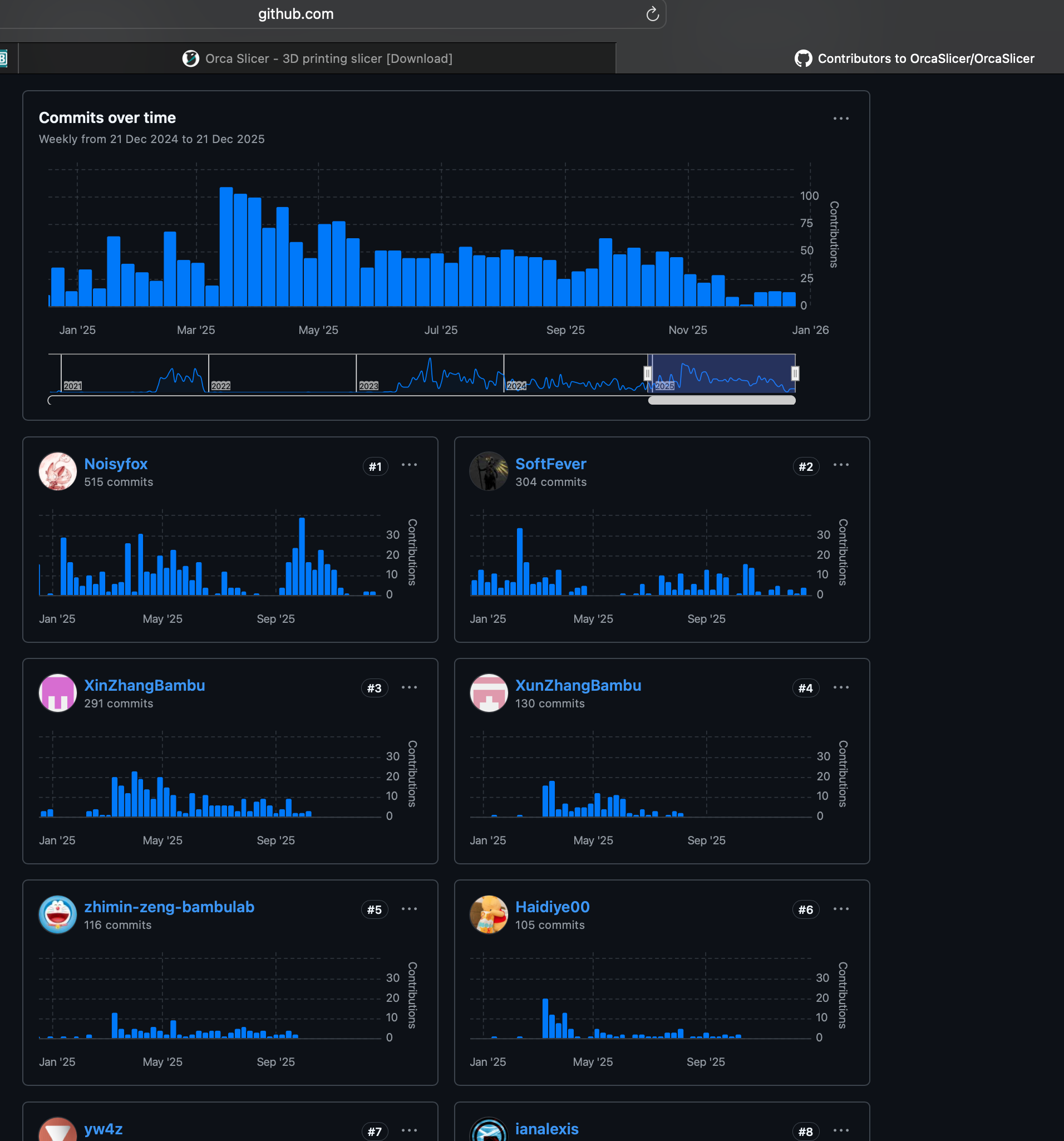
Sorry our posts overlap but indeed you are showing that things are not black/white they never are in this area bambu or any other company only have to follow the license if they use code they don’t have to live the lifestyle. Saying most of the 3d printer space was made by thinkers is also well a little simple to say the least again its a grey area with companies, patents, r&d, researchers a mix of things how it evolved. My guess (and its a guess) bambu is not the enemy but there are several other companies making opensource claims but in reality dragging their feet with tricks like only releasing very late and/or only for old models etc etc…
I want to revisit the idea that Bambu is “just acting like a business” and that its behavior should therefore be viewed as expected or harmless. That framing sidesteps the real issue, which is how Bambu is leveraging open source and where it has inserted control.
Open source did not originate as a monetization strategy. It came out of academic environments with a simple premise: shared infrastructure, shared improvement, shared benefit. That model only works if access remains meaningfully open, not merely visible in source code.
An analogy I used to explain the concern.
Imagine a public beach funded by taxpayers. For decades, people reach it by crossing a narrow strip of privately owned land. The owner allows this, so in practice the beach is public and usable. Then the land changes hands. The new owner installs a gate. The beach is still public on paper, and no one is explicitly banned from using it. But unless you arrive by boat, you can no longer reach it. The resource did not change. The access path did. Functionally, the beach has been privatized.
In my view, that is the role Bambu Connect plays.
Historically, open slicers could communicate directly with printers. That direct path is what enabled third-party slicers, tools, and experimentation without a gatekeeper. Bambu did not close the slicer and did not cripple the hardware. Instead, it inserted a mandatory authorization and licensing layer for sanctioned access between them.
The slicer remains open.
The hardware remains capable.
The access path is now gated and subject to Bambu’s approval and rules.
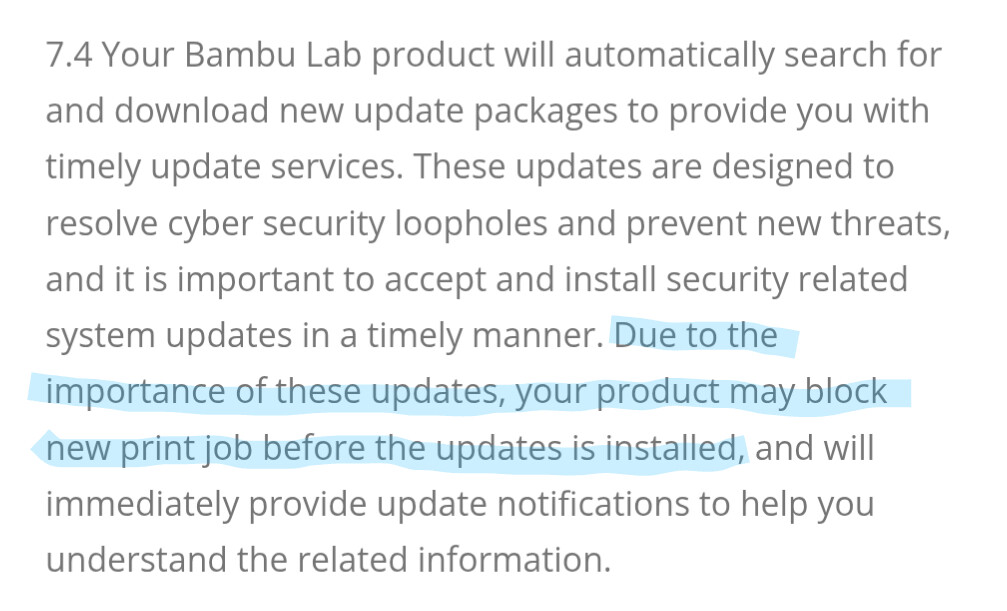
Whether this is legally permitted under open-source licenses is beside the point. The effect is that a previously open route - for which many of us based our original purchase - is now controlled by a single party. That is not open collaboration.
Doesn’t turning on LAN and dev mode enable the slicer to talk directly to the printer like it used to?
I thought the Bambu connect thing was only an issue if you want to use their cloud service.
Yes and no. You have to tell the whole truth because things are not as simple as they seem. Why was the Connect app introduced? Because there was no token system before - or rather, it was inadequate. Anyone with even basic knowledge of how to access GitHub could gain unauthorised access to 3D printers. This problem wasn’t limited to Bambu; it affected all manufacturers. Security against hackers, even inexperienced ones, was completely lacking. Bambu was one of the first manufacturers to respond, and rightly so. It was desperately needed.
For third parties, there is the API, but I have already discussed this in detail and it is a different topic.
Some people here probably don’t understand this, but there was a desperate need for a Connect app to control access and encrypt data. Before that, anyone could access the 3D printer. Whether this was the right solution is debatable, but it was a solution nonetheless. Unfortunately, other manufacturers still don’t implement such measures, meaning strangers can access the 3D printer at any time with a simple token.
Even today, some manufacturers’ products remain vulnerable to remote camera access or the execution of malicious G-code. Even worse, they are vulnerable to WiFi infection. The Bambu printer was previously a ticking time bomb for unauthorized access to the Wi-Fi and WiFi infection.
As I said, I’m not saying you’re wrong, but tell the whole story.
Yes, that used to be true - and that’s a fair question.
The issue is that on current firmware, enabling LAN and dev mode is no longer sufficient for full, sanctioned access. Once you move past the early firmware generations, Bambu Connect becomes a requirement for supported slicer-to-printer communication. Since SoftFever chose not to participate in Bambu’s licensing and authorization framework, Orca is effectively shut out of that sanctioned path on current firmware.
It’s also worth noting that LAN/dev mode was expanded only after significant user backlash, and Bambu Connect is now the default model for new devices. That’s their prerogative, but it materially changed the terms of ownership compared to the early days.
One of the big draws of the original P1P for many of us was how open it felt in practice - custom enclosures, Biqu panels, MQTT-based enhancements, and general freedom to mod and integrate without asking permission. Had it been clear up front that this level of openness would be rolled back over time, I personally would have made a different decision about entering the Bambu ecosystem.
I’m not at all saying you are wrong, but are you really, really sure this is the case? I don’t routinely use Orcaslicer this way but as far as I remember it simply worked, no bambu connect necessary, just put it it lan & developer mode and it works exactly like before.